A New Roosevelt Institute Report Confronts the Roots of Our Media Crisis—and Calls for Breaking Up Corporate Media
Today’s journalism crisis wasn’t inevitable, but it’s time to free journalism from the straitjacket of turning a democratic obligation into a profit-maximizing business model.
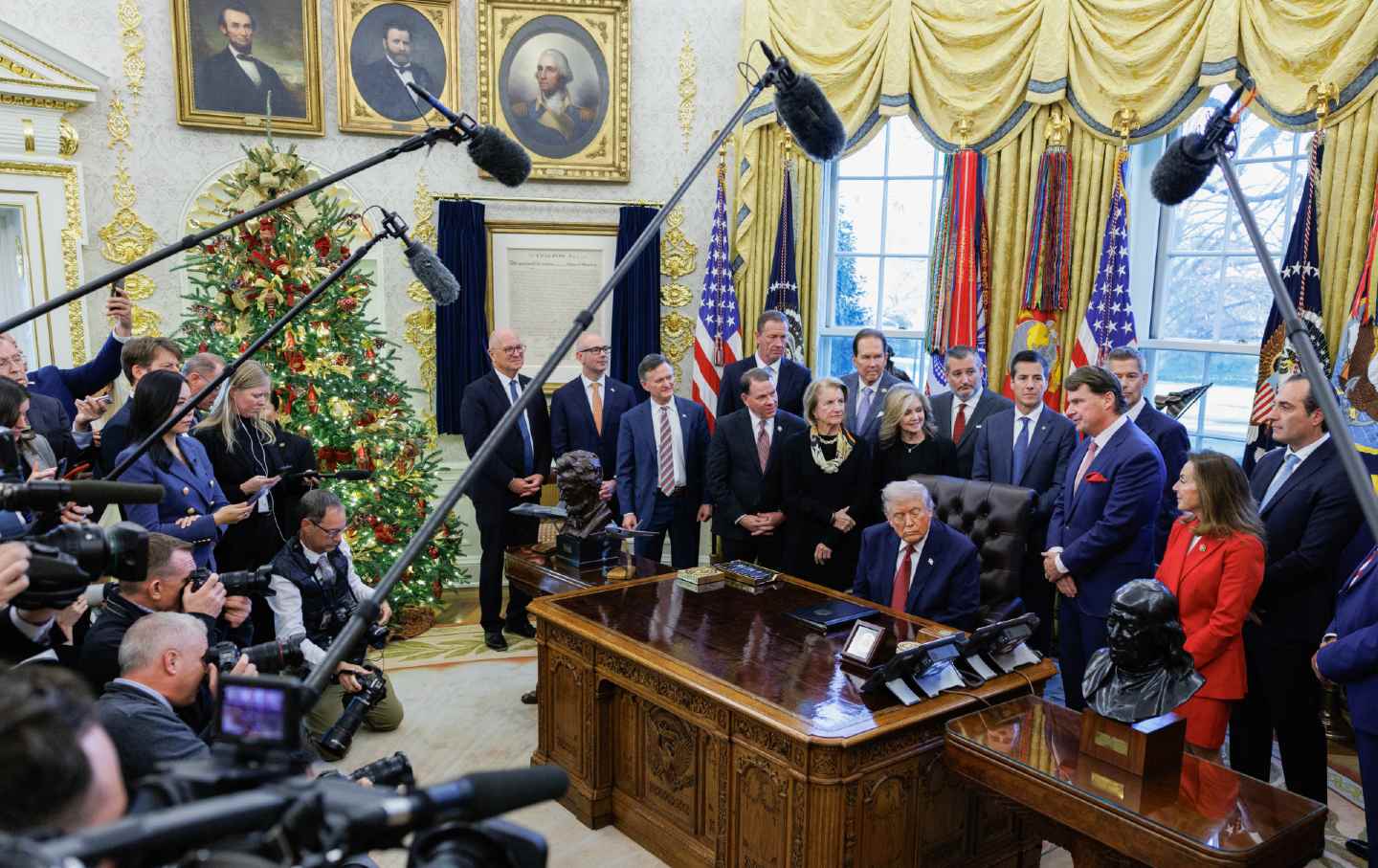
The desire to attack and ultimately control the media is a through line of modern authoritarian governance across the globe. President Donald Trump’s reign as the defining political figure of the last decade has demonstrated how quickly that tactic can take hold here. In courtrooms, agencies, and White House briefings, Trump and his allies have sought to punish and delegitimize journalists. In the second Trump term, the bully pulpit has been turned into a battering ram, with open or implied threats to withhold the broadcast licenses or block the media mergers of insufficiently loyal companies. But a singular focus on state meddling has, ironically, obfuscated how authoritarians come to wield such great power over the media system in the first place, and why a free press must be protected from both state and commercial coercion.
What we’re experiencing now is a dangerous convergence of the two.
The truth is that the administration’s threats have rippled across a media ecosystem buckling under the weight of commercial pressures—pressures that existed long before that fateful golden escalator ride more than a decade ago. It’s these long-standing commercial imperatives that Trump knows how to weaponize to manipulate media institutions. He understands that newsrooms accountable first and foremost to investors will sell out their accountability function to survive. Likewise, media conglomerates pursuing mergers cannot afford to anger the administration holding the regulatory pen. When journalism is trapped inside a commercial straitjacket, it can’t fight back.
In our oligarchic age, where billionaires can decide which fledgling outlets live or die for pennies on the dollar and even themselves command powerful roles in government, the line between state-run media and state-aligned media through private means becomes vanishingly thin. A press dependent on the whims of the ultra-wealthy cannot claim meaningful independence from the political forces its owners serve. And even though our Constitution protects the press for democratic reasons, our policy regime assumes that news organizations should behave like profit-maximizing firms.
How did we get here? As we show in our new Roosevelt Institute report, today’s media crisis wasn’t inevitable but the consequence of policymakers’ embracing a corporate libertarian approach to media policy. This framework treats our information ecosystem as an ordinary market, rather than vital democratic infrastructure, resulting in a media system riddled with structural deficits. Such a media environment is vulnerable to pressure from every direction, from the White House to the C-Suite.
The consequences of this policy failure have been catastrophic. Newsrooms have been gutted as advertising revenue collapsed. Local papers have closed or been absorbed by vulture capitalists whose short-term incentives are fundamentally at odds with journalism’s public mission. More than 1,000 counties now lack the equivalent of a single full-time journalist; the number of journalists per 100,000 residents has fallen 75 percent since the early 2000s. Platforms dominate news distribution, leaving publishers dependent on algorithmic systems designed to maximize engagement rather than inform the public. A handful of billionaires can bend the flow of information with the proverbial push of a button, and conglomerates continue conglomerating: Just earlier today, after a major bidding war, Netflix beat out Paramount Skydance and Comcast in a deal to acquire Warner Bros. Discovery, resulting in a merger that will further concentrate cultural and informational power in fewer hands.
Today most Americans, and even many policymakers, take these developments and the system that led to them for granted. As the late media scholar Robert McChesney argued, media policy has been rendered invisible, designed behind closed doors in the public’s name, but without the public’s consent—placing core questions related to our information ecosystem outside the purview of democratic contestation. This invisibility has given cover to a set of neoliberal assumptions that define the boundaries of what’s possible, empowering a small set of wealthy private actors to decide, for the rest of us, what our media system looks like, and whose interests it serves.
Such invisibility obscures how our media system’s design—and the many problems ailing it—is the result of policy decisions. Over the course of decades, policymakers diluted the meaning of the media’s public interest responsibilities, refashioning them into something more akin to consumer preferences. At the same time, the media market faced a series of re-regulatory structural moves that shifted power away from the public and into the hands of corporate actors. And well before Trump dismantled the Corporation for Public Broadcasting, Congress resisted meaningful public media investment. All these developments were in turn legitimized by a First Amendment media jurisprudence that prioritizes unbridled commercial speech over the public’s “right to know.” Combined, these constraints created a media system that treats commercial imperatives as natural law, and democratic obligations as optional.
Before we can build solutions, a basic question must be settled: Should our media system primarily serve democracy, or profit?
To us, the answer must be the former. News and journalism should be treated as core infrastructures of democracy—infrastructures that must be restored by rebuilding our impoverished public media system, treating platforms as the critical utilities that they are, and developing a meaningful notion of the public interest to media governance. In addition to breaking up corporate media conglomerates, we must free journalism from the impossible mandate to turn a democratic obligation into a profitable business model. Only then can our news media serve as a true democratic counterweight to authoritarianism. Almost every other advanced democracy invests far more in public media and treats information as a civic good rather than a commercial product. The United States can—and must—do the same.
The stakes extend beyond the newsroom. A democracy cannot function when citizens lack access to reliable information or when the nation’s most powerful media institutions operate at the mercy of wealthy patrons and political strongmen. Our media system ought to reflect that truth. The first step is to recognize that its failures were engineered—and can be reengineered to serve the public good.