A Brief History of Right-Wing Attacks on Food Stamps
A trip through The Nation’s archives offers essential insights into why Republicans have long tried to weaken SNAP—and why they’re trying to kill it now.
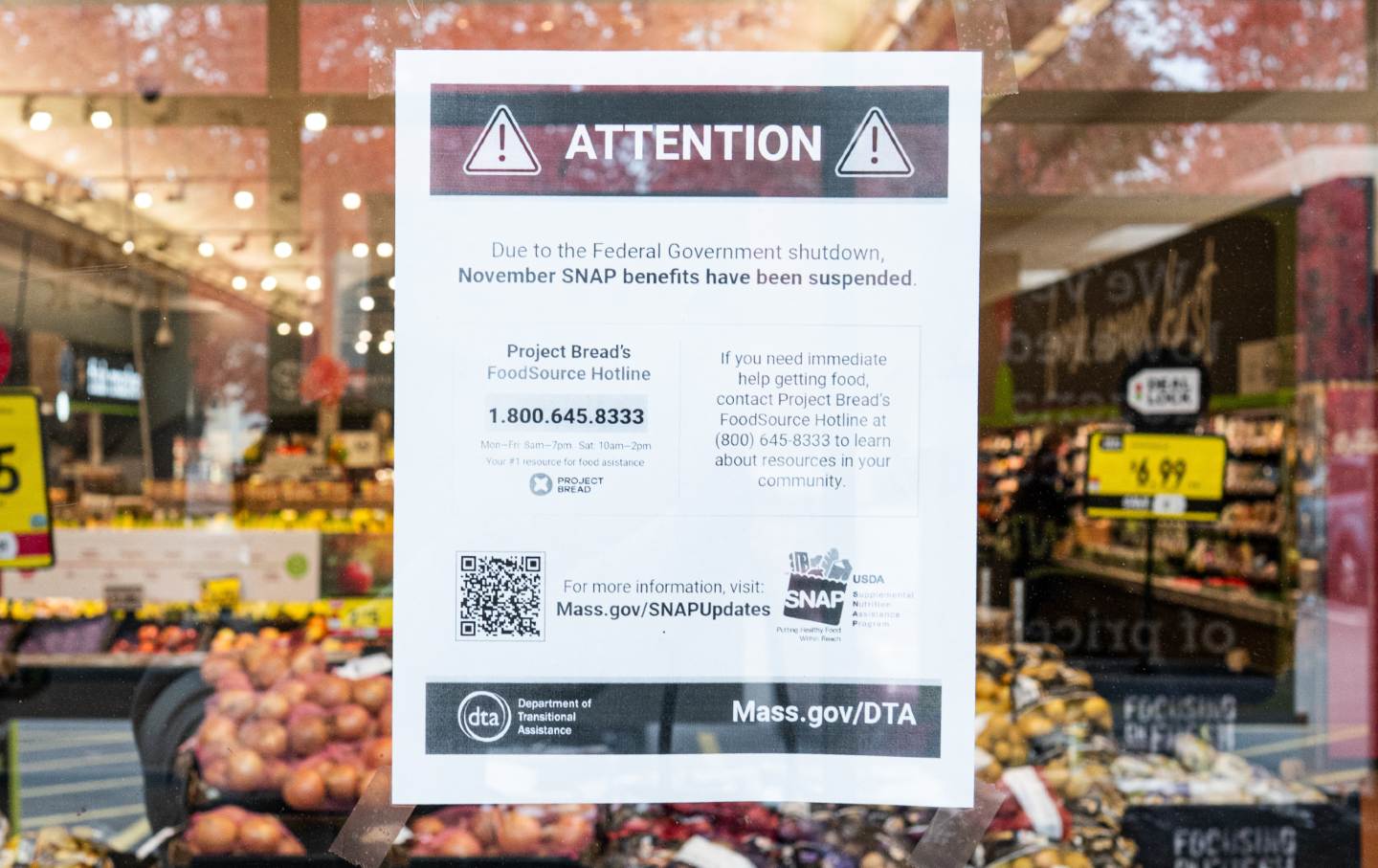
A grocery store in Dorchester, Massachusetts, warns customers that SNAP benefits have been suspended.
(Mel Musto / Bloomberg via Getty Images)
It should not have been surprising that the Trump administration would use the cover of a government shutdown to withhold food-assistance benefits from the 42 million Americans who rely on the Supplemental Nutritional Assistance Program (SNAP). After all, Republicans have had it in for food stamps for nearly as long as the federal government has tried to address hunger.
Federally funded food assistance was first introduced in the United States in 1939, with the twofold goal of helping farmers offload surplus crops that were depressing prices and helping Depression-era unemployed people get food. A classic New Deal initiative—partly the brainchild of Henry Wallace, Franklin D. Roosevelt’s Iowa-born secretary of agriculture and later vice president who ran for president in 1948 on the Progressive Party ticket—the food-stamp program began as a way to connect people who needed food but couldn’t buy it with people who had far too much food but could not sell it. It allowed low-income Americans to buy orange stamps equal to their normal food budget and receive additional blue stamps for free, which could be used to purchase surplus farm goods.
Writing in The Nation in 1940, the journalist Jane Whitbread celebrated this early version of food stamps as “a triumph of simplicity,” an elegantly designed program that had managed to win “wholesale acclaim.” She wrote: “With remarkable deftness the stamp plan smooths hurt feelings by helping the farmer, feeding the needy, and paying the grocer, too.”
The program was wound down by 1943, after American entry into World War II had stabilized the agricultural market and solved unemployment. But the concept of food stamps returned, in slightly different form, as part of President Lyndon Johnson’s War on Poverty in the mid-1960s. Unlike the New Deal version, which was primarily a farm-relief measure with hunger alleviation as a welcome byproduct, Johnson’s revived Food Stamp Program was explicitly anti-poverty policy—aimed not at stabilizing crop prices but at ensuring that no American in the richest nation on earth would go hungry.
By the 1970s, the revamped food-stamp program had become a target for conservative, self-styled reformers who argued that federal food assistance was a locus of waste, fraud, and abuse—“a haven for welfare chiselers,” as David Tabacoff summed up the accusations in a 1976 Nation article:
The food stamp program has been under attack from the Right since its inception fifteen years ago, but only in the last two has it become the target of such slanders as these. President Ford in his State of the Union message described the program as “scandal-riddled,” and he, along with other politicians who share his conservative views, are now proposing legislation that could cut food stamp aid in half.
Tabacoff would later serve as Bill O’Reilly’s executive producer at Fox News for more than 15 years, helping to mainstream those draconian conservative views. But back in the 1970s, he wrote in this magazine that the attempt to restrict the reach of the food stamp program was simply part of “a continuing campaign to turn the federal government away from the needs of the poor and disadvantaged.” Today, thanks in large part to O’Reilly and his acolytes and imitators, that campaign stands on the brink of heartless success.
Over the following decades, as the political winds shifted, the food-stamp program was repeatedly restructured and expanded. In 1977, Congress made the program more accessible to the poorest Americans. The arrival of Ronald Reagan in the 1980s brought a wave of cutbacks, tightening eligibility and reducing benefits, while the 1996 welfare reform law—signed into law by Bill Clinton—imposed some of the harshest restrictions yet, excluding many recent immigrants, instituting some work requirements, and limiting aid for others. By the early 2000s, the familiar paper coupons had disappeared, replaced by electronic benefit transfer (EBT) cards. And in 2008, in a bid to shed the stigma associated with the phrase “food stamps,” the program was officially renamed the Supplemental Nutrition Assistance Program, or SNAP.
The program was wildly insufficient, failing to reach nearly one-third of those who qualified for its benefits, and forcing poor Americans to survive on precious little sustenance. Even so, it endured as a rare instrument of public policy that continued to offer a vital measure of security to those living closest to the edge.
In 2011, The Nation’s Lizzy Ratner took a look at how surprisingly effective SNAP was in feeding the hungry and alleviating poverty—even at helping those let down by other social programs that should have served them. Food stamps, Ratner wrote, had become “the safety net’s safety net.” Reporting from a somewhat chaotic food stamp center in downtown Manhattan, she continued:
Welcome to the food stamp system: decaying, inundated and one of the most unexpectedly effective safety net programs still standing…. It may not look pretty, but while other social safety net programs, like public assistance (more commonly called welfare), public housing, Section 8 and even unemployment insurance, have been so thoroughly hobbled that they can no longer respond to the struggles of millions of Americans, the food stamp program has remained surprisingly sensitive to people’s needs. It is one of the defining reasons more Americans were not as immiserated by this recession as they were in eras past.
Thanks in part to an infusion of funds through President Obama’s stimulus package, SNAP had proven effective in helping the poorest Americans buy basic necessities during the darkest days of the financial crisis. “And it did this, continues to do it,” Ratner wrote, “despite decades of on-again, off-again neglect, budget cuts and Republican attacks….
The fact that the program remains as successful as it does is remarkable given the beatings it has taken since Ronald Reagan began sweeping away the buttresses of the welfare state. Since the Reagan revolution, funding has regularly been slashed, eligibility tightened and, during the Gingrich years, most immigrants banned from the program. And yet, even amid these attacks, food stamps have enjoyed enough bipartisan support to avoid the radical disemboweling experienced by, say, the welfare system. The reason, at least in part, is the way the program has historically been framed: as a voucher (always Republican-friendly) supporting the working (and hence “deserving”) poor. As a result, funding has often been restored, some categories of documented immigrants have been readmitted to the rolls, and the program has retained sufficient flexibility to respond quickly when the need is greatest.
This quiet yet astonishing effectiveness, this “triumph of simplicity,” as Jane Whitbread wrote in The Nation more than 85 years ago, is precisely the reason Trump and his fellow Republicans are so eager to use the government shutdown to shut the SNAP program down—if only the courts will let them get away with it.
The history of food stamps tells an unequivocal story about the power of government to relieve suffering and improve lives—an inspiring example of a public program doing exactly what it was designed to do. And for that very reason, it has long been a target for those determined to prove that government programs cannot, should not, and must not be made to work. For those of us who continue to believe—as FDR and LBJ did—that no American should go hungry, the lesson is clear: We must fight to defend and expand SNAP, ensuring that this crucial program continues to protect the most vulnerable among us.