Who Did What?
Luca Guadagnino’s messy campus thriller.
The Messy Campus Thriller of “After the Hunt”
Luca Guadagnino’s films have always asked viewers to turn off their brains when it comes to love and sex. In his new film, he asks the opposite.
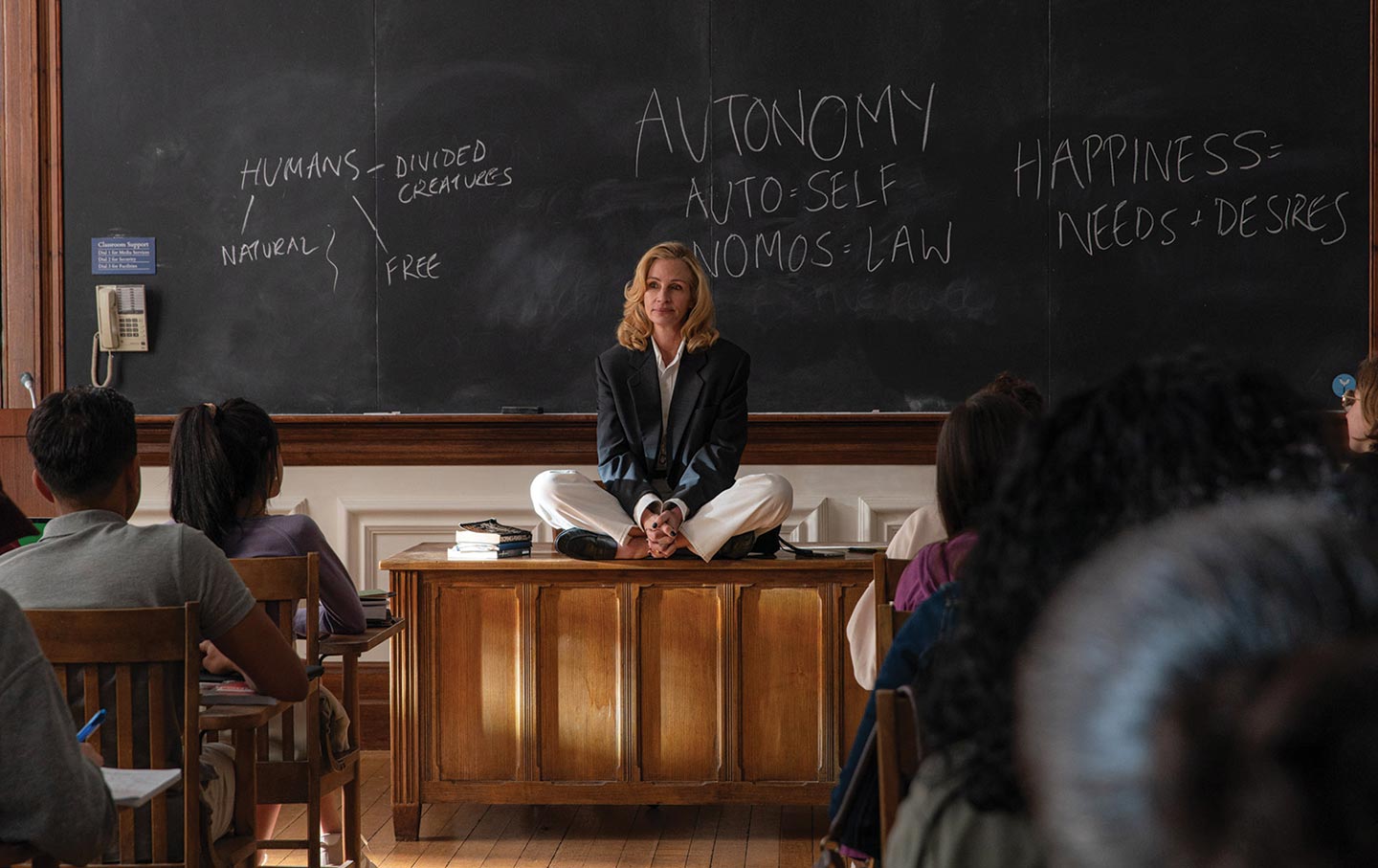
There’s a scene in Luca Guadagnino’s campus melodrama After the Hunt in which a student, in a bid to meaningfully connect with her steely professor, issues a desperate plea: “Can we just stop being smart for, like, one fucking second?”
The student is Maggie Resnick, played by the dependably charismatic Ayo Edebiri. She’s a struggling doctoral candidate in the philosophy department at Yale, and she puts her request to Alma Imhoff, brought to life by a striking Julia Roberts, over dinner. The pair are sitting in Alma’s elegant apartment, a tasteful space warmed by rich wood paneling, amber light sources, and distinctive sconces. The mood is tense, and that question—“Can we stop being smart for one second?”—hangs in the air.
There is some ambiguity about its meaning. Is Maggie asking Alma to descend from her perch on the mountain of hypotheticals? Does she want to dissolve the boundary between teacher and pupil? Or does she simply want to be seen as a person by a woman whom she’s desperate to be like? Whatever it suggests, the question touches a nerve and prompts the viewer to wonder whether it has always existed between the two. By the end of Guadagnino’s film, about how a sexual-assault allegation upends a campus, we come to realize: Well, yes, it has.
It’s in the room at the beginning of the film, when Alma, adorned in a crisp white boxy suit, hosts a lavish party with her husband, a steadfast psychoanalyst named Frederik (Michael Stuhlbarg). One can sense its presence when she swans into her seminar, commanding an obsequious group of students to reflect on Foucault’s panopticon. It’s also there as Maggie, the queer Black adopted child of generous donors to the university, navigates the aftermath of a traumatizing assault in an era in which public opinion is, in theory, on the side of survivors. And it haunts even the film’s most comic moments: As zingers and witty ripostes ping-pong between the characters, After the Hunt entreats its audience to stop trying to be so cerebral about a #MeToo story.
Guadagnino’s films have always petitioned viewers to turn off their brains when it comes to love and sex. The Italian director is attracted to the outcome of impulsive actions taken in the name of desire. Since Call Me By Your Name, which followed a 17-year-old boy’s torrid summer romance with a man nearly a decade his senior, Guadagnino has been cast as a patron saint of romantic and sexual exaltation. He revels in suggestive close-up shots—a sun-kissed arm emerging from a pool, fingers caressing a peach, a searching hand rubbing a lover’s chest—and lingers on the details of touch. His characters, from the hypercompetitive tennis champions in Challengers’ horny universe to the wistful lovers in Queer’s sweaty locales, are bedeviled by yearning and are often experiencing, in Guadagnino’s words, “unsynchronized love.” Human connections, he has long insisted, cannot be intellectualized. Yet despite circling this familiar theme, After the Hunt (with a screenplay by Nora Garrett) ends up moving in the opposite direction: It asks us to stop being so smart even as it continues trying to be.
Some of this seems inevitable, given the setting. Taking place on a university campus in 2019, the film begins in the heady atmosphere of Alma’s plushy fête. Her apartment is packed with peers and preferred students. The liquor flows, a tart appears, and the conversations dart between the banal and the exasperating. It’s a delightful scene because of Guadagnino’s confident compositions. Working with the cinematographer Malik Hassan Sayeed (Belly, Dreams Are Colder Than Death), the director stages and shoots bodies like pieces of a puzzle bursting with carnal undertones. In one of the earliest scenes, Alma is parked on the edge of a coffee table, hand draped across her lap, surveying the room as Frederik and her colleague Kim Sayers (an underused Chloë Sevigny) share a couch behind her. In the next scene, Alma lounges near Hank Gibson, a bullish philosophy professor played with familiar brawn by Andrew Garfield. Their legs touch ever so gently, gesturing to the casualness with which they treat the depth of their mutual affection. Frederik, played with appropriate panache by a wonderful Stuhlbarg, slyly observes the pair before flitting around and checking on guests. Maggie, dressed like she’s performing the idea of an adult, sits adjacent to Alma and Hank, wearing an inscrutable expression. As with everybody in Guadagnino’s cinematic worlds, you wonder if she is merely watching or secretly longing.
After a particularly heated debate about the sincerity of recent cultural correctives, Maggie retreats to the bathroom, where she finds a mysterious envelope hidden beneath Alma’s cabinet shelf. The discovery establishes a crucial secret that After the Hunt would have benefited from revealing a touch earlier. Uneasiness permeates the air as Guadagnino, with the help of Trent Reznor and Atticus Ross’s spiky score, establishes an atmosphere of suspicion. With a liberal use of whip pans and tight shots, the director recalibrates the film’s mood and teases elements that reveal its thrilling ambitions.
The next day, during a severe rainstorm, Maggie journeys across campus to Alma’s apartment. Soaked and sitting on the floor in a deserted hallway, Maggie confides to her mentor that on the previous night, Hank crossed a line. The details are left intentionally vague. Maggie, hugging her knees to her chest, just wants to know if she can trust Alma: Will the professor, whom she so deeply admires, have her back? The answer to the question is as haunting as the truth of what happened that night. Maggie and Alma already have an insecure dynamic, suggested by a woefully underdeveloped erotic thread, and what follows should further strain and blur their relationship. But the accusation, which thrusts the campus into a maelstrom, mostly becomes a source of frustrating confusion. The story rarely slows down enough to explore its established ambiguities or settle into the thorny discomforts it reaches for. Maggie’s allegations turn into a cipher, and as After the Hunt makes its way through the politics of consent culture, of restorative justice, of race, class, and gender, the film stumbles into clichéd terrain.
After the Hunt, which landed in theaters in October, exists in stark contrast to another recent feature that explores the aftermath of an on-campus sexual assault. Eva Victor’s accomplished debut, Sorry, Baby, tells the story of Agnes, a reserved former graduate student who is raped by her professor, in five parts that jump between past memories and present moments. The film, which premiered at Sundance and is now available to stream, approaches the trauma of this violation in an understated manner. Victor, who plays Agnes, stays curious as both actor and director about the arrhythmic grooves of healing and builds a narrative around Agnes’s relationships. The film basks in the details of conversations between Agnes and her best friend, Lydie, portrayed by the always compelling Naomi Ackie, and also dwells on the surprising rapport that Agnes develops with her neighbor Gavin, played by Lucas Hedges. Like Guadagnino, Victor cares about desire, but the emerging director also embraces how it can become warped and unrecognizable after an assault.
Like After the Hunt, Sorry, Baby withholds depictions of physical violence. Victor opts instead for a chilling quiet, staging a sequence in front of Agnes’s professor’s house in which a blunt cut demarcates time before and after the incident. This approach allows Victor to establish, in addition to the narrative itself, a visual vocabulary of care and dignity for her characters.
Although Guadagnino’s film is intended as a psychological thriller, rarely does it feel invested enough in its characters to really be one. This cadre of ivory-tower dwellers is an undeveloped bunch, which leaves a formidable cast of stars fending for themselves. Roberts proves to be an excellent anchor, and she manages to pull off a persuasive interior performance despite Alma’s on-the-page limitations. In a post-Tár universe, it’s hard not to compare her Yale professor to the bristling conductor at the center of Todd Field’s taut portrait of the classical-music world. Like Cate Blanchett’s Lydia, Alma is a furtive figure shrouded by her elegant wardrobe. As a woman in the university’s male-dominated philosophy department, she has intentionally constructed a life that distances biography from scholarship. But this unyielding posture, coupled with the weight of her secrets, prevents Alma from fully submitting to Maggie’s pleas, and Roberts’s disciplined portrayal lays bare the realities of this internal conflict.
The film’s other performances don’t fare as well. After the Hunt wants Hank to be a more complicated antagonist, one whose guilt or innocence can’t be so easily determined, but Garfield is working in the melodramatic shadow of his turn as Eduardo Saverin in The Social Network, which doesn’t leave much room for inscrutability. But perhaps most shortchanged is Edebiri, who is saddled with a character written to exist primarily as a foil. The actress possesses the talent to do far more, as exhibited by her role in FX’s hit culinary drama The Bear, but she’s operating under duress here. Her character, as written, is an amalgamation of archetypes: a survivor, a representative of Gen Z, an avatar for extreme wealth, and, of course, a Black woman confronting the racist prejudices baked into an American institution.
There’s a moment, during a heated confrontation with Alma in the middle of the campus, when we catch a glimmer of who Maggie is and what After the Hunt could have been. Edebiri, matching the tenor of Roberts’s performance, generates a new dynamic of tension and conflict between their characters. It’s an intergenerational showdown that the film, in a rare move, lets play out so that we might better understand Maggie’s obsession with Alma and Alma’s obsession with herself. While After the Hunt is occasionally gripping—especially when Guadagnino returns to form and delights in the absurdity of melodramatic expression—it’s more often a plodding film that abandons any promise of real, complex insights in order to chase the fleeting highs of unsatisfying provocation.
Support independent journalism that does not fall in line
Even before February 28, the reasons for Donald Trump’s imploding approval rating were abundantly clear: untrammeled corruption and personal enrichment to the tune of billions of dollars during an affordability crisis, a foreign policy guided only by his own derelict sense of morality, and the deployment of a murderous campaign of occupation, detention, and deportation on American streets.
Now an undeclared, unauthorized, unpopular, and unconstitutional war of aggression against Iran has spread like wildfire through the region and into Europe. A new “forever war”—with an ever-increasing likelihood of American troops on the ground—may very well be upon us.
As we’ve seen over and over, this administration uses lies, misdirection, and attempts to flood the zone to justify its abuses of power at home and abroad. Just as Trump, Marco Rubio, and Pete Hegseth offer erratic and contradictory rationales for the attacks on Iran, the administration is also spreading the lie that the upcoming midterm elections are under threat from noncitizens on voter rolls. When these lies go unchecked, they become the basis for further authoritarian encroachment and war.
In these dark times, independent journalism is uniquely able to uncover the falsehoods that threaten our republic—and civilians around the world—and shine a bright light on the truth.
The Nation’s experienced team of writers, editors, and fact-checkers understands the scale of what we’re up against and the urgency with which we have to act. That’s why we’re publishing critical reporting and analysis of the war on Iran, ICE violence at home, new forms of voter suppression emerging in the courts, and much more.
But this journalism is possible only with your support.
This March, The Nation needs to raise $50,000 to ensure that we have the resources for reporting and analysis that sets the record straight and empowers people of conscience to organize. Will you donate today?
More from The Nation
The Hidden History of Free Choice The Hidden History of Free Choice
A conversation with Sophia Rosenfeld, about her recent book, on the roots of the concept of choice.
The Fictitious Capital of HBO’s Industry The Fictitious Capital of HBO’s "Industry"
In the show’s fourth season, everyone has a story to sell and very few are true.
Tehching Hsieh—an “Artist Without Art” Tehching Hsieh—an “Artist Without Art”
In his performances, he questioned whether or not an artwork needed to supply a specific meaning in order to generate a feeling.