The Supreme Court Has Always Been This Bad
From allowing segregation to gutting abortion rights, the court’s reactionary streak runs deep. A new collection shows why calls for reform are as old as the court itself.
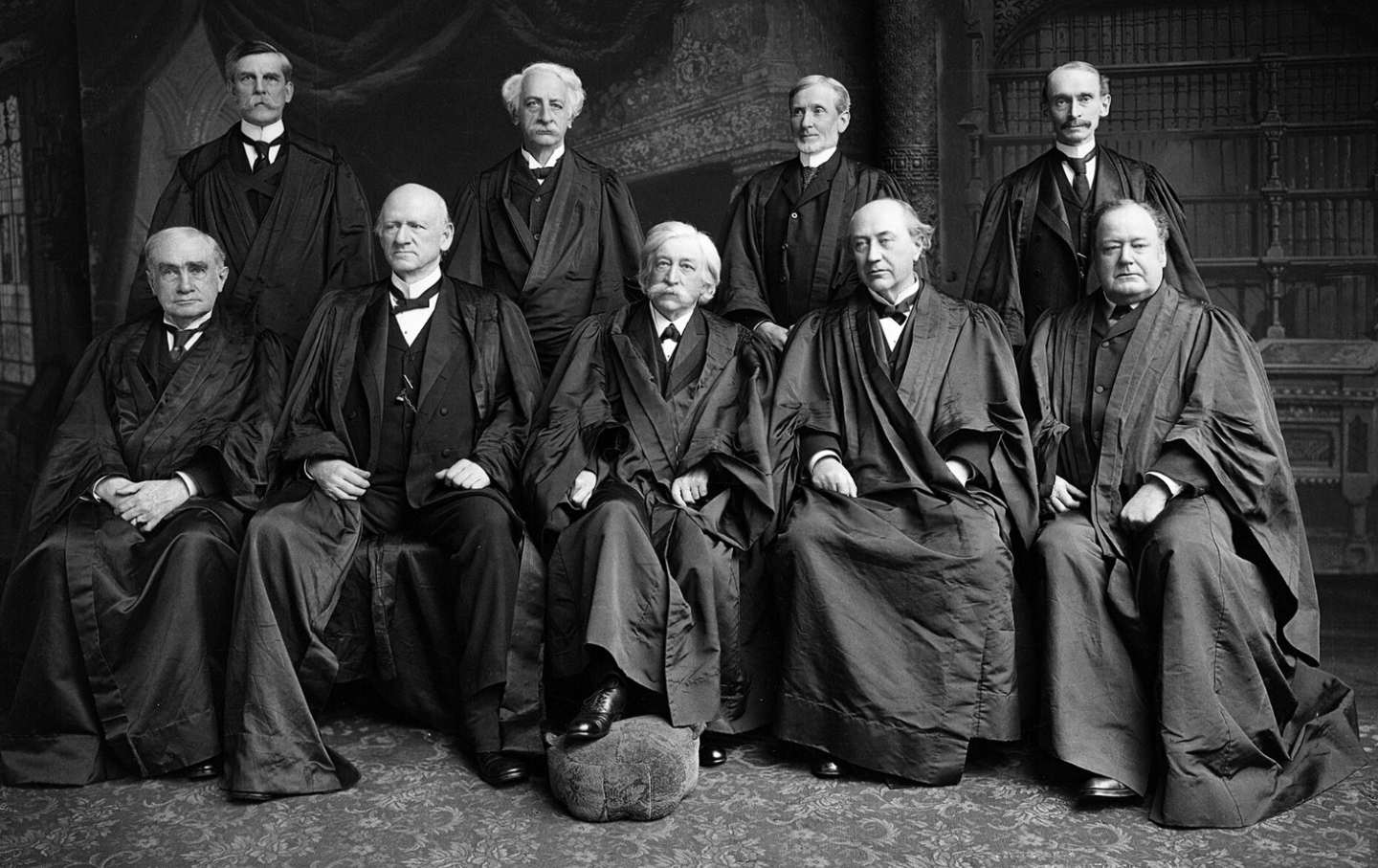
The Supreme Court in 1904. In front, from left to right: Henry Billings Brown, John Marshall Harlan, Chief Justice Melville Fuller, David Josiah Brewer, Edward Douglass White Jr. Standing, left to right: Oliver Wendell Holmes, Rufus W. Peckham, Joseph McKenna, William R. Day.
(Supreme Court of the United States)It would be difficult to overstate the extent to which the American republic’s current set of staggering problems and seemingly intractable crises can and should be blamed on a single institution: the United States Supreme Court.
Other actors, of course, bear responsibility as well: a highly distractible mainstream media, corporate kleptocrats, a generation or two of now-discredited neoliberals and neoconservatives pushing domestic and foreign policy initiatives that it was clear at the time were unjust and unworkable and indeed have not worked out at all.
Yet none of them would have been in a position to see their will so consequentially enacted had they not been empowered by the Supreme Court, which, over the last 40 or so years, has greenlighted media consolidation and conglomeration, hollowing out the local and independent journalism on which democracy depends; turned corporations into persons, opening the campaign-finance spigots and flooding the public square with dark money; and even halted the counting of ballots in a presidential election so as to deliver victory to the candidate preferred by a bare majority of its members.
Not to mention rulings that have hollowed out labor unions; overturned hard-earned protections for the right to vote; and annulled the right to have an abortion it had itself previously recognized as inviolable. Most recently, the court decided that the president is above and beyond the reach of the law—a decision it is no exaggeration to say demolished in one blow an essential pillar of the constitutional system. It is terrifying to think that the conservative justices on the court are not yet done with their labors. If she holds on as long as Ruth Bader Ginsburg did, Amy Coney Barrett will still be hearing cases in 2059.
It is both freshly infuriating and strangely comforting, at such a moment, to cast a long look back through the history of the Supreme Court and see just how long the questions and issues raised by the justices’ recent interventions have been the subject of conversation and debate. The Nation has been airing and reporting on such debates since its founding three months after the end of the Civil War, when it was clear the court would play a vital role shaping the nation that emerged from the ashes. Covering more than a century and a half, the articles, columns, letters, and editorials included in these pages contain eloquent critiques of the court’s trespasses on democracy, its selective application of supposed constitutional principles, and persistent mockery of the justice’s half-hearted pleas that the court stays out of politics and simply applies the Constitution to the issue is at hand. As more than one contributor points out, the court often claims to be powerless when it comes to protecting individual liberties but somehow finds justification to act as an almighty sovereign when property rights or corporate interests are at stake.
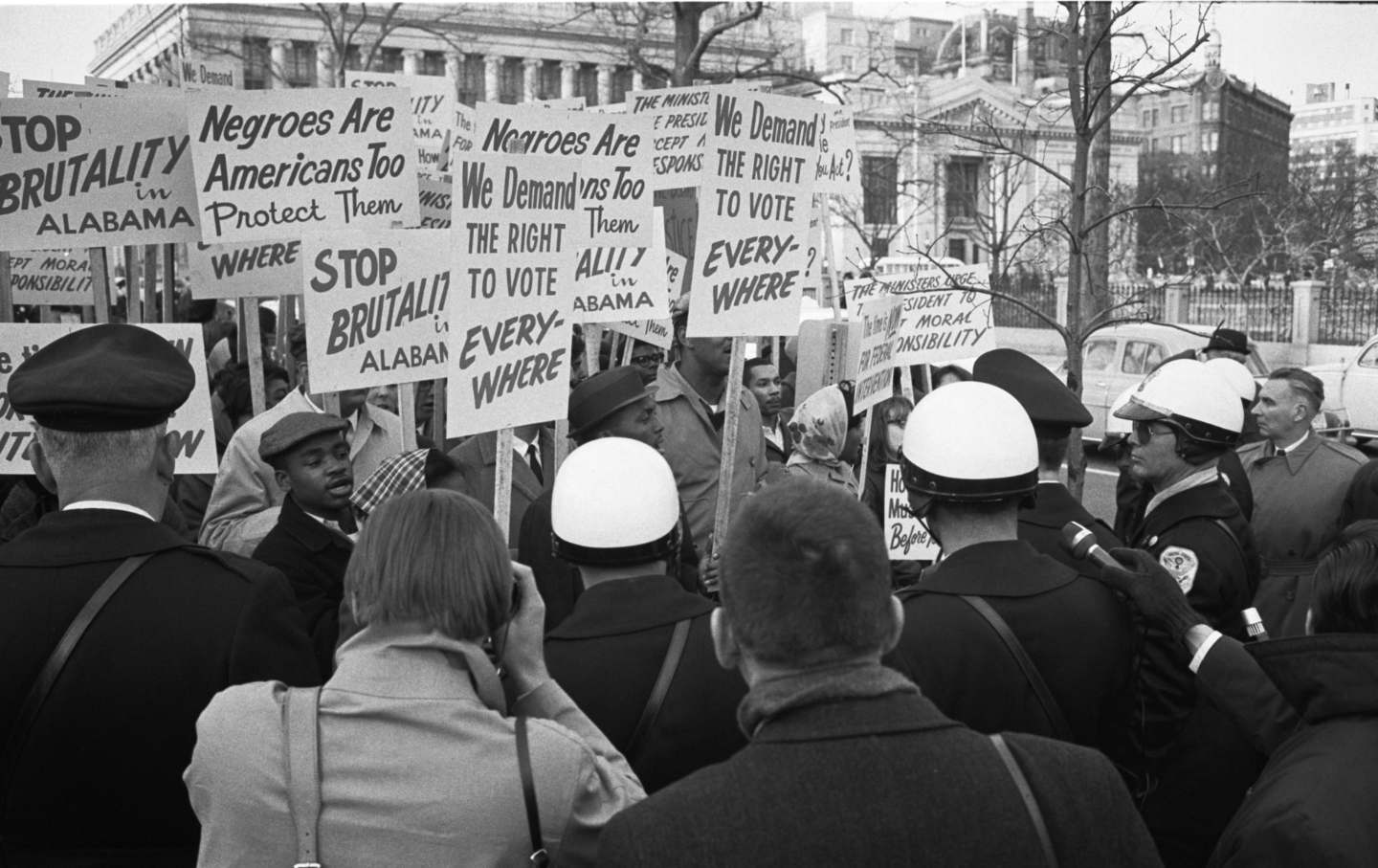
The heyday of Chief Justice Earl Warren (1953 to 1969) offers a brief exception, an era when Nation writers and editors rediscovered along with other liberals the value of an activist court. “Of course, the world cannot be improved by law alone,” a contributor noted in 1954, after Brown v. Board of Education, “but just as surely it cannot be improved without law.” The same magazine that two decades earlier had pushed President Franklin Roosevelt to undertake a thorough overhaul of a hidebound court now celebrated the “wisdom and restraint of Congress” for defeating such initiatives. The writer of that piece, Maxwell Brandwen, cheered the Warren court’s early decisions in favor of civil liberties as “in harmony with the traditional spirit of our country,” evidence of “a sensitive regard for high ethical values.” Such praise is understandable in the context of a period when, as Brandwen put it, the justices “upheld and even extended the traditional rights of the individual.” What a contrast with our own time, when rights are not being extended but rescinded.
Oddly, the magazine did not take notice at the time of some of the most significant court decisions of the first few decades of its existence. One searches in vain for a response to Plessy v. Ferguson, the 1893 decision that endorsed “separate but equal” public schools and other facilities for Black Americans, or the shameful Korematsu ruling (1943) that approved the wartime detention of Japanese Americans. After Brown v. Board of Education overturned Plessy in 1954, The Nationmore or less skipped right over the news in order to ask the next question the case necessarily raised: What about racial segregation in the North?
Some of the magazine’s best writing on the court emphasizes the complicated relationship between legal strategy and political activism. Two years before Brown, the accomplished lawyer and activist Earl B. Dickerson took to The Nation to urge his fellow Black Americans to “place less reliance on the goodwill of a few appointed justices” and to focus more on building “strength in the political arena.” An editorial about the court’s ruling in Roe v. Wade (1973) asked:
What are the prerequisites for such a reversal of attitude at the highest judicial level? For one thing, there must be a special constituency, imbued with zeal, equipped with reason, and pushing hard for a change in the law. Without an activist vanguard, ancient concepts will not be questioned, much less critically examined.
Tragically, the right, not the left, got the message, at least regarding reproductive rights. It’s poignant and depressing to read several decades’ worth of warnings in The Nation that, thanks to the anti-abortion “activist vanguard” channeling political organizing into federal judicial appointments, Roe would soon be on the chopping block. It only took 49 years, but with the Dobbs decision of 2022, the “special constituency” accomplished their goal at last.
The Nine Have Spoken contains repeated and consistent warnings that readers should not get too hopeful about the possibilities of liberation via court decree, nor place too much trust in a fundamentally undemocratic institution. “Not a few timid liberals still fear curtailment of the court’s swollen powers lest it be unable to protect us from fascism,” the young I.F. Stone (still Isidor Feinstein) wrote in 1937, at the height of the battle over Roosevelt’s “court-packing” plan. “This is pure fancy.”
Trump v. United States (2024), which is where the book ends, offers more conclusive proof than Stone could ever have hoped—or feared—to be able to marshal in support of his case. “Far from being a bulwark against fascism,” Stone presciently wrote, “the court may serve a double function in its rise. If the court continues to hamstring Congress and state legislatures, it will play directly into the hands of the fascist demagogue who sneers at the ‘inefficiency’ of democratic processes. On the other hand, a fascist regime will find material in past court decisions to provide itself with legal, nay, ‘constitutional,’ justification.” What could be more useful to such a regime than the court’s approval of the idea once put forward by Richard Nixon, to the howls of a horrified nation, that the president is forever shielded from prosecution for crimes committed while in office?
To informed and thoughtful left-leaning Americans, it has never not seemed cruel and absurd for so much of our lives to be determined by nine berobed attorneys granted effectively insuperable authority and, with life tenure, immunized against the discontent of the governed. All the more so these days, when several of the justices are known in their private lives to possess little personal integrity and to align with insurrectionists against the government they are sworn to serve.
From I.F. Stone and other early Nation writers’ demands for court reform to justice correspondent Elie Mystal’s impassioned and astute coverage in recent years, this collection of Nation writings about the court puts the choices we face today in proper historical perspective. It shows that the justices’ recent spate of reactionary rulings is not a departure from history but a return to the norm, and that proposing ideas for overhauling the court should not be considered particularly radical or beyond the pale. Rather, questioning the court’s legitimacy, demanding a more democratic, accountable federal judiciary, is a tradition nearly as old as the court itself.
Adapted from The Nine Have Spoken: The Nation vs. the Supreme Court, 1870 to Today, edited by Richard Kreitner. Order your copy from OR Books for only $10.
Become a Sustaining Donor This September
Between the reemergence of right-wing red-baiting and Donald Trump’s use of the chilling National Security Presidential Memorandum–7 to criminalize left political organizing, we’re seeing McCarthyism reborn before our eyes.
This assault on democracy cannot be ignored or wished away. Resisting it requires bravery in the face of threats and repression, a steadfast commitment to the truth, and the unwavering belief that we can—and will—overcome this darkness.
We must have an independent media that sets the record straight, unearths corruption and abuses of power, and advances a politics of justice and dignity for all if we’re to win this fight.
That’s why I’m writing to you today. This September, The Nation needs to add 100 monthly donors to sustain our progressive journalism. Your contribution makes the next investigative report, the next truth-speaking column, and the next pathbreaking essay all possible.
I hope you’ll support our work with a recurring donation today. If you donate $10 or more a month, we’ll send you a brand new “Hands Off the Free Press!” sticker to recognise your commitment to our cause. Please, donate today.
Onward,
Katrina vanden Heuvel
Editor and Publisher, The Nation