
That Wild “Wired” Article Is Not a Case Against Surrogacy
That Wild “Wired” Article Is Not a Case Against Surrogacy
It’s a horror story about Silicon Valley, and an extreme example of what happens when we conceive of children as property.

The lurid story has captured the horrified imaginations of millions ever since it broke last Wednesday in Wired magazine: A San Francisco “angel investor” by the name of Cindy Bi—who manages a venture capital firm called CapitalX—is attempting to sue her surrogate for the imagined crime of miscarrying a fetus she understood as her own possession. Bi believes the surrogate should be charged with murder, although the “gestational carrier” in question nearly died in the process herself.
The near-total consensus reaction has been, unsurprisingly, that Bi’s campaign is deranged (fair enough), but also that it demonstrates “of course” that an inherently monstrous practice known as surrogacy must end. In reality, while this grotesque episode joins a long list of litigious surrogacy-related melodramas, it says more about natalism in Silicon Valley than it does about any inherent ethical egregiousness of compensating or delegating the carrying of fetuses. In 2019, amid an “explosion of demand” for alienated gestational labor in California, The Economist celebrated Silicon Valleyites’ willingness to espouse “stigmatized” kin-making practices and “go off script.” But, I’d submit, proprietary parenthood is the script. The problem does not start with the individuals buying and eugenically curating pregnancies from working-class women, but with the “soft” eugenics, competitiveness, and individualism that permeates our culture’s entire approach to baby-making to begin with.
Not that the particulars here aren’t eye-popping. As reported by Emi Nietfeld, to whom Bi told everything (in flagrant violation of a court-enforced agreement not to speak of her surrogate), Bi hired “Rebecca Smith”—a pseudonym Nietfeld chose—in 2023, to gestate her and her husband, Jorge Valdeiglesias’s genetic material using IVF and Bi’s frozen eggs. Specifically, they implanted the “only male embryo,” and the surrogacy went swimmingly right up until it didn’t. Following the stillbirth of “Baby Leon” in 2024 due to a random placental abruption, the “genetic mother” launched a campaign of harassment and persecution against the traumatized C-section and hemorrhaging survivor. She spent a million dollars on lawfare, attempting to get Smith bankrupted, fired, and jailed, on the basis that “our contract specified a ‘well-baby.’”
Bi repeatedly spelled the case out to Nietfeld: “I am the victim here.” She also set up an advocacy organization called Baby Leon (tagline: “protect innocent children”), and proceeded to whip up a small tsunami of hatred of Smith online by painting her as a money-grubbing psychopath who expressly “did what she did to kill my son,” posting her real full name and photo on social media alongside her employer’s details, a link to her home address, and her 7-year-old son’s first name. The aggrieved Cindy even sent a photo of Leon’s remains to the latter child’s iPad. Consequently, Smith has experienced suicidal ideation and been forced, so far, to relocate her family twice, all the while relying only on free legal help and GoFundMe.
In a particularly repugnant Facebook post on March 18, 2024, Bi shared a ChatGPT-generated speech in Baby Leon’s voice, showering “Mama”—herself—with “my #eternal love,” and congratulating her on her “determination to make a change through investment and #influence” as manifest in “launching CapitalX Fund II on my due date.” Leon even thanks Bi for “#birthing me,” which suggests a Handmaid’s Tale–esque level of confusion on Bi’s part about who actually birthed the baby—confusion that is unfortunately characteristic of “commissioning” mothers in a patriarchal culture that pathologizes, in women, the inability or unwillingness to be pregnant.
The futuristic, “innovation”-obsessed twist on neo-“trad,” Christian-nationalist commitment to more and “better” babies in the West is, of course, emblematized by Elon Musk’s proudly megalomaniacal approach to the conversion of his own sperm into personal heirs. Indeed, Californian techno-libertarian fascism helped fuel a surrogacy boom in Silicon Valley starting in 2019. Predictably, the more fetal manufacture becomes a frontier of consumerism, the more fetal loss becomes an industry in its own right, too, full of ghoulish ambulance-chasers.
Bi consulted fertility influencers, hired psychics, and private investigators, and deployed her $1,275-an-hour lawyer. She leveled accusations about Smith’s having secret, fetus-harming “rough sex,” premised on anti-Black aspersions about Smith’s “undisclosed live-in boyfriend with #felony JAIL TIME record.” Make no mistake: The Wired feature is a journalistic coup. Bi mistakenly trusted Nietfeld—a former employee of Google, like Valdeiglesias—to represent in print the rights of parents to hound and torture those whose wombs they rent. The result is a cartoon villain. (Keeping strategically out of it all, lest he catch blame himself, Valdeiglesias blithely said that this rampage is just his wife’s grieving process.)
But are we really still shocked to find that sometimes megalomaniacal patriarchs are women? While venting our horror at Bi, the more important thing is to understand that hers is merely an attitude encouraged and enshrined in the United States (think of the “My Child, My Choice” bill, a proposed act to prohibit providing elementary schools from receiving federal funds if teachers do not request written permission from parents prior to teaching anything related to gender identity). Much like Musk’s breeding compound, surrogacy’s headline-grabbing excesses are ultimately symptoms of a much vaster economic institution that imagines procreation as a form of self-replication offering immortality, and treats all children as quasi-property: the family.
Nietfeld, conversely, implies that the problem has been created by Silicon Valley capitalists: “A shocking number of techies,” she summarizes, “now believe growing a baby can be a straightforward business transaction.” I fear, unfortunately, that the injustices of the contract-pregnancy industry are inextricable from the privatizing logics in play even in unwaged baby-making under capitalism. My first book argues that assisted reproducing appears different from normal pregnancy only because we subscribe to the harmful fantasy that some of our reproduction is unassisted: We conceptualize kinship as an objective status (rather than a relation that we create and maintain), which in turn makes babies individual assets, quasi-owned by their parents.
To be sure, it is unsurprising that both Cindy Bi and Rebecca Smith buy into these ideas, which are usually ideologically resilient enough—when transactions go smoothly—to pass off the astonishing fiction that a tiny body filled with the blood, guts, and energy of the carrier could somehow be “someone else’s baby.” If the capitalist family system did not set up kinship as biogenetic, progeny as possession, and care in general as private, surrogacy clinicians would have nothing to sell. But what if instead of reflexively presuming exceptional harm and uniquely unethical horror in the domain of surrogated gestating, we squinted toward an abolitionist horizon of relational proliferation, one we might call “full surrogacy,” or “real” surrogacy, in the sense of everyone parenting all babies?
The speculative vision put forward in Full Surrogacy Now is one of universal nonhierarchical holding and carrying of one another: In other words, it suggests that real surrogacy might be worth trying. Living as carriers for our own carriers, stand-ins for our neighbors and mothers of strangers, nonhierarchically, would be a good idea, I propose—something like gestational communism—as well as a way of honoring how life-making already works, albeit invisibly and informally, in the sense of the proverbial “village.” This means turning the concept of surrogacy inside out, to reveal that what we currently think of as surrogacy makes sense as “something different” only because reproduction itself is falsely imagined as independent and proprietary. This doesn’t mean simply inverting the equation such that those in Smith’s position are endowed with parental status. Rather, I’m rejecting the idea that a “true” mother exists at all. Mother is a verb.
Challenging the false idea that surrogacy is unusual or unnatural demands that we recognize the many highly exploitative, systematically invisibilized surrogacies all around us—i.e., the outsourcing arrangements and stratified care-labors, crisscrossing class society, that prop up every putatively autonomous household, not just those of the Cindy Bis of the world. We should ask ourselves how to manage this interdependence without class divisions. Rather than defend and protect the norms of the genetic family against the predations of the market, we can and should advance a critique of private property radical enough to posit neonatal humans as people who are a collective responsibility. In other words, we have to figure out how to act like we are all each other’s makers—because, inevitably, we are.
Become a Sustaining Donor This September
Between the reemergence of right-wing red-baiting and Donald Trump’s use of the chilling National Security Presidential Memorandum–7 to criminalize left political organizing, we’re seeing McCarthyism reborn before our eyes.
This assault on democracy cannot be ignored or wished away. Resisting it requires bravery in the face of threats and repression, a steadfast commitment to the truth, and the unwavering belief that we can—and will—overcome this darkness.
We must have an independent media that sets the record straight, unearths corruption and abuses of power, and advances a politics of justice and dignity for all if we’re to win this fight.
That’s why I’m writing to you today. This September, The Nation needs to add 100 monthly donors to sustain our progressive journalism. Your contribution makes the next investigative report, the next truth-speaking column, and the next pathbreaking essay all possible.
I hope you’ll support our work with a recurring donation today. If you donate $10 or more a month, we’ll send you a brand new “Hands Off the Free Press!” sticker to recognise your commitment to our cause. Please, donate today.
Onward,
Katrina vanden Heuvel
Editor and Publisher, The Nation
More from The Nation
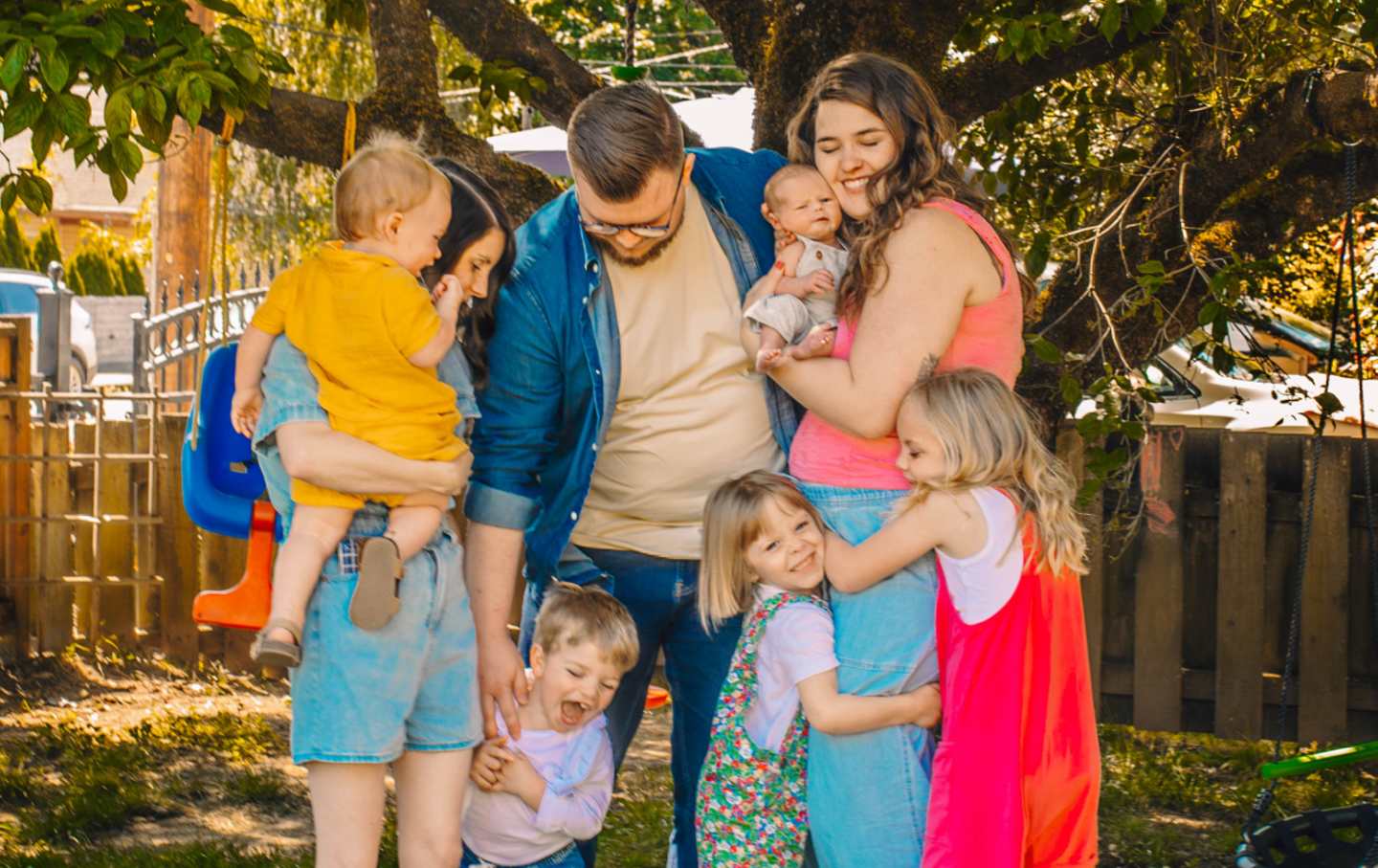
Is Platonic Co-Parenting the Future of the Family? Is Platonic Co-Parenting the Future of the Family?
Disillusioned with the nuclear family and apprehensive of tethering their reproductive futures to the bleak hellscape of modern love, young people are seeking a different way.


How Trump’s Crackdown on Speech Has Damaged the Student Press How Trump’s Crackdown on Speech Has Damaged the Student Press
I serve as editor in chief and president of The Stanford Daily. Our newsroom has keenly felt the effects of Trump’s campus crackdown, which is why we sued the federal government.
Treat Spotify Like a Public Utility Treat Spotify Like a Public Utility
Music streaming platforms have way too much control over musicians and music lovers. It’s time to rein them in.
What’s the Matter With Effective Altruism? What’s the Matter With Effective Altruism?
President Trump has decried the techbro creed for indulging in AI doomerism, but its excesses are far worse than that.
As Morale Sags, More Military Service Members Are Having a Crisis of Conscience As Morale Sags, More Military Service Members Are Having a Crisis of Conscience
According to multiple GI rights organizations, service members are inquiring in unprecedented numbers about seeking conscientious objector status.

