
Is Tom Cruise the Last Action Hero?
After a strange, controversial career, he has become one of the few figures who upholds the old rules of Hollywood—where the human body is the greatest special effect.
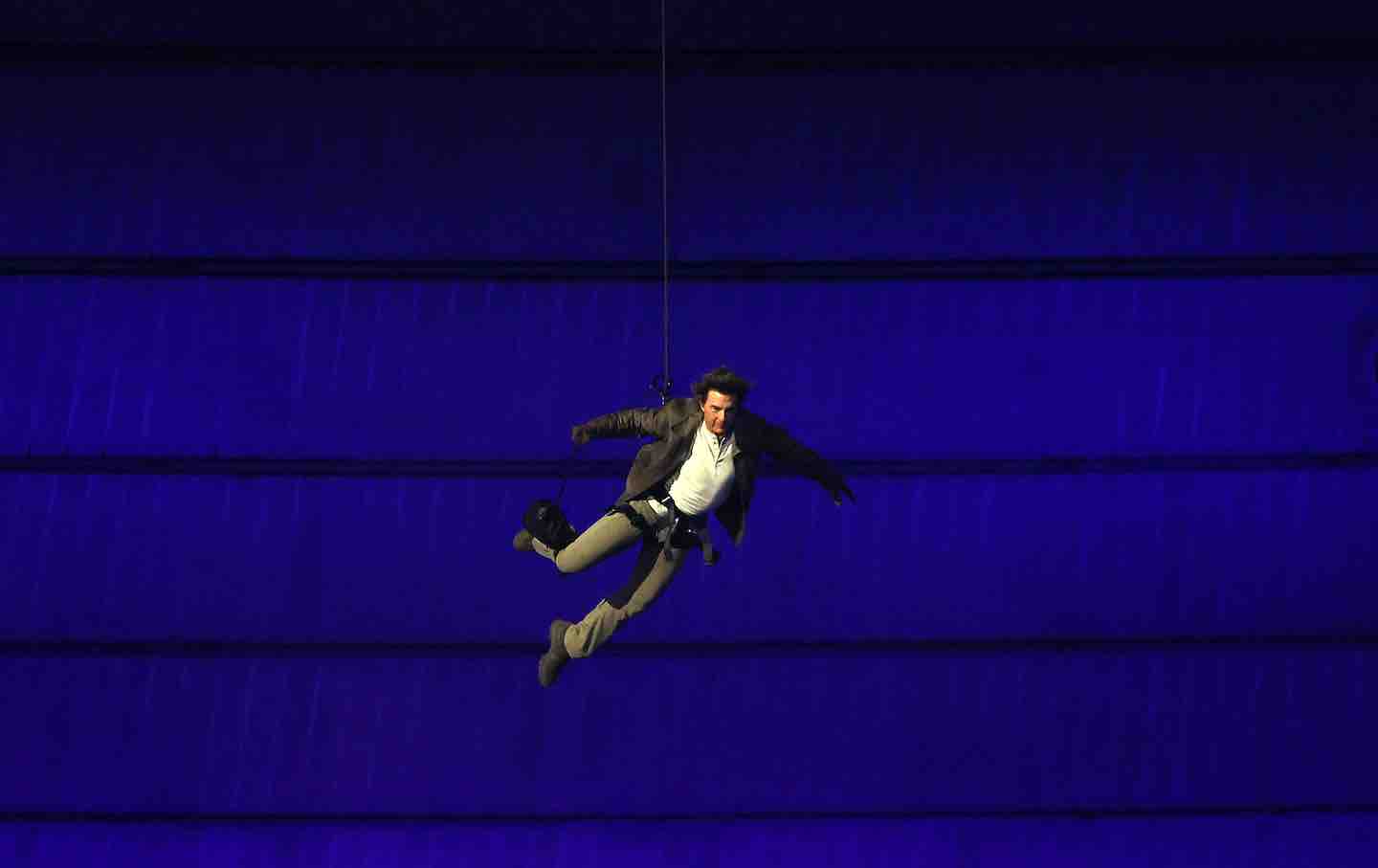
Tom Cruise repels into the Stade de France during the Closing Ceremony of the Olympic Games in Paris, 2024.
(Carl Recine / Getty Images)Tom Cruise holds the Guinness World Records title for “most burning parachute jumps by an individual.” The dubious institution awarded this honor to the Hollywood icon not long after the release of Mission: Impossible—The Final Reckoning, the eighth entry in the popular action franchise. The film features Cruise’s superspy character Ethan Hunt escaping from a biplane via a parachute that catches fire in midair. Cruise actually jumped from a helicopter 7,500 feet above the ground while strapped to a chute presoaked in fuel and lit ablaze. He had roughly three seconds to cut away from the burning parachute and deploy a backup. He performed this stunt 16 separate times.
Cruise’s commitment to death-defying authenticity has become an intractable part of his contemporary public image. Since 2010, following a decade of tabloid scandal, Cruise has successfully rebranded himself as a consummate action star who performs all of his own stunts, a persona that blurs on- and off-screen. If his character has to evade bad guys in a high-speed car chase or grab onto an airplane as it takes off (or, really, anything to do with jumping out of or onto planes), chances are it’s actually Tom doing the work.
This dedication to verisimilitude in the name of spectacle stands out as studios increasingly succumb to the supposed cost-saving allure of AI and push to erase human beings from the filmmaking process, along with their pesky demands for fair wages and civil liberties. Spitting in the face of copyright concerns and the technology’s deleterious environmental impact, Hollywood has reportedly been incorporating generative AI into its productions for some time now. Cruise couldn’t be more out of step with the industry in this regard: He sincerely believes in the power of humans, to the point of gleefully courting death with dégagé elegance. It stands to reason that Cruise believes his current role as a movie star is to constantly model the idea of one. By demonstrating its enduring appeal, he stands in opposition to an amnesiac, disposable entertainment culture.
Indeed, his crusade to affirm the human in the filmmaking process is made literal in the final two Mission: Impossible movies, in which a sentient, rogue AI program threatens nuclear holocaust by manipulating cyberspace to take control of military systems and networks across the globe, forcing Ethan and his merry band of agents to regain control of “the Entity” to prevent world destruction. The best defense against an almighty, man-made technological power is apparently the almighty man himself. While Ethan Hunt has been a transparent stand-in for Cruise from the franchise’s beginning (the character partly exists to demonstrate the actor’s physical prowess and producorial acumen), the gap between actor and performance began to contract even further when Christopher McQuarrie became the series’ director in 2015 with Mission: Impossible—Rogue Nation, and especially when Cruise’s stunts became an integral part of the franchise’s marketing. (They’re so essential, in fact, that McQuarrie and his cowriters frequently update and rework the script around the set pieces that Cruise concocts.)
Lately, however, the Mission: Impossible films are just as concerned with man’s struggle against the ultimate machine—only an unstoppable Übermensch like Cruise can prevent an equally unstoppable AI from unleashing hell. The worshipful tone that the series’ supporting characters adopt to speak about Hunt’s superhuman abilities and his fated role as the world’s savior also reflects the awestruck manner in which Cruise’s costars and production team speak about him. (On a recent Jimmy Kimmel Live! appearance, actor Nick Offerman half-jokingly said he’d take a bullet for Cruise after working with him for the first time in Final Reckoning.) At one point in Rogue Nation, a character states, “Hunt is the living manifestation of destiny.” A decade ago, it was possible to read such a melodramatic assertion as merely a cheeky reference to Cruise’s enduring star power. By Final Reckoning, any intimation of subtext has crumbled. Much like how Hunt is the only man who can save the world in Mission: Impossible, Cruise is the only man who can save Hollywood, even if he dies in the process. But is it worth saving at all?
Cruise has always been strongest as an actor when he’s projecting vulnerability. Sometimes that takes the form of his character comically expressing desperation or rage, such as when he’s venting his frustration with his autistic brother in Rain Man or contending with the stubborn demands of a flamboyant pro-athlete client in Jerry Maguire. Other times, it stems from pure devastation: vomiting repressed rage toward a patriarch on his deathbed (Magnolia), tearfully reconciling with his partner after a journey through New York’s seedy sexual underbelly (Eyes Wide Shut), or barely concealing a torrent of fear in front of his young children (War of the Worlds). Cruise’s cocksure confidence, embodied by the open-wide smile he basically trademarked in Risky Business, would feel truly hollow if it weren’t counterbalanced by his ability to communicate a mixture of unguarded emotions through minute facial gestures.
Crucially (and obviously), the unrestrained feelings that Cruise conveys on-screen are products of disciplined performance craft. The Mission: Impossible films emphasize the physical aspects of his technique; Cruise’s body, and the extent to which it’s tested and strained, is one of the series’ main selling points. But his palpable emotional sensitivity lends as much genuine danger to the films as the sticky situations that Hunt maneuvers through. Think of the silent panic on Cruise’s face in the first Mission: Impossible when Hunt escapes from a restaurant after exploding an enormous lobster tank, or when he famously almost falls while suspended from the ceiling by a cable. Cruise impressively performs both stunts himself, but neither would have much impact if he wasn’t exuding the sheer terror of the moment.
As the stunts became more extravagant and hazardous over the course of the franchise, Cruise’s herculean energy came into productive friction with the actor’s august age. By Final Reckoning, Cruise has largely shed his famously youthful countenance; he no longer needs to project vulnerability because it’s on full display when he’s sprinting toward a bad guy or engaging in hand-to-hand combat. Whenever the film locks into Cruise’s weathered face as he holds his breath underwater for lengthy periods or jumps from one biplane to another in midair, his steadfast allegiance to spectacular realism is diametrically opposed to a popular culture addicted to unreal images.
It’s understandable that the series would laud Cruise via Hunt in response to the actor’s physical sacrifice. But while the Mission: Impossible films have always visually lionized Cruise, the adoration gained a more seraphic tone when the series entered the McQuarrie era, which adopted certain long-term structural changes for the franchise. The films deployed a uniform aesthetic, in contrast to previous entries that had showcased the visual trademarks of their auteur directors. (The canted angles and split-focus shots favored by Brian De Palma in the first Mission: Impossible obviously aren’t deployed in the sequels directed by John Woo and Brad Bird.) The series also began to directly probe real-world political trends: The incorporation of media disinformation into the plot of Mission: Impossible—Fallout presages Dead Reckoning and Final Reckoning’s pointed critique of AI.
Final Reckoning is one of the series’ weakest entries for a variety of quotidian reasons, some of which are endemic to mainstream franchise filmmaking: slack pacing, a frustrating emphasis on dull exposition (especially in the interminable first hour), and a scattered narrative made convoluted by too many new characters and numerous rewrites and reshoots. But the film’s fixation on its own history ultimately becomes its biggest liability. Partly to accentuate Final Reckoning as a swan song, the film integrates flashbacks and callbacks that sweatily tie together elements from the previous entries in an attempt to force serialized cohesion, despite the series’ refreshing disinterest in such soapy mechanics.
The worst offense in this regard involves the return of CIA analyst William Donloe (Rolf Saxon), a minor character from the first Mission: Impossible who was induced with food poisoning by Hunt’s team so that a crucial piece of intel was left unattended. Donloe becomes a major supporting figure in Final Reckoning, helping Hunt’s team to transmit the coordinates of a sunken submarine and later to defuse a bomb. His return to the series would be merely a cutesy example of fan service if it wasn’t also used as a way to glorify Hunt in the most laughably overwrought fashion. We learn that Donloe was exiled to a remote island off the Bering Sea after he allowed the intel to be stolen from CIA headquarters; when Hunt apologizes for his actions, Donloe thanks him instead—otherwise, he wouldn’t have met his Inuk wife or found inner peace in a beautiful land. “I owe you my life,” he tells Hunt. It’s one thing for McQuarrie’s camera to visually place Cruise on a pedestal, but having multiple supporting characters basically express awe and gratitude simply for being in Hunt’s presence (whenever they’re not enthusiastically supporting his superheroic efforts) is comically reverent. That Final Reckoning features the fewest set pieces in the series (possibly due to the fact that Cruise is now 63 years old) makes the overly deferential attitude that dominates the film even more glaring.
The idea that Hunt and Cruise both routinely risk their lives in the service of others has always been the subtextual foundation of Mission: Impossible, but Cruise’s gift to audiences seems to transcend merely providing them with entertainment. By becoming the loudest on-screen version of himself, i.e., a cinematic Evel Knievel, he has decided to brute-force “the movie star” into the public consciousness. Mainstream film culture demands either homogeneity or aggressive personal branding to cut through the noise in a fractured attention economy. Only Tom Cruise can be Tom Cruise, even if he has to constantly remind people of that fact.
Popular
“swipe left below to view more authors”Swipe →In 2021, the performer Miles Fisher, in partnership with the visual and AI effects artist Chris Umé, started to create popular deepfake TikTok videos of Cruise. The videos featured Fisher imitating Cruise’s voice and mannerisms while engaging in mundane activities like hitting a golf ball or monologuing about bubblegum. Fisher, who superficially resembles the actor, insisted in a Hollywood Reporter op-ed that the videos were partly a way for him to embrace a comparison that has dogged him his entire life, while also demonstrating the power of burgeoning AI technology. The success of the videos helped Umé cofound the artificial intelligence company Metaphysic, which entered into a strategic partnership with Creative Artists Agency in 2023 to “develop generative AI tools and services for talent.” Metaphysic’s AI technology was used by Robert Zemeckis to de-age Tom Hanks and Robin Wright in his latest film, Here.
Cruise has never publicly commented on the deepfake videos, but the Entity’s insidious ability to flawlessly imitate people’s likenesses for malicious ends in Dead Reckoning feels as much like a pointed commentary as one can expect from the actor. The fact that the Entity inspires a doomsday cult, whose influence stretches from the streets to the inner sanctum of the White House in Final Reckoning, feels similarly barbed. Fisher has said the technology is “morally neutral,” but Cruise clearly believes that any technology that can steal a person’s image is inherently a threat, even if it’s merely being used to make viral jokes.
Cruise might be easy to imitate, but he’s rightfully eager to protect his irreducible image because, for better or worse, it’s hard-won. He’s remained an ever-present figure in culture despite and because of the various tensions at the heart of his stardom. His frictionless charisma and slight unknowability allows for maximum projection from an audience well versed in his obsessive careerism, his influence within the Church of Scientology, and the simmering menace undergirding his otherwise amiable public persona. Genuine talent and business savvy can’t be discounted, but it’s also the internal contradictions and enduring mystery that have made Cruise such a durable figure.
His singularity has all but guaranteed that Final Reckoning will likely cross $600 million at the worldwide box office. Even if the film doesn’t generate a profit during its theatrical run because of perplexing Hollywood accounting (the reported $400 million budget not only makes it one of the most expensive films ever made but also imposes an exorbitantly high break-even point), its considerable success clearly depends on Cruise’s undeniable popularity. The self-flattery in Final Reckoning might make for a frustrating viewing experience, but going purely by numbers, it’s probably justified.
For the past 15 years, Cruise has demonstrated that the human body is the greatest special effect. Now he will receive an Honorary Academy Award this fall for his “incredible commitment to [the] filmmaking community.” Maybe it’s fitting that the academy will finally pay tribute to the man’s manic work ethic and perilous physical exploits rather than any of his individual performances. In a culture so determined to erase the idea of prestige, the gap between the Oscars and the Guinness World Records may be smaller than we ever thought.
More from The Nation

The Genius of Charli XCX The Genius of Charli XCX
On her new album, Music, Fashion, Film, the musician embraces rock.

The Architectural Follies of Trump’s Washington, DC The Architectural Follies of Trump’s Washington, DC
The president plans to remake the capital in his own image, but is all he is doing destroying what’s already there?
The Carnival of Venice Biennale The Carnival of Venice Biennale
That so much of the art of “In Minor Keys” is muted in effect is ironic, because so much of it is overproduced, aspirationally eye-catching, and so big.

