Monuments to Migration and Labor
In the face of escalating ICE raids, how can we honor and give voice to immigrant laborers?
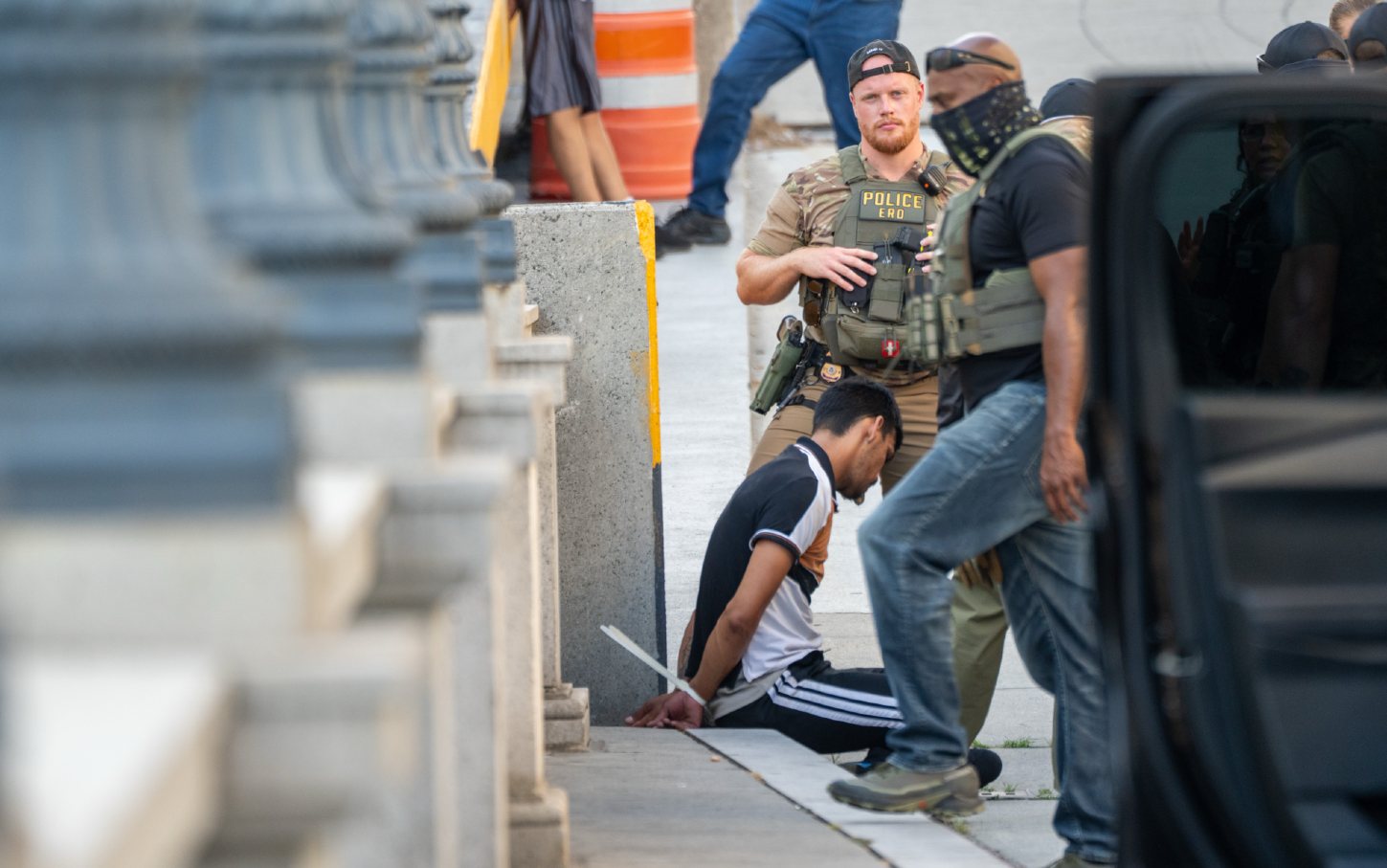
In the days after US Immigration and Customs Enforcement officers raided the Alba Wine & Spirits Warehouse in Edison, New Jersey, on July 8, 2025, media coverage of the event has rightfully emphasized the fear, trauma, and injustice that immigrant communities and advocates have felt in its wake. One response to ICE raids, in New Jersey and across the country, has been to argue for the hardworking nature of immigrants and the value they contribute to the American economy.
These lines of reasoning are appealing, since they offer sober rebuttals to the fictional nonsense about immigrant crime and violence that the Trump administration manipulates to justify raids. At the same, however, this framing can add to the dehumanizing characterization of immigrants as only useful when they are economic subjects willing to take on low-paying and undesirable jobs—and not because they are human beings deserving of dignity. When it comes to warehouses and immigrant labor in New Jersey, there is a more complicated backstory that speaks to both the nuances of how the American economy is organized in the 21st century, and to the activism and agency that immigrants have demonstrated as workers—stories that deserve to be told.
The raid in Edison, which ICE referred to as a “worksite compliance inspection”—euphemistic language inaccurately suggesting employers were the target of enforcement—resulted in the arrest of 20 individuals. ICE brought immigrants to Delaney Hall, the infamous Newark immigration detention facility that the Department of Homeland Security contracted the GEO Group to reopen this year. Delaney Hall was in the news back in May for playing host to federal agents’ arrest of Newark Mayor Ras Baraka. Scenes like the one in Edison will occur even more frequently now that the Big Beautiful Bill Trump signed in early July provides the DHS with $170.7 billion in funding, and includes incentives such as $50,000 signing bonuses to bolster ICE’s ranks.
Why is it that ICE so frequently raids warehouses? Warehouses are a ubiquitous part of the New Jersey landscape, distribution points in a consumer economy where nearly everything can be purchased online with the click of a button. A 2024 report from the Environmental Defense Fund counted 3,034 warehouses in New Jersey, serviced by 380,000 daily truck trips. Nearly a third of New Jersey’s population lives within half a mile of a warehouse, most of them Black and Latine residents who face higher rates of asthma due to vehicle congestion.
Many warehouse workers are recruited by temp agencies, who, as brokers, contract unauthorized as well as documented immigrant workers for placement. Under-the-table contracts to employ unauthorized workers often result in precarious and exploitative employment.
In New Jersey and elsewhere, advocates have challenged the invisibility and exploitation of migrant workers by centering the voices of immigrants themselves and building long-term relationships with immigrant communities. In 2023, for instance, New Labor fought for the Temporary Worker Bill of Rights, which protects against wage theft and illegal fees that agencies charge, and mandates that temporary workers receive equal pay and benefits for performing “substantially similar work under similar working conditions,” regardless of employment status.
This summer, the New Jersey Monuments to Migration and Labor project hosted dialogues across the state, creating safe environments where immigrant workers were invited to share their stories. As attendees at these dialogues, we saw participants emphasize the pride they have in their labor and speak of the families they support and the communities they build. From these narratives, the project plans to create public monument installations that illustrate the complexity and nuance of immigrant lives and make visible the contributions of immigrants as both workers and humans.
Stakeholders in this project, such as the National Domestic Workers Alliance, who were leaders in advocating for the 2024 New Jersey Domestic Workers’ Bill of Rights, have reminded us to recenter conversations around immigration to focus on migrants themselves. Illuminating the stories and victories of activists is essential to combating policies that dehumanize immigrants. Amid escalating attacks from the federal government and ICE, it is more important than ever to return to not-so-distant achievements in immigration worker advocacy, and to build commemorative spaces where the public can gather to both honor the past and to organize for the future.
Become a Sustaining Donor This September
Between the reemergence of right-wing red-baiting and Donald Trump’s use of the chilling National Security Presidential Memorandum–7 to criminalize left political organizing, we’re seeing McCarthyism reborn before our eyes.
This assault on democracy cannot be ignored or wished away. Resisting it requires bravery in the face of threats and repression, a steadfast commitment to the truth, and the unwavering belief that we can—and will—overcome this darkness.
We must have an independent media that sets the record straight, unearths corruption and abuses of power, and advances a politics of justice and dignity for all if we’re to win this fight.
That’s why I’m writing to you today. This September, The Nation needs to add 100 monthly donors to sustain our progressive journalism. Your contribution makes the next investigative report, the next truth-speaking column, and the next pathbreaking essay all possible.
I hope you’ll support our work with a recurring donation today. If you donate $10 or more a month, we’ll send you a brand new “Hands Off the Free Press!” sticker to recognise your commitment to our cause. Please, donate today.
Onward,
Katrina vanden Heuvel
Editor and Publisher, The Nation