
The Danes Resisted Fascism, and So Can We
Danish resistance didn’t arrive all at once during World War II. But taken as a whole, the Danes’ actions are a testament to what’s possible when we work together to fight fascism.
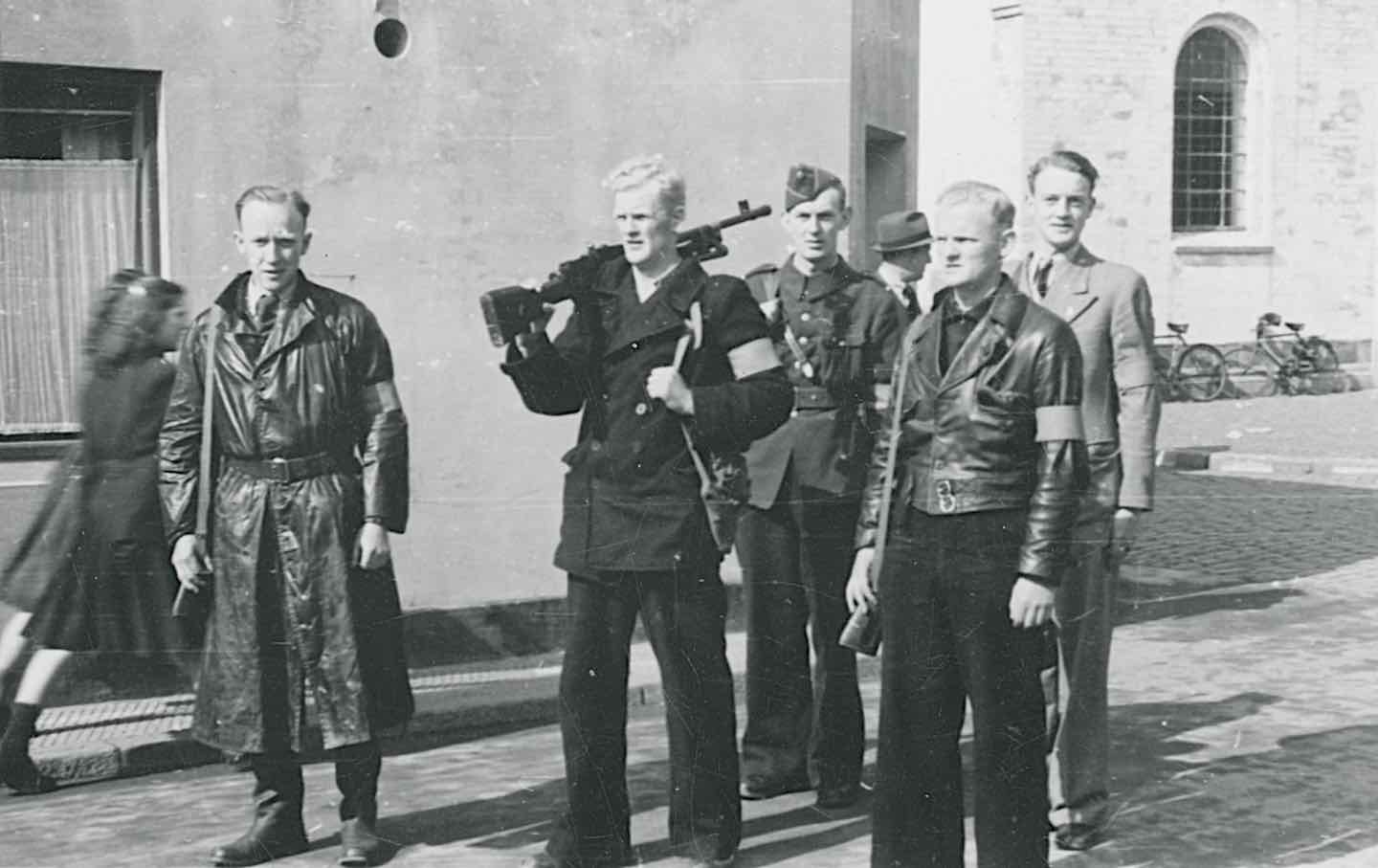
A group of resistance fighters at Lemvig Church. One of them has a Madsen machine gun over his shoulder.
(The Museum of Danish Resistance)As a child, I was regaled with stories of my great-grandfather Prime Minister Thorvald Stauning of Denmark. A tall, bearded, righteous man, he was the first working-class prime minister, and he paved the foundation for the Danish welfare state of today. He unimpeachably deserves all the laurels.
But truth be told, it turns out my favorite story—the one of Great-Grandfather Stauning and King Christian X leading the country in mass resistance—was not true.
As the story went: During World War II, the occupying Germans demanded that Jews in Denmark wear the yellow star. In defiance, my great-grandfather and the beloved king donned the star and rode on horseback through the cobbled streets of Copenhagen, rallying every last Dane—the entire police force included—until all wore the accursed symbol in a profound act of solidarity.
This was a myth, popularized by a Swedish cartoon at the time, depicting Stauning and the king discussing what action to take if such a demand were made. But the myth led me to discover an even greater truth about Danish resistance to Nazism.
I am half Danish, half New Jersey Jew. Born in 1970s Copenhagen during the salad days of jazz, communal living, and the rise of Christiania, I was raised by parents with soft hearts and strong morals. They set me up to build a life of good trouble, and for the past two decades I have worked as a political organizer and artist. Still, over the years, I have kept this story of my great-grandfather close, dutifully following the unwritten “Jante law,” which discourages drawing attention to oneself. I feel compelled to share what I’ve learned now, not out of obligation to historical accuracy but because the facts reveal a powerful map for the road ahead. They are a testament to what’s possible when a society commits to the long game of ending fascism and protecting those who incur the fascists’ wrath.
Often when I come home to Denmark and the subject of WWll resistance is broached, I discover more family members who took part in the resistance. My maternal grandfather, Soren, slept with his shoes on throughout the war, perpetually primed for action. Aunt Gitte defied the Nazis from the hospital where she worked. Uncle Mogens, a journalist, undertook great risk as a courier for the resistance, successfully delivering vital war information, before he turned to reporting for the daily wartime paper, Information, which began as an illegal, underground publication.
Their resistance led me to begin researching Denmark’s quieter, more muted history of defiance during WWII. I learned that the Danish resistance didn’t arrive all at once. Like what we are witnessing now in the United States, it unfolded gradually—slow, then fast, then full tilt—driven by flash points that demanded escalation and deepened solidarity.
Thorvald Stauning, who was elected as Denmark’s first working-class prime minister in 1924, popularized the term samfundssind —“community-mindedness”—during the rise of Nazism. This concept of shared responsibility became a moral and cultural anchor at a time when capitulation to Hitler’s fascist regime was the norm.
In 1940, Germany unceremoniously assaulted neutral Denmark and its 3.8 million residents. Unable to mount a military defense, Denmark initially surrendered. But Danes soon began to disobey.
One early, unsung act of defiance came from a 17-year-old resistance member, Arne Sejr. Frustrated by Denmark’s initial passivity, he wrote and distributed the “Ten Commandments for Danes”—simple moral instructions calling on Danes to stand against the Nazis. Don’t work for the Nazis. Don’t shop in their stores. Don’t believe their propaganda. Protect those they persecute. These commandments ran riot, copied by hand, whispered between neighbors, wheat-pasted on walls. They became a moral guide for ordinary people to resist. (And, in fact, the Czech “Ten Commandments of Nonviolent Resistance” during the 1968 Soviet invasion was inspired by Arne Sejr.)
The Danish Commandments set the stage for mass defiance. The Danes were encouraged to do bad work for the Germans, to destroy what mattered to the occupiers, and to refuse to support Nazi collaborators. Crucially, the Danish Commandments emphasized using one’s privilege to protect others: “You shall protect anyone chased by the Germans,” it read. We are witnessing a similar defiance happen in real time in the United States today, with neighborhood ICE watches and community members who have no special skill or relationship to those being targeted rushing to form a human shield to block agents from detaining their neighbors.
And the Danish Commandments offered tactics, such as the “Cold Shoulder,” or cooly snubbing (as only a Dane can) the occupying Germans, or otherwise lampooning the would-be strongmen, bruising their frail egos. This minor act, repeated en masse, annoyed Nazi officials enough that historians noted it. Arthur Koestler wrote, “Dictators fear laughter more than bombs.” We know, today, that authoritarian types are ego-driven and hate being mocked. “Bird-dogging”—the idea that collaborators should not get a moment’s rest from public scrutiny—was de rigueur in 1943 Denmark.
Cultural resistance surged through “song festivals,” with hundreds of thousands of Danes participating in 1940 to unify and build momentum for defiance. These festivals gave way to strikes, slowdowns, go-home-early campaigns, and widespread sabotage. In retaliation, the Nazis cut off electricity, water, and heat. Disobedience was met with violence, deportation to camps, and even death. A near entirety of the Danish police joined the resistance.
Journalists dissented early on—using satire, printing double-spaced articles that suggested their audience “read between the lines.” As censorship reigned, the underground press grew. By 1943, illegal publications were distributed to 2.6 million people—representing the entire adult population.
In August 1943, the Nazis insisted on further draconian terms that the Danish government officials could not abide by. Subsequently, the undivided government resigned, putting Denmark under direct Nazi rule.
Danes responded by forming organized resistance groups in the hundreds. The Churchill Club, founded by seven teenage boys, declared, “If the adults won’t do something, we will.” Large interfaith coalitions preached defiance from the pulpit. The Danish Freedom Council emerged as a shadow government—similar to recent appeals for a “shadow cabinet” in the United States—purporting that with enough noncompliance, Nazi rule would crumble. Less than two years later it did. After all, fascism cannot thrive without obedience.
But before it fell, the Nazi government, free from safeguards that the Danish government had doggedly maintained, commenced efforts to deport Denmark’s 8,000 Jewish citizens to concentration camps. An occupying Nazi officer—his conscience pierced by the moral clarity surrounding him—leaked the plan. Danes acted swiftly. In a coordinated rescue, they spirited over 99 percent of Danish Jews to safety in Sweden, which welcomed them and allowed them to work.
Denmark was liberated from Nazi occupation on May 5, 1945. Five years of collective noncooperation saw Denmark emerge unique in its defiance and with a stronger sense of community, buoying its unparalleled social policies.
But back to the folklore of my youth: No, Danes never wore yellow badges in protest. Nor did the Nazis require Danish Jews to do so. On the contrary, a greater feat was accomplished. Danes rejected divisions of “us” and “them” that are historically endemic to atrocity.
Hannah Arendt, the exiled Jewish and German American philosopher, believed that the Danish exception should be required learning. The Danes’ unified refusal to indulge hate and their insistence that there was no “Jewish question” overtook their more powerful opponent, dashing their plans and even changing some of the German occupiers’ mindsets, standing in stark contrast to the compliance of most other European countries.
Today, in these violent times, we would be wise to let this history be our guide. Right-wing extremists have been coordinating across borders to dismantle democracy. We must respond in kind, across generations and geographies, until no daylight is to be found between our values and our actions.
Popular
“swipe left below to view more authors”Swipe →The Danes used empathy politically—an action abhorred by right-wing leaders, who have gone so far as to brand it as an enemy and a weakness. But what they are leaving unsaid is that fascism cannot prosper where empathy exists.
Arendt observed that the occupying Germans who were surrounded daily by Danish resistance began to question orders from the Nazis: “Denmark is the only case we know of in which the Nazis met with open native resistance, and the result seems to have been that those exposed to it changed their minds.… Their ‘toughness’ had melted like butter in the sun.”
Americans must learn from this history and force the mirror upon those enacting violence in our names.
Ask ICE agents how they sleep at night. Record their actions. Ask collaborators if they recognize themselves. Emotional sabotage matters—now witnessed in countless videos by citizen journalists, in which recalcitrant voices ask, Do you have a family? Why won’t you show your face?
Interrogate collaborators, bird-dog them, let them find no rest.
Here and now—as elected officials are arrested, people disappeared, as censorship runs amok, rights are stripped, dissent criminalized, the most assailable among us targeted, and communities weaponized against each other—we are being summoned to act. And to do so urgently, before normalization sets in and before the unimaginable becomes routine. Let us reject the forces that divide us. Let us summon our own samfundssind—our shared duty to each other. Samfunssind was successfully resurrected in Denmark after Trump became fixated on Greenland—an autonomous territory within the Kingdom of Denmark. The Danes won’t easily be intimidated; the muscle memory is too strong.
As the fight against fascism commences in our homes and communities, each act of defiance is a grain of sand—enough grains can bring the entire machine to a halt.
When asked to betray your integrity: Hold fast to your ideals, gum up the works, disobey when able. Question everything, say nothing. Keep meticulous records. Leverage your advantages and harbor those who have none. Get in the way. Tell the story. Archive the truth.
Even in darkness, there is incandescence—the flicker flames of everyday people fixed on the side of morality. I want to recognize myself in the mirror when this ends.
Make yourself recognizable with me. Together, we can build an America we believe in.
More from The Nation

Netanyahu Came to New York. New Yorkers Were Ready for Him. Netanyahu Came to New York. New Yorkers Were Ready for Him.
Scenes from the defiant protest against the genocidal leader’s UN speech.
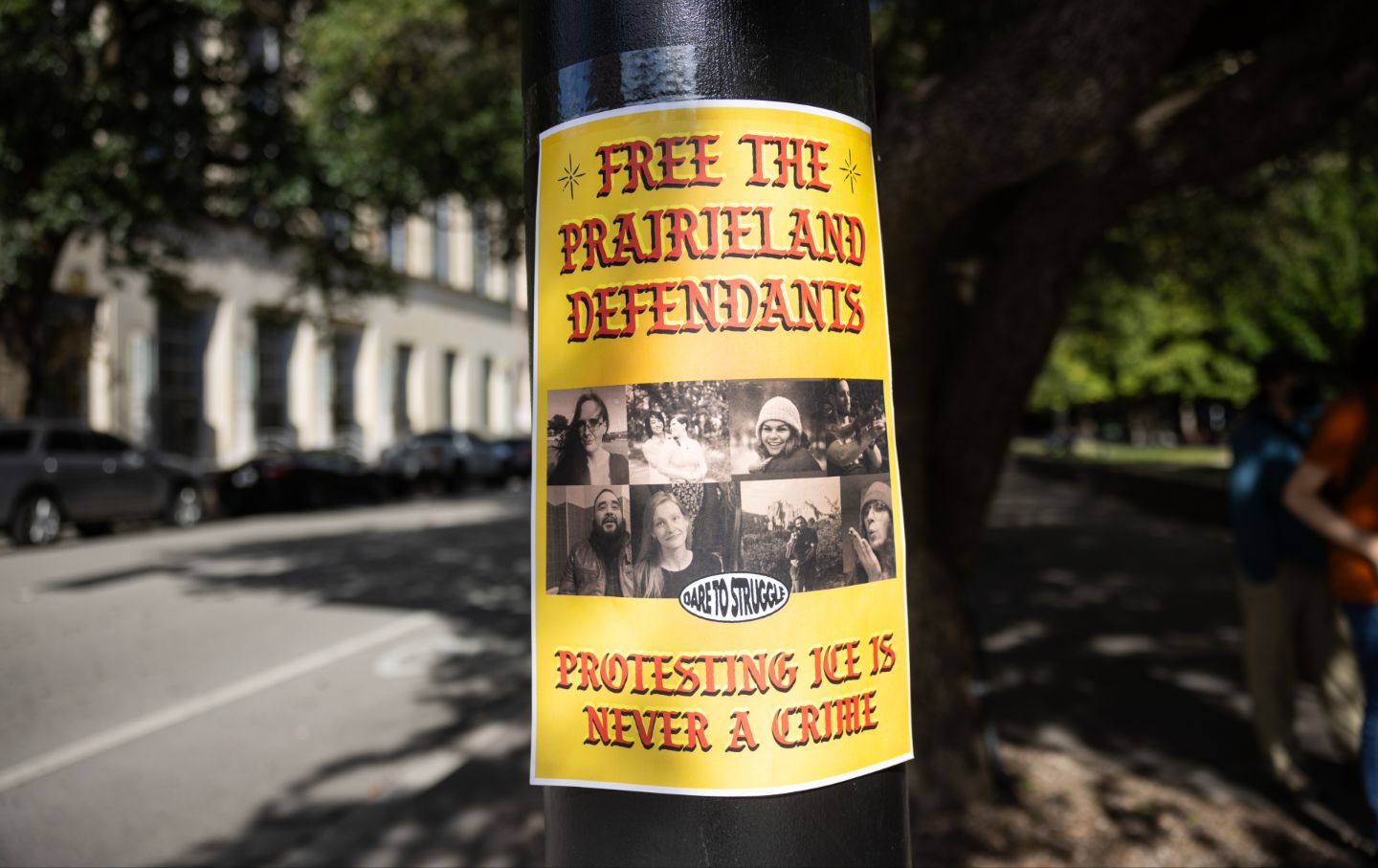
A Message From Prairieland Prisoner Autumn Hill: “Don’t Be Afraid” A Message From Prairieland Prisoner Autumn Hill: “Don’t Be Afraid”
I talked to the political prisoner about the politics of love, her case, surviving as a trans woman in a men’s prison, and how she makes it through the day.

The Impossible Will Take a Little While: The Power of Persistence The Impossible Will Take a Little While: The Power of Persistence
In troubled times, history offers a lesson: Seemingly impossible change can begin with ordinary people who refuse to give up.
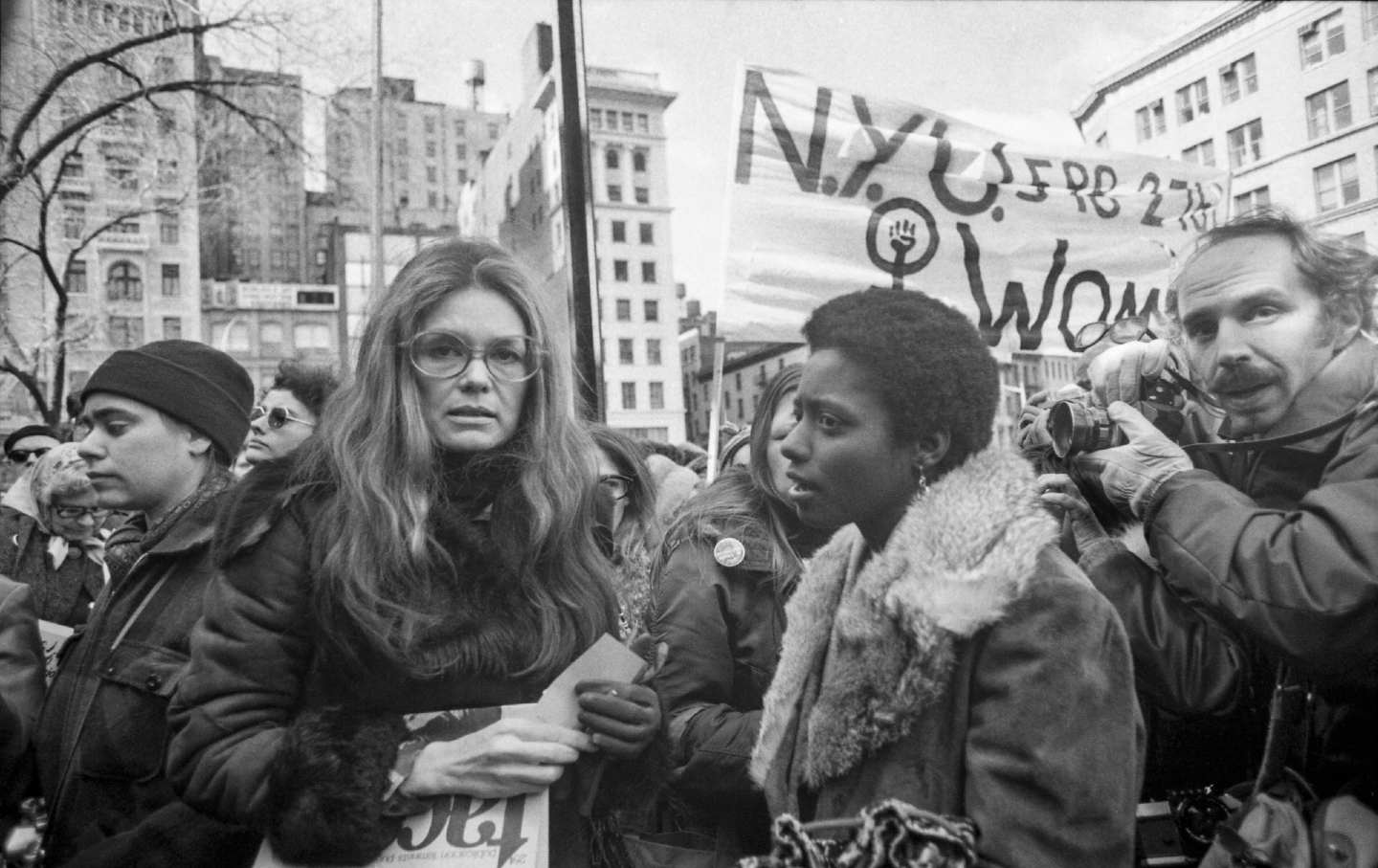
Gloria Steinem’s Many-Splendored Feminist Life Gloria Steinem’s Many-Splendored Feminist Life
The feminist icon lived the struggle for gender equality and always found time to lend support and solidarity to other women leaders, even in her final days.

No, Woke 1 Was Not Crazy No, Woke 1 Was Not Crazy
AOC and others are laughing off 2020 as a wild, isolated moment. None of that is true.

How Occupy Wall Street Still Explains Politics Today How Occupy Wall Street Still Explains Politics Today
It sowed the seeds for a new era of social movements—but its politics of powerlessness should act as a cautionary tale.

