Zohran Mamdani Is Keeping Hope Alive
The doom-obsessed Democratic Party remains as unpopular as ever—but there is another path.
Current American politics is a dismal race between two sinking ships heading to the bottom of the sea. Donald Trump, never a widely loved figure and only president because he positioned himself as the alternative to an unpopular status quo, has again made himself an intensely despised president in record time. As Gallup reported on Thursday:
Six months into his second term, President Donald Trump’s job approval rating has dipped to 37%, the lowest of this term and just slightly higher than his all-time worst rating of 34% at the end of his first term. Trump’s rating has fallen 10 percentage points among U.S. adults since he began his second term in January, including a 17-point decline among independents, to 29%, matching his lowest rating with that group in either of his terms.
One might think that Trump’s hitting near rock bottom in terms of popular support would redound to the benefit of the Democrats, whose entire political strategy (at least as executed by party leaders such as Senator Chuck Schumer and Representative Hakeem Jeffries) is predicated on the belief that all they have to do is wait for Trumpism to collapse in order to win back power.
Yet the more the public hates Trump, the more hostile it also becomes to the Democratic Party. As The Wall Street Journal reported on Friday, a new poll shows that “the Democratic Party’s image has eroded to its lowest point in more than three decades.” The newspaper added “that 63% of voters hold an unfavorable view of the Democratic Party—the highest share in Journal polls dating to 1990 and 30 percentage points higher than the 33% who hold a favorable view.”
It might seem paradoxical that voters are turning against Trump while also becoming much more hostile to the Democratic Party. But this contradiction is easily resolved. The very fact that Trump and his policies are unpopular creates a hunger for an alternative path—one that Democratic Party leaders have sedulously avoided providing, instead offering muted criticism on hot-button topics such as immigration or a plutocracy-enriching budget. If you roll over and play dead, people who know you are only pretending are liable to think you are weak and contemptible.
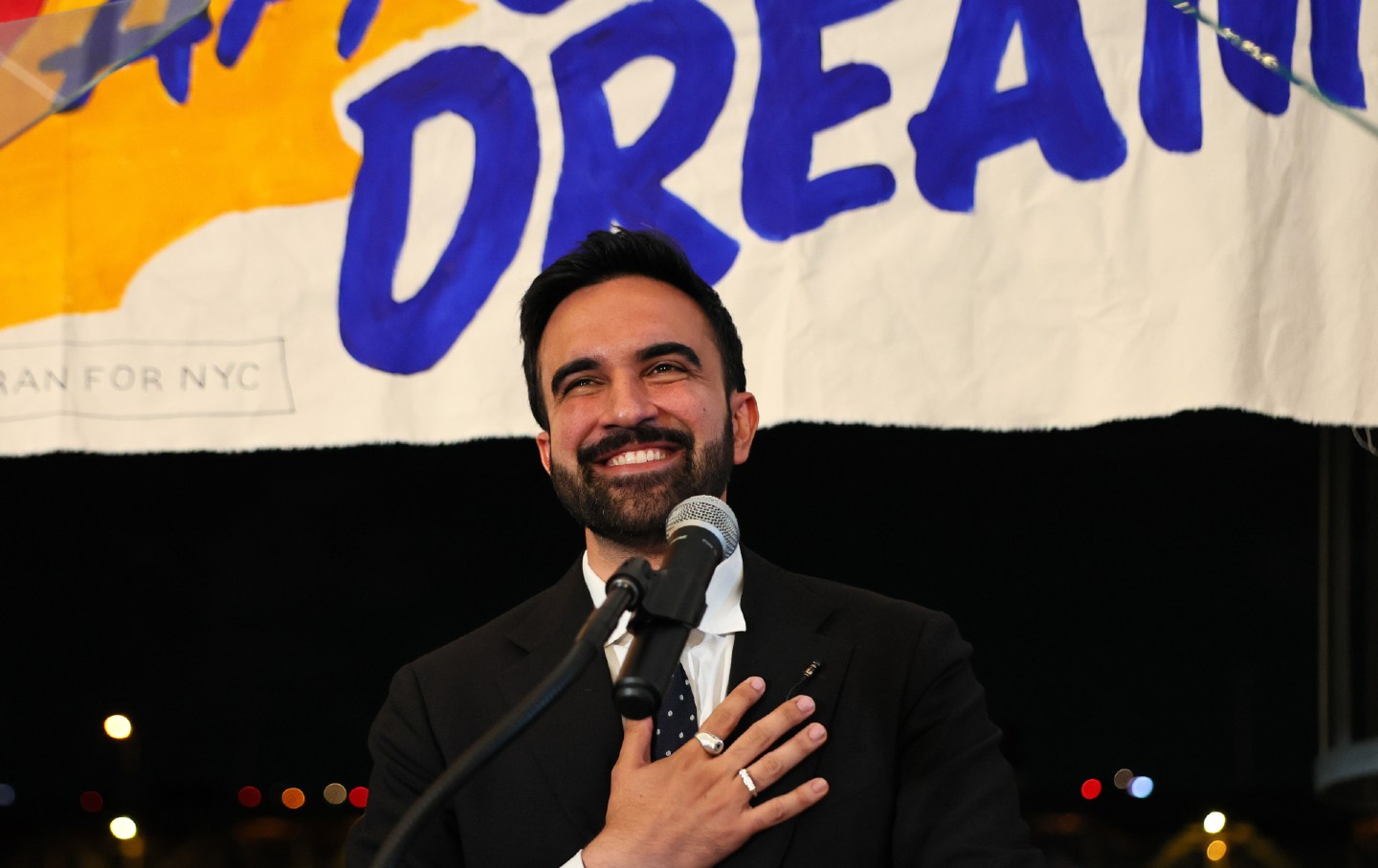
It’s in this context that the emergence of Zohran Mamdani as the Democratic mayoral nominee for New York City offers a much-needed new path. Mamdani ran on a strong message of economic populism that drew in new voters. He performed particularly well among demographics that have been slipping away from the Democratic Party in recent elections: young people (including young Black voters), Latinos, and Asian Americans. Mamdani ran an upbeat campaign heavy on proposals for dealing with the affordability crisis (such as a rent freeze and fare-free buses).
In a recruitment e-mail for the Democratic Socialists of America (DSA), Mamdani wrote, “I couldn’t stomach a system designed to profit off despair, so I joined D.S.A.” Of course, the “system designed to profit off despair” is capitalism, but the phrase also describes the existing two-party system. It’s a striking fact that over the last decade both parties have abandoned any substantively optimistic vision of the future, preferring instead to peddle fear (often realistic fear) about what the other party will do. Donald Trump’s signature phrase “American carnage” (from his first inaugural) encapsulates the dystopian mood of the times.
Meanwhile, the Democratic Party has offered its own variation of “American carnage.” In 2016, Hillary Clinton liked to tell voters, “I’m the last thing standing between you and the apocalypse.” To recall a period when American politicians offered hope rather than competing claims to fend off national disaster, one would have to go back to Barack Obama’s 2008 campaign. The promise of Mamdani’s candidacy is a new politics of hope—but one grounded in a far more concrete economic egalitarianism than Obama either promised or delivered.
Of course, even if Mamdani wins the mayoralty in the fall, his ability to challenge the current downward spiral of American politics will be limited. New York, however large, is only one city, and mayors have limited power. Fortunately, Mamdani isn’t a lone figure but part of an emerging wave of left-wing politicians who are remaking urban America.
Even The New York Times, a newspaper that has often been churlishly hostile to Mamdani, acknowledges that his success is due not just to personal charisma but to an expanding public appetite for economic populism. As reporter Benjamin Oreskes wrote in the Times on Sunday:
The emphasis on Mr. Mamdani’s style overlooks the substance of his progressive message and how the city’s voters came to embrace it, much as voters did in Boston in 2021 and in Chicago two years later.
Those elections, along with recent polling on issues like rent control, wealth taxes and the burden of childcare, suggest that many voters, particularly those in large Democratic-leaning cities, have become more receptive to progressive agendas….
A recent national survey from the Pew Research Center found that about six in 10 adults supported raising taxes on large businesses and households making more than $400,000.
That support has also materialized in voter referendums, even in cities where progressive candidates have stalled.
Winning elections is one part of politics; governing, another. Chicago Mayor Brandon Johnson has faced a backlash for failing to deliver on his ambitious agenda—a problem that can be blamed not just on a hostile media and political establishment but also on his executive skills. However, his Boston counterpart, Michelle Wu, remains popular. If Mamdani wins and governs successfully, he’ll be joining a progressive beachhead forming in urban America. The DSA could continue to grow as an independent organizing power, one offering an alternative model to a Democratic Party establishment that has grown increasingly reliant on wealthy donors. The anger that voters have toward the Democrats itself provides fertile ground for a growing progressive challenge to the party elite—one that could also play a significant role in primaries next year.
Despair is too easy an indulgence in the current moment. Politics requires the promise of a better future—not just a rebuke to a depressing status quo. Mamdani is a reminder that even as Trump and the Democratic Party establishment have rightfully earned the contempt of voters, it still remains urgent and possible to live by the message of Jesse Jackson and “keep hope alive.”
Become a Sustaining Donor This September
Between the reemergence of right-wing red-baiting and Donald Trump’s use of the chilling National Security Presidential Memorandum–7 to criminalize left political organizing, we’re seeing McCarthyism reborn before our eyes.
This assault on democracy cannot be ignored or wished away. Resisting it requires bravery in the face of threats and repression, a steadfast commitment to the truth, and the unwavering belief that we can—and will—overcome this darkness.
We must have an independent media that sets the record straight, unearths corruption and abuses of power, and advances a politics of justice and dignity for all if we’re to win this fight.
That’s why I’m writing to you today. This September, The Nation needs to add 100 monthly donors to sustain our progressive journalism. Your contribution makes the next investigative report, the next truth-speaking column, and the next pathbreaking essay all possible.
I hope you’ll support our work with a recurring donation today. If you donate $10 or more a month, we’ll send you a brand new “Hands Off the Free Press!” sticker to recognise your commitment to our cause. Please, donate today.
Onward,
Katrina vanden Heuvel
Editor and Publisher, The Nation