
Ralph de la Torre: The Making of a Healthcare Oligarch
And the price the rest of us pay—in money and in blood.

Oligarch Watch profiles America’s plutocrats who are wielding their wealth and power to further enrich themselves at the expense of workers, communities, and the environment. Penned by longtime economic researcher and campaigner Chuck Collins, a leading thinker and writer on inequality in America, the new monthly column will crisscross industries and centers of power in the US, tackling oligarchy in action to spotlight the crushing monopoly power these individuals yield, and what it means for the rest of us.
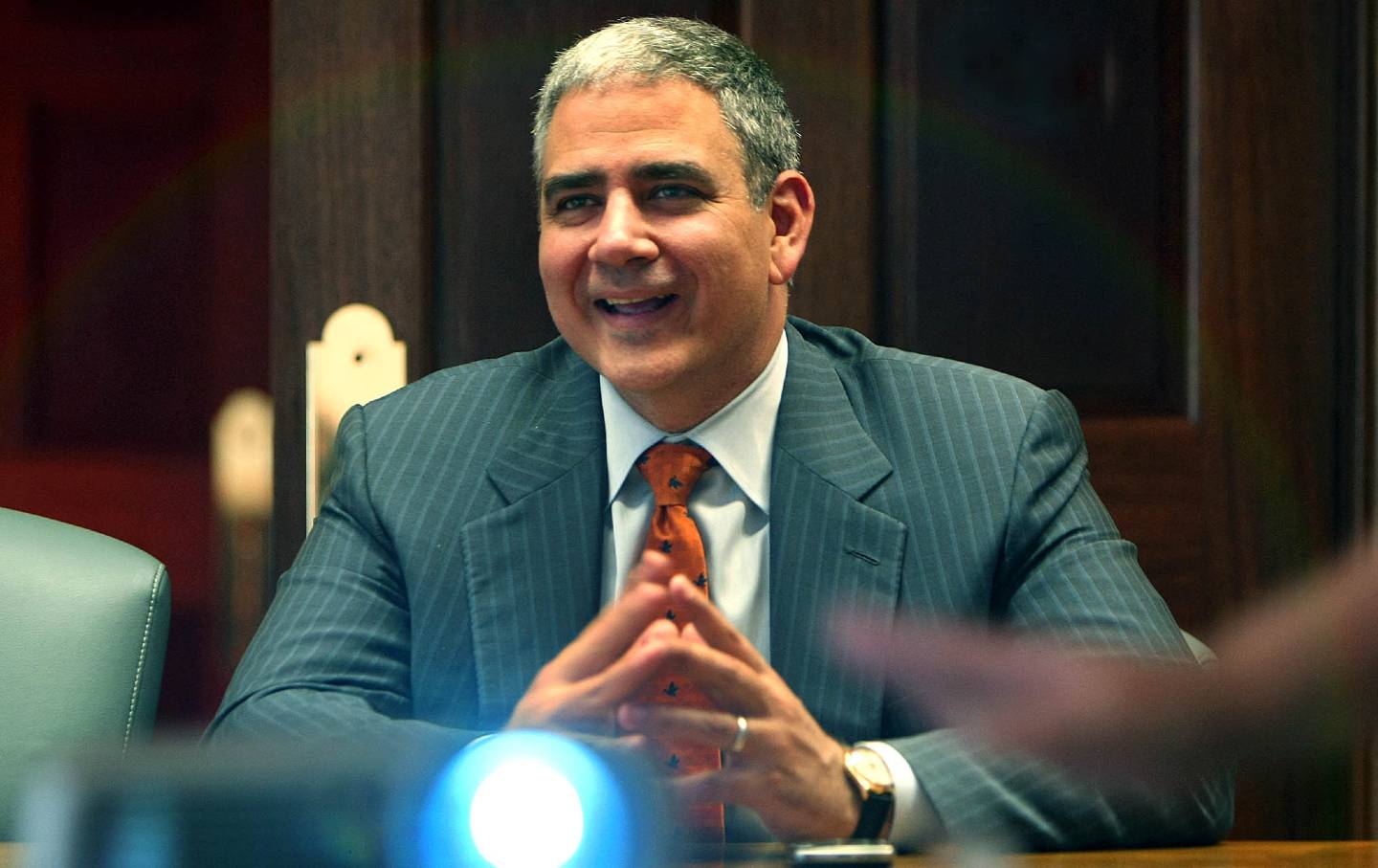
Ralph de la Torre was recently spotted outside a horse barn at the Global Dressage Festival in Wellington, Florida. He was wearing cowboy boots, dark shades, and smoking a cigar, watching his wife Nicole Acosta compete in an elite horse event. But when an investigative reporter from The Boston Globe approached him, he jumped into a pickup truck and sped away.
De la Torre is a cofounder and the former CEO of Steward Health Care, a case study of how a private equity firm can loot a once-vibrant hospital system. De la Torre’s hyper-extraction of wealth from largely financially viable health facilities has fueled hospital bankruptcies and closures in dozens of communities around the United States.
As he lounged in the Florida sunshine, de la Torre was in contempt of Congress for ignoring a subpoena. His trail of destruction ranges from Orlando, Florida, where the formerly Steward-owned Rockledge Hospital is facing closure after years of disinvestment, to Massachusetts, where two hospitals have closed and six are teetering in bankruptcy. And where Governor Maura Healy threatened to take Steward hospitals by eminent domain.
His notoriety even extends to Malta, where authorities are investigating scandalous allegations that Steward’s international arm fraudulently took over the island nation’s main hospital and healthcare system.
The story of Ralph de la Torre is a particularly sordid example of an oligarch pillaging billions from the healthcare system. But it’s also an example of communities fighting back and diligent investigative reporting by the Boston Globe Spotlight team, who were finalists for this year’s Pulitzer Prize for Public Service.
De la Torre, a once-respected cardiac surgeon, was CEO of Caritas Christi, a nonprofit hospital network of six acute-care facilities in eastern Massachusetts. In 2010, facing financial insolvency, de la Torre brought in the private equity fund Cerberus Capital to acquire the hospital system for $246 million from the Roman Catholic Archdiocese of Boston.
To convert a nonprofit hospital to a for-profit entity in Massachusetts required the legal approval of the state’s attorney general, who at the time was Martha Coakley. Coakley approved the hospital sale in 2010 after determining that “all potential conflicts of interest had been sufficiently addressed.” De la Torre lubricated the process with a $5,000 donation to the Massachusetts Democratic Committee in support of Coakley’s run for the US Senate (she eventually lost to Republican Scott Brown, who helped unleash the Tea Party backlash to Obamacare).
Cerberus rebranded its hospital holdings as Steward Health and de la Torre was CEO. In 2011, it purchased two additional hospitals in Taunton and Quincy, pledging to keep both open for at least 10 years. Three years later—shortly after Coakley lost her bid for governor—they closed the Quincy hospital.
Taking a page from the private-equity wealth-extraction playbook, Cerberus sliced and diced the health system’s assets, squeezed operations—and paid itself enormous fees. Steward sold off land and buildings for $1.2 billion to a closely affiliated real estate investment trust called Medical Properties Trust (MPT). Loading the company with debt and steep rental payments, Steward began to pay rent on real estate the hospitals had previously owned.
In 2017, Cerberus further expanded the Steward network, purchasing additional hospitals to build the largest for-profit hospital system in the US with 37 hospitals in 10 states. Cerberus sold Steward in 2020, extracting an estimated $800 million for their decade of ownership. The sale to a physician’s group was made possible with $335 million in flexible financing from Medical Properties Trust. Shortly after the sale, Steward leaders paid themselves $111 million in dividends.
Within a year, the financial house of cards began to topple, as the hospitals could not afford the increased costs of real estate payments, and private fees. The entire Steward network of hospitals plunged into bankruptcy, with the largest debt owed to MPT, the subsidiary that once owned its properties.
In one case, medical services at Steward’s Carney hospital became so diminished that patients and staff referred to it as “Carnage Hospital.” A group of medical residents urged the graduate education accreditation agency to shut down Carney’s faltering residency program.
Even with Steward on the brink, De la Torre was recklessly using Steward assets to purchase luxury items, give personal status-enhancing charitable gifts, and line his own pockets. Steward’s founder also paid himself tens of millions in compensation, purchasing a 190-foot yacht worth $40 million and 90-foot $15 million sportfishing boat. He also owns a 11,108 square-foot Dallas mansion, valued at $7.2 million, in the exclusive Preston Hollow neighborhood, with neighbors such as George W. Bush and Mark Cuban.
In 2023, de la Torre made a $100,000 donation to two charities, including the Dallas Museum of Art. This allowed him, his wife, Nicole, and several guests to occupy a Diamond Table at the museum’s charity gala and rub elbows with other Texas oligarchs, including Jerry Jones, owner of the Dallas Cowboys. De la Torre then reimbursed himself for the donation from Steward Health Care.
Days before the Dallas gala event, a 39-year old new mother named Sungida Rashid entered Steward’s hospital in Boston’s Brighton neighborhood with a bleed deep in her liver, requiring she be treated with an embolism coil. But because Steward had stiffed the vendor, the coils had been repossessed, meaning none were available for Rashid, who died shortly after.
The Boston Globe Spotlight team tracked de la Torre’s multiple private-jet trips to Costa Rica, where he owns three luxury properties. They also documented a few self-serving charitable donations that de la Torre represented as coming from him personally, but which were reimbursed by Steward. For example, after moving the company and himself to Dallas, de la Torre donated $10 million to create a science center at his kid’s private school in honor of his mother—with funds from Steward Health Care. The school then hired a construction company in which de la Torre had a 40 percent ownership stake—a form of self-dealing with company money.
In May of 2024, Steward Health declared bankruptcy, a development that has jeopardized healthcare services at Carney and seven other Massachusetts hospitals. A year ago, Massachusetts state officials proposed to take over the hospitals by eminent domain.
Popular
“swipe left below to view more authors”Swipe →Among its bankruptcy creditors, Steward owes more than $7 billion to Medical Property Trust, the entity that owns the real estate and land under its hospitals, along with $2 billion to other lenders and contractors they stiffed.
Meanwhile, investors like Cerberus have long since exited the scene, taken their fees, and moved on. De la Torre resigned as CEO of Steward in October 2024, but has continued to jet around the globe and attend horse events. Upon his return from a Caribbean scuba vacation in the fall of 2024, federal agents served him with a search warrant and seized his phone.
As part of an investigation into Steward Health Care, US Senator Ed Markey (D-MA) commissioned a report that reviewed 55 studies of the impact of private equity on the healthcare industry. The study found that “across the outcome measures, [private equity] ownership was most consistently associated with increases in costs to patients or payers. Additionally, PE ownership was associated with mixed to harmful impacts on quality.” These harms included 32 percent higher costs to patients and insurers, lower staff-to-patient ratios, and patients’ suffering 25 percent more hospital-acquired complications.
Will de la Torre ever be held accountable for the harm he has caused? Federal prosecutors are exploring charges against him for potential embezzlement and fraud in the United States—and international charges of corruption and bribery under the Foreign Corrupt Practices Act. Fortunately for de la Torre, President Trump, the oligarch in chief, issued an executive order in February freezing new prosecutions and enforcement actions under the FCPA.
Private-equity oligarchs like de la Torre are sucking community health systems dry, leaving residents without health providers while the government struggles to clean up the wreckage. Communities and hospital workers have repeatedly organized protests attempting to protect their hospitals and patients. But until oligarchs like de la Torre face jail time, they will continue to take the money and run—or fly off on their jets, or cruise away on their yachts.
Become a Sustaining Donor This September
Between the reemergence of right-wing red-baiting and Donald Trump’s use of the chilling National Security Presidential Memorandum–7 to criminalize left political organizing, we’re seeing McCarthyism reborn before our eyes.
This assault on democracy cannot be ignored or wished away. Resisting it requires bravery in the face of threats and repression, a steadfast commitment to the truth, and the unwavering belief that we can—and will—overcome this darkness.
We must have an independent media that sets the record straight, unearths corruption and abuses of power, and advances a politics of justice and dignity for all if we’re to win this fight.
That’s why I’m writing to you today. This September, The Nation needs to add 100 monthly donors to sustain our progressive journalism. Your contribution makes the next investigative report, the next truth-speaking column, and the next pathbreaking essay all possible.
I hope you’ll support our work with a recurring donation today. If you donate $10 or more a month, we’ll send you a brand new “Hands Off the Free Press!” sticker to recognise your commitment to our cause. Please, donate today.
Onward,
Katrina vanden Heuvel
Editor and Publisher, The Nation
More from The Nation

As Morale Sags, More Military Service Members Are Having a Crisis of Conscience As Morale Sags, More Military Service Members Are Having a Crisis of Conscience
According to multiple GI rights organizations, service members are inquiring in unprecedented numbers about seeking conscientious objector status.

What Remains of Riis? What Remains of Riis?
A new members’ club has revived Riis Park’s long-vacant bathhouse, reopening old questions about whom the People’s Beach is really for.

When Texas Sex Ed Falls Short, Gen Z Women Turn to Social Media When Texas Sex Ed Falls Short, Gen Z Women Turn to Social Media
A 2025 study found that 70 percent of adolescents sought reproductive health information through social media platforms.

Justice for Macklemore Justice for Macklemore
The rapper has been dumped from Ed Sheeran’s tour for saying “free Palestine.” That’s a disgrace.

We Are Living Under Roy Cohnian Logic We Are Living Under Roy Cohnian Logic
The political fixer created a career for himself as a self-promoting, ubiquitous hustler. Like Trump, he got away with it by having the right friends.

Time Has Run Out for AI Risk Deniers Time Has Run Out for AI Risk Deniers
The recent spate of reports about the technology’s destructive power underline two prime directives: Be afraid, and regulate aggressively.

