Trump and Johnson’s Big Ugly Lie
Last night, the president’s destructive spending bill passed the House by a single vote.
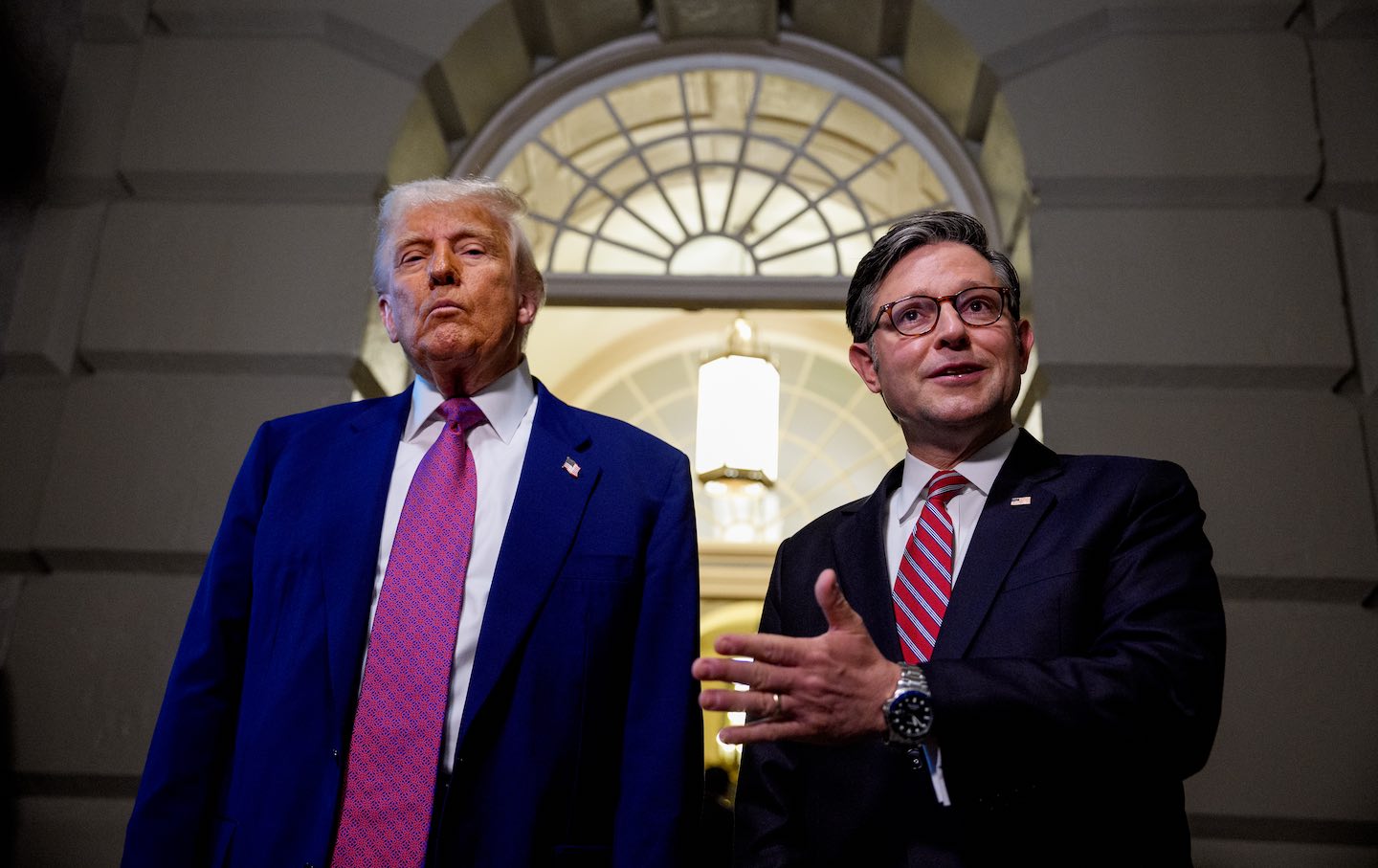
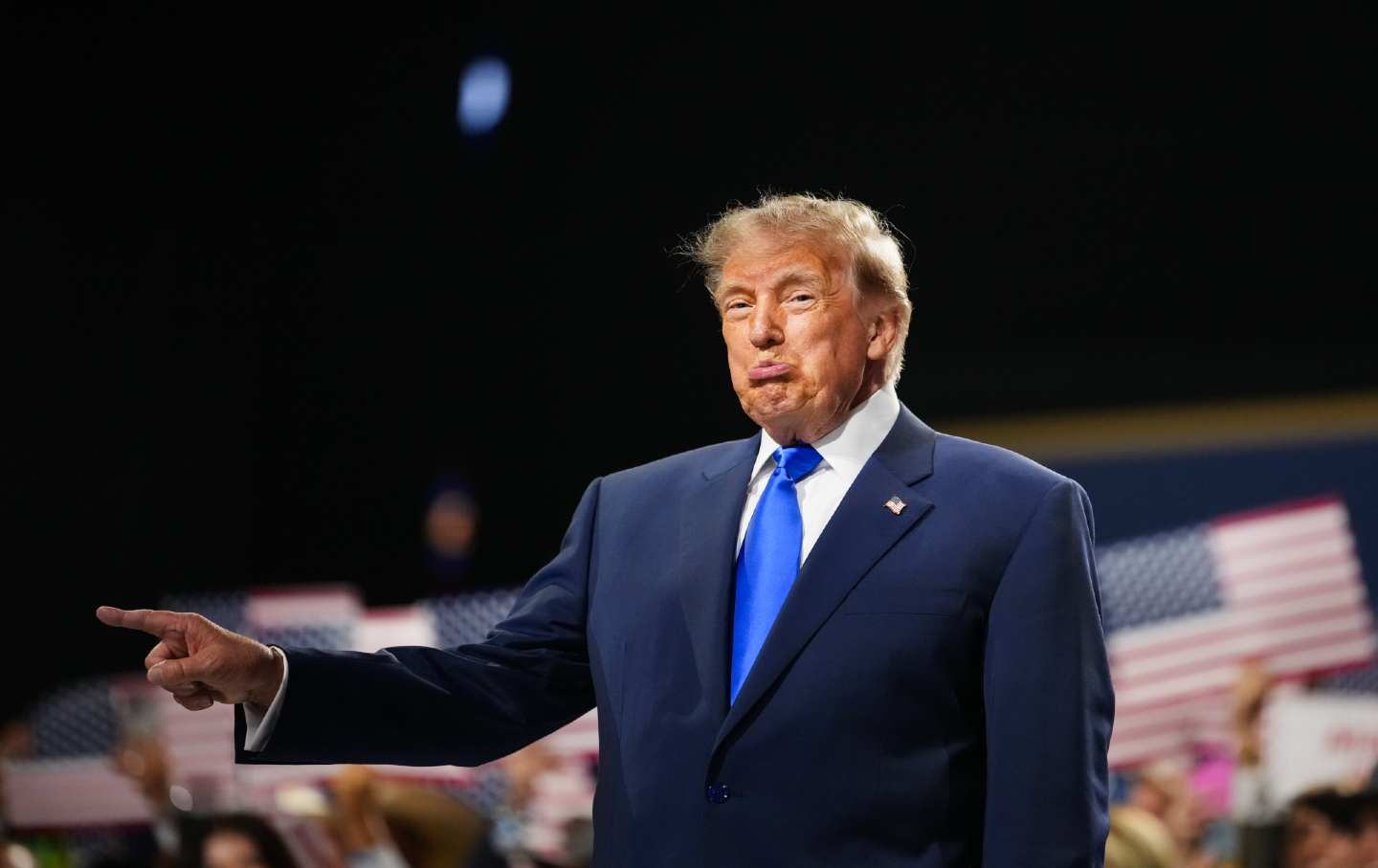
Speaker of the House Mike Johnson and President Donald Trump speak to members of the press as they depart a House Republican meeting at the US Capitol in May.
(Andrew Harnik / Getty Images)It wasn’t quite the dead of night, but in the bleary dawn of Thursday morning, the House GOP conference rallied to pass President Donald Trump’s signature domestic spending bill, by the narrowest of margins, with a vote of 215 to 214. House Speaker Mike Johnson scheduled a floor vote as the first order of business today, after engineering a set of concessions to holdouts seeking to institute work requirements for Medicaid recipients, increase federal tax deductions for payments to state and local governments, and curb clean-energy initiatives under the Inflation Reduction Act. By springing a high-visibility timeline on the vote, Johnson had effectively dared the spending hawks in and around the House Freedom Caucus to dissent from the MAGA party line under maximum conditions of publicity. Predictably, they caved; just two spending hard-liners, Thomas Massie of Kentucky and Warren Davidson of Ohio, voted no, while two others didn’t vote. Freedom Caucus chair Andy Harris of Maryland voted present—a symbolic, but empty, gesture of dissent.
The legislation, which House sponsors officially dubbed the Big Beautiful Bill in fealty to Trump, is actually a big ugly lie. The package crams together a lavish tax cut to the wealthiest Americans with a regressive set of cuts to basic income supports for working Americans—notably $625 billion in reduced Medicaid benefits over the next 10 years, which would deny coverage to 7.6 million Americans, according to the Congressional Budget Office. Food assistance under the federal SNAP program will also undergo $300 billion in cuts, with cash-strapped state governments expected to pick up the lapsed support. The bill cannily schedules the first wave of cuts to such critical assistance to kick in after the 2026 midterm cycle, in the hopes that off-cycle voters won’t feel the brunt of these massively unpopular rollbacks during campaign seasons. GOP candidates will be able to campaign instead on cynical symbolic features of the package that have almost no redistributive or revenue impact, such as the suspension of taxes on tips and a write-off for automotive loans. (These deductions are also scheduled to phase out at the end of Trump’s presidency, another deeply cynical link to the electoral cycle that budget analysts say hasn’t turned up in past spending deals.)
When you look beyond such cosmetic frippery, the bill enacts the largest upward redistribution of wealth under any piece of legislation in American history, with some $4 trillion in projected tax cuts. It makes the already regressive tax cuts enacted under Trump’s 2017 spending program permanent: Two-thirds of the additional $2.5 trillion in tax cuts will accrue to people in the top quintile of taxpayers, earning at least $217,000; one-fourth will go to the top 1 percent, who make $1 million or more, according to the nonpartisan Tax Policy Center. Meanwhile, in 2026—the first year the bill goes into effect—the bottom quintile of earners, who make $17,000 a year or less—will see their after tax income decline by $1,035; that figure will increase to $1,405 by 2030, according to an analysis from the nonpartisan Penn Wharton Budget Model. (The comparable figure for the very top earners, the 0.1 percent making more than $4 million a year, is an after-tax increase in their incomes of $389,280.)
Republicans are also dishonestly touting the spending cuts under the plan as essential measures of fiscal discipline. In reality, the measure locks in a $3 trillion boost to the federal deficit over the next decade, while expanding the debt ceiling—the artificial mechanism to bolster increased deficit spending—by $4 trillion. As these numbers sank in, the credit rating agency Moody’s downgraded the United States’ triple-A rating for the first time, concluding that the country is deeply unserious about its spending deficits.
Republican lawmakers have dismissed that move, citing the prospect of enhanced overall economic growth as a likely palliative to the fiscal impact of the bill. But that’s what deluded supply-siders always claim about steep tax cuts, and the evidence has yet to bear them out; indeed, the investment markets—which had already administered severe discipline to Trump’s incoherent tariffs offensive—have already swooned in response to the same figures that sent the Moody analysts into bear mode.
This regressive tax scheme is also accompanied by a draconian new set of MAGA border measures, with $150 billion allocated to the detainment-and-rendition regime erected under this Congress’s first major piece of legislation, the Laken Riley Act. The bill also denies immigrants basic benefits under Social Security and the Affordable Care Act, even though immigrant workers are outsize contributors to both programs. The immigrant crackdown, combined with the seizure of wealth for the top quintile, represents the migration of authoritarian MAGA ideology into the heart of the budget process, creating an artificial scarcity in social benefits that will be used as a brutal means of confining rewards to “real Americans” and inordinately punishing the migrant workers who already contribute unrecognized subsidies to social spending.
The time-limited sops to tip income and car loans serve to shore up the same broken social contract, as does the onetime $1,000 payout to couples with a newborn child. All these measures draw up a MAGA moat around social programs and income supports, promising a meager windfall for US-born kids or borrowers on car titles, while ransacking whatever remains of the American welfare state to underwrite lavish tax cuts to the wealthy that aren’t remotely justified under prevailing economic conditions.
None of this is surprising, and it’s all broadly in line with the regressive economic promises of the 2024 Trump campaign. But in raw political terms, the most brutal takeaway from the debacle wrought by Trump and Johnson is this: It’s a legislative victory fashioned out of the blind gerontocratic drift of Democratic Party politics. The GOP started this congressional session with a five-vote majority; it has since grown to an eight-vote margin, thanks to the deaths of three Democratic House members sworn in as members of the 119th Congress.
The most recent of these was Virginia Representative Gerry Connolly, the 75-year-old ranking member of the House Oversight Committee who announced that he was diagnosed with esophageal cancer just after fending off an insurgent challenge from the left for the Oversight post from the young New York Representative Alexandria Ocasio-Cortez. Had he lived out the week, Connolly could have furnished a key vote against this gruesome and predatory bill—one that might well have helped to defeat it. Instead, Connolly’s death is a grim replay of Joe Biden’s parallel heedless and harmful death grip on power; like that now-infamous episode that helped seal Trump’s reelection, it’s a Democratic-brokered depth charge that set a deeply unpopular and reactionary marquee bill of the MAGA right on course to passage. And with a pending roster of 70-and-over Democrats cruising on autopilot into the next election cycle, Trump, Johnson, and their allies can likely continue banking on assists from the Grim Reaper in future legislative showdowns.
Become a Sustaining Donor This September
Between the reemergence of right-wing red-baiting and Donald Trump’s use of the chilling National Security Presidential Memorandum–7 to criminalize left political organizing, we’re seeing McCarthyism reborn before our eyes.
This assault on democracy cannot be ignored or wished away. Resisting it requires bravery in the face of threats and repression, a steadfast commitment to the truth, and the unwavering belief that we can—and will—overcome this darkness.
We must have an independent media that sets the record straight, unearths corruption and abuses of power, and advances a politics of justice and dignity for all if we’re to win this fight.
That’s why I’m writing to you today. This September, The Nation needs to add 100 monthly donors to sustain our progressive journalism. Your contribution makes the next investigative report, the next truth-speaking column, and the next pathbreaking essay all possible.
I hope you’ll support our work with a recurring donation today. If you donate $10 or more a month, we’ll send you a brand new “Hands Off the Free Press!” sticker to recognise your commitment to our cause. Please, donate today.
Onward,
Katrina vanden Heuvel
Editor and Publisher, The Nation