
Why US Engagement Is Essential in Setting Terms for Peace in Ukraine
The Russian and Ukrainian positions are far apart, and absent US sticks and carrots, there seems little prospect they will come together.
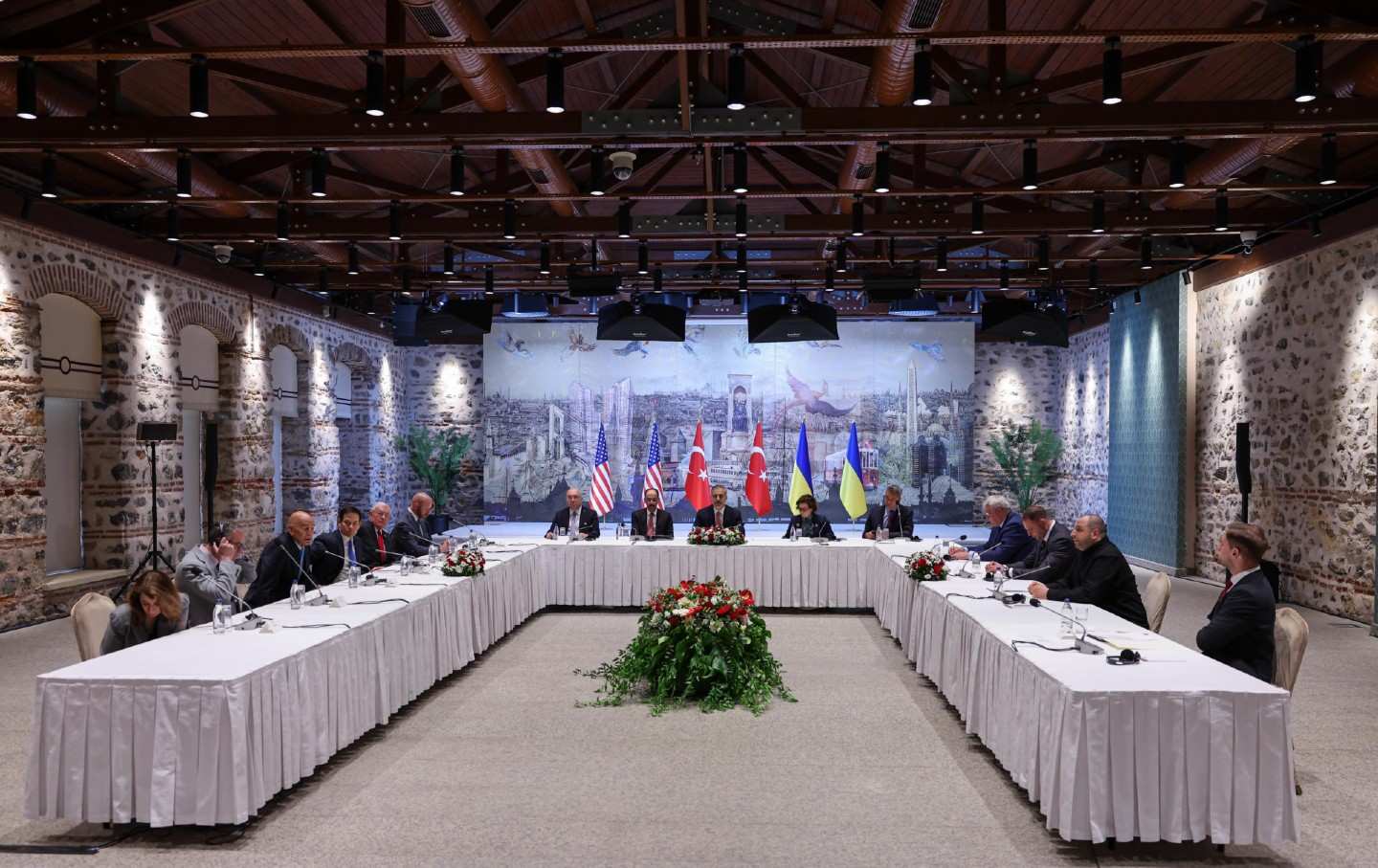
President Trump’s new strategy of getting Russia and Ukraine to negotiate directly might seem to make sense. In the end, after all, they will have to sit down together to sign any agreement that can be reached. Without active US involvement, however, that end is likely to be postponed for a very long time; and as Trump has said, that time will be measured not just in months or years, but in tens of thousands of human lives.
The Russian and Ukrainian positions are far apart, and absent US sticks and carrots applied to both, there seems little realistic prospect that they will come together. US engagement is also essential because a new relationship between the United States and Russia is the greatest incentive that Moscow can be offered in return for making peace with Ukraine.
As a European, I say this with deep regret, but until the basic shape of a peace settlement has been worked out, the European Union should be left out of the process. European positions are totally incoherent. European governments, media, and think tanks say that Putin is playing for time, because the war is going Russia’s way; but they themselves seem determined to keep the war going (and some of them have said quite openly that the purpose is to keep Russia pinned down in Ukraine, irrespective of the cost in Ukrainian lives and territory).
They call for additional pressure on Russia to make peace, but they either refuse to set out concrete peace terms, or set terms that essentially constitute Russian surrender and that there is no chance whatsoever that even the most moderate members of the Russian establishment could accept. They call for additional EU economic sanctions on Russia and increased European military aid to Ukraine if US aid is withdrawn, but other articles in the very same publications admit that sanctions so far have failed, and that the EU cannot in fact replace US aid in key areas.
For the Trump administration to bring the two sides to peace, it will have to do something that it has not really done so far: develop a set of detailed conditions that it regards as reasonable and practicable and a strategy for bringing the parties to agree to them. To craft this strategy effectively, it is essential to realize that a debate is taking place in the Russian establishment over Ukraine strategy; and while Putin of course will in the end be the one to decide, it does not appear that he has made up his mind yet between the various positions. This is something that has been completely obscured in Western media and think tank “analysis” by the portrayal of the Russian establishment as a monolith totally subservient to and identical with “Putin.”
There are two main camps when it comes to Ukraine in the Russian establishment (though each of them contains several different elements that differ according to the specific issue). Broadly speaking, the first aims at the complete defeat and subjugation of Ukraine, including its disarmament, the replacement of its government. Its members believe that if Russia continues the war—if necessary for years—Ukraine will collapse, and these aims can be achieved.
This hard-line camp has not only given up any hope of improved relations with the West but it also actively welcomes Western sanctions and isolation from the West, believing that this encourages Russia to develop its own economy. Adherents of this view are strongly influenced by the strands of Russian nationalism that view Russia as its own civilization and separate identity.
The second camp believes that Russia can gain great advantages from a reconciliation with the United States and, thereafter, with Europe. Its adherents are highly skeptical that complete military victory is possible, and do not think that fighting on to conquer a few more ruined and depopulated Ukrainian cities is worth the cost and risk to Russia. They are therefore prepared to accept the US proposal for a ceasefire along the existing battlefront, and that Ukrainian disarmament should be limited to long-range missiles.
They are deeply troubled by the prospect that long-term isolation from the West will lead to subservience to China. These people are descended from the tradition that sees Russia as part of Western civilization, albeit an autonomous one with its own particular identity and interests. It is however vital to understand that like “Westernizers” in the Russian state service of the 18th and 19th centuries, adherents of this view are also patriots devoted to the idea of a strong Russia. They advocate compromise with Washington and Kyiv, not the de facto Russian surrender that is still being demanded by the EU.
Assuming that Putin has not made up his mind between these two positions, then clearly a central part of US strategy must be to present a combination of pressures and incentives that will weaken the first camp and strengthen the second one. The pressure obviously consists of continued US military and intelligence aid to Ukraine, and sanctions against Russia. Without corresponding incentives however, all this pressure will do is to strengthen the Russian hard-liners, who—as stated—actually welcome isolation from the West.
The incentives that the US administration can offer to Russia consist of sanctions relief, and the reopening of trade with Russia. Even if the Europeans do not initially agree to this, without US participation their sanctions would be far less effective. Washington can also offer a bar on US military deployments in Poland, the Baltic States, and Romania, a veto on all further NATO expansion, negotiation of new nuclear arms treaties, and some form of institutionalized consultation mechanism on European security.
In return, the US administration should require that Russia drop or heavily qualify those demands on Ukraine that are clearly impossible for any Ukrainian government to accept: notably, that Ukraine should withdraw from further territory, reduce its armed forces to a level where they could not defend the country, and suppress a range of Ukrainian national groups and symbols. The United States can, however, quite justly agree with the need for Ukrainian constitutional guarantees of Russian language and cultural rights in Ukraine.
If Russia refuses these terms, then the war will continue. If Moscow can be brought to accept them, then the US should present them to the Ukrainian government and give it the choice of accepting them or fighting on without US support. This may seem harsh, but it is a great deal less harsh than what Ukraine would face in the event of Russian victory; and as everyone now seems to agree, time is on Russia’s side.
Become a Sustaining Donor This September
Between the reemergence of right-wing red-baiting and Donald Trump’s use of the chilling National Security Presidential Memorandum–7 to criminalize left political organizing, we’re seeing McCarthyism reborn before our eyes.
This assault on democracy cannot be ignored or wished away. Resisting it requires bravery in the face of threats and repression, a steadfast commitment to the truth, and the unwavering belief that we can—and will—overcome this darkness.
We must have an independent media that sets the record straight, unearths corruption and abuses of power, and advances a politics of justice and dignity for all if we’re to win this fight.
That’s why I’m writing to you today. This September, The Nation needs to add 100 monthly donors to sustain our progressive journalism. Your contribution makes the next investigative report, the next truth-speaking column, and the next pathbreaking essay all possible.
I hope you’ll support our work with a recurring donation today. If you donate $10 or more a month, we’ll send you a brand new “Hands Off the Free Press!” sticker to recognise your commitment to our cause. Please, donate today.
Onward,
Katrina vanden Heuvel
Editor and Publisher, The Nation
More from The Nation
Israel’s Election Can’t Fix What Netanyahu Broke Israel’s Election Can’t Fix What Netanyahu Broke
The fundamental problem is not the name of the prime minister, but rather the actions of the Israeli government and the urgent issues that need to be addressed.
The AfD’s Rise Isn’t Just About East Germany The AfD’s Rise Isn’t Just About East Germany
The Alternative für Deutschland has a stable national poll lead, including in the former West Germany. Its rise owes to much more than Eastern grievances.
Chinese Development Is the Betrayal Washington Cannot Forgive Chinese Development Is the Betrayal Washington Cannot Forgive
The prospects for Xi Jinping’s visit are dim because American leaders are blaming China for the failures of globalization.

Pinochet: The Verdict of History in the Letelier-Moffitt Case Pinochet: The Verdict of History in the Letelier-Moffitt Case
An act of international terrorism on the streets of Washington, DC, still reverberates 50 years later.
How to Arrest Benjamin Netanyahu How to Arrest Benjamin Netanyahu
Make no mistake: The United States can seize Netanyahu for crimes under US law and prosecute him in US courts when he is in New York City this week.
In the Age of AI, Nuclear Weapons Abolition Is a Renewed Imperative In the Age of AI, Nuclear Weapons Abolition Is a Renewed Imperative
As long as we have nuclear weapons, the job of ending humanity will continue to be as easy as the push of a button—or an AI agent hacking into a nuclear command-and-control system...

