The DNC’s Latest Feud Is an Exercise in Futility
Democrats are acting more like a bickering political science department than an opposition party.
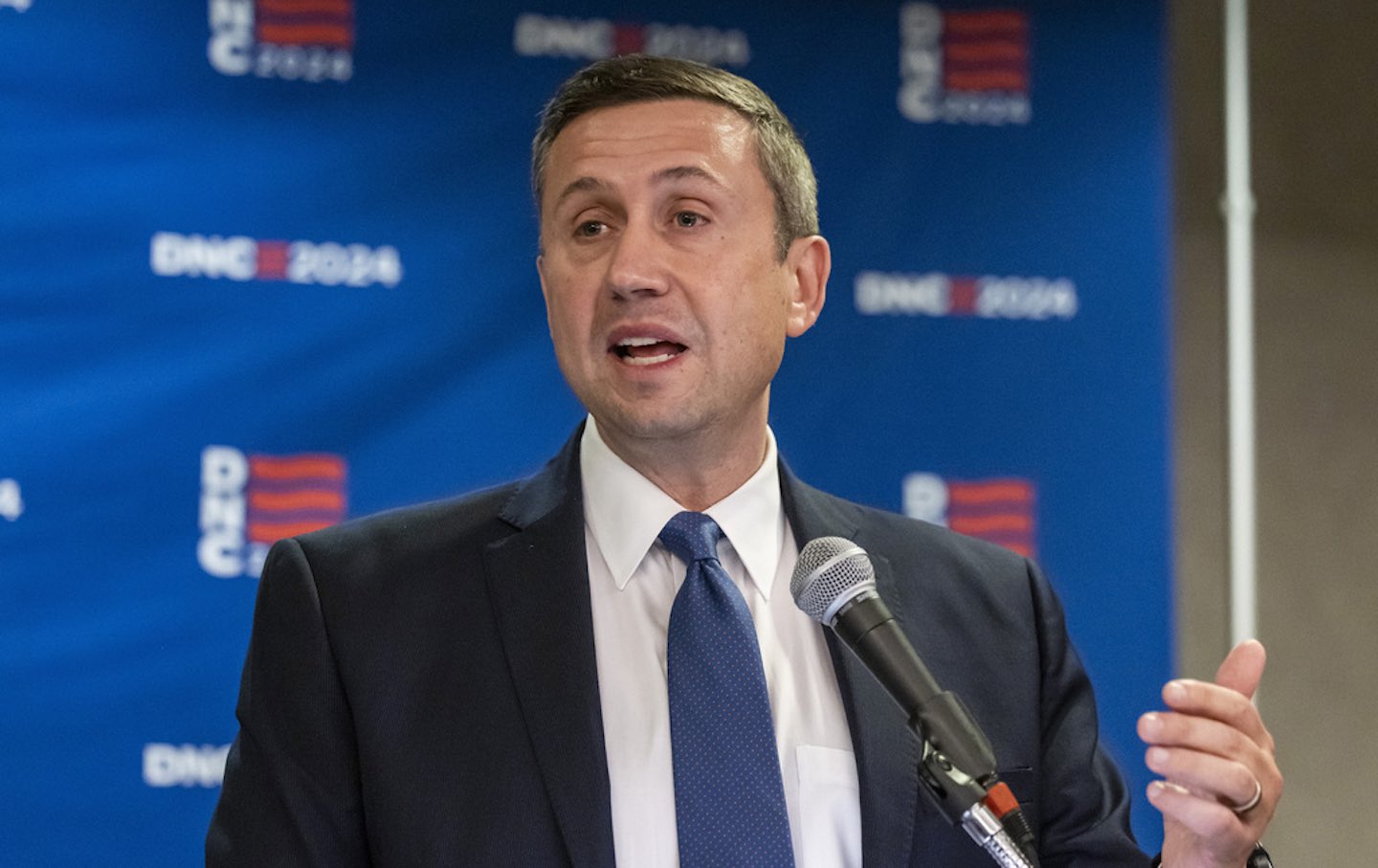
Ken Martin, chair of the DNC, speaks to reporters during a press conference.
(Ashlee Rezin / Chicago Sun-Times via AP, File)
As the political press lit up last week with new revelations about the extent of former President Joe Biden’s physical and cognitive decline, the Democratic Party moved with alacrity to bolster the conditions that enabled Biden to dodder his way into a second Trump term. In the wake of the 2024 election debacle, seemingly chastened party leaders flirted with the idea of adopting a new set of electoral appeals; as a result, members of the Democratic National Committee voted in February to designate a pair of up-and-coming young activists, David Hogg and Malcolm Kenyatta, to vice-chair slots. Hogg, a 25-year-old survivor of the 2018 Parkland school shooting, has called for Democrats to recruit younger candidates and rethink many of the party’s status-quo positions to reverse its plummeting appeal among young white men and other low-propensity voters; Kenyatta, a 34-year-old African American state lawmaker from Pennsylvania, likewise seemed to embody a welcome youth movement within a Democratic Party in desperate need of a relevance reboot.
But the Democrats’ dalliance with youth-minded reform lasted all of three months—about as long as one of Trump’s tariffs. The DNC voted on May 12 to void the election of Hogg and Kenyatta, citing an alleged breach in parliamentary protocol. Kalyn Free, a 61-year-old candidate for vice chair, filed a complaint arguing that, in combining two questions before committee members into a single vote, the balloting for Hogg and Kenyatta sidestepped committee rules on gender diversity. In voting to sustain Free’s complaint—which was borne out by the rushed February vote—the DNC set the stage for a new election for the Hogg and Kenyatta seats.
It’s doubtful that this procedural showdown would have happened at all if Hogg hadn’t announced his intention to primary Democratic incumbents with younger rivals via his political action committee, Leaders We Deserve. The idea that one of the DNC’s youth-minded officials was determined to have young candidates target the seats of incumbents in safe blue districts proved too much for the party’s brain trust—and it certainly didn’t help that Hogg, a tireless self-promoter, had used his election to the committee to fundraise for his PAC. DNC chair Ken Martin, who’d earlier attempted to still restive economic populists in the party with his praise for “good billionaires,” contended that Hogg’s plan compromised his standing as an impartial party official; when the DNC bylaws didn’t seem to support that claim, he moved to amend them to force Hogg to take a pledge of neutrality. In other words: Democratic leaders have tried one procedural feint after another to sideline Hogg and his criticisms of the party status quo.
The most dismaying takeaway from the present leadership battle, apart from the marquee generational conflict, is that after a decade’s worth of failed initiatives targeting Donald Trump with procedural and legal complaints, Democrats remain ruinously committed to the same form of process politics in overseeing internal party business. Rather than engaging with Hogg’s plan on the merits—which, for the record, aren’t self-evident—Martin and his lieutenants seek out telltale evidence of rule-breaking to justify a procedurally mandated do-over. As some critics have noted, this reflex, combined with the call for enhanced gender equity at the managerial level, is all but designed to play into right-wing caricatures of liberal fecklessness in a moment of political crisis. It’s also an ungainly look for a party that enforced an omertà on calling out Biden’s obvious unfitness for a second term on pain of professional isolation.
Equally damning is the closest analog to this model of power distribution and decision making in American institutional life: the woebegone groves of academe. As a recovering former graduate student married to a professor, I followed the DNC showdown with a sickening sense of recognition. It showcased the same patronizing, passive-aggressive clamor for maximum symbolic authority and insulation from conflict you typically encounter in a departmental hiring committee or a vote to endorse a faculty senate resolution—complete with professorial éminences grises seeking to secure a monopoly on acceptable dissent in what is otherwise an absolute vacuum of actual social power.
The Democratic wonk elite is a professariat outfitted for public-sector rule, and it has long dictated the Democrats’ neoliberal policy agenda, from trade policy to fealty to Silicon Valley to privatized school reform. From the 1990s on, the Democrats’ anointed wonk leadership caste has presided over a steady retreat from social-democratic policy aims while dismissing holdouts and skeptics as retrograde merchants of anger, bigotry, and worse. There’s a distressing we-know-better through line in the presidencies of Bill Clinton, Barack Obama, and Joe Biden, and the candidacies of Hillary Clinton and Kamala Harris. They have all evinced a proud allegiance to the dictates of market-driven realism, while decrying the uninformed “anger” and “resentment” of rival movements for power. To distance themselves from the “politics of division,” wonk leaders typically invoke a gauzy, managerial vision of a higher American unity. In her 2018 campaign memoir, What Happened, Hillary Clinton laid out this word-picture in language that could be easily pasted into a Kennedy School syllabus–or intoned from a Davos lectern:
One of the most important but least recognized facts in American politics is that Republicans tend to win in places where more people are pessimistic or uncertain about the future, while Democrats tend to win where people are more optimistic. Those sentiments don’t track neatly with the overhyped dichotomy between the coasts and the heartland. There are plenty of thriving communities in both blue and red states that have figured out how to educate their workforces, harness their talents, and participate in the twenty-first century economy. And some of the most doom-and-gloom Americans are relatively affluent middle-aged and retired whites—the very viewers Fox News prizes—while many poor immigrants, people of color, and young people are burning with energy, ambition, and optimism.
Even more succinctly, Clinton famously rebuked Bernie Sanders’s angry populist economic agenda with an unbelievably callow rhetorical plea, widely hailed by party leaders and pundits: “If we break up the big banks tomorrow…would that end sexism? Would that end racism?” This, too, was academic liberalism dressed up as a tough-minded political realism. Neither Sanders nor anyone else had suggested that banking reform would achieve such utopian social ends, but Clinton’s riposte distilled the agenda of academic politics in an increasingly corporatized university scene.
Now that the Trump administration is targeting all American universities, and specifically their DEI-related policies—with many US colleges meekly rolling over—it’s long past time for the Democratic Party to recognize that its pivot toward the professariat has been a bust. The Democrats’ recurring identity crisis stems largely from their own self-imposed reticence on matters of class inequality and economic redistribution—and their addiction to the symbolic cultural politics of the academy. There’s obviously no quick single-bullet fix to the Democrats’ electoral plight, or to the rigid gerontocratic makeup of the party leadership–the issue that touched off the Hogg backlash at the DNC. But a good starting point would be to stop running the DNC like a university.
Disobey authoritarians, support The Nation
Over the past year you’ve read Nation writers like Elie Mystal, Kaveh Akbar, John Nichols, Joan Walsh, Bryce Covert, Dave Zirin, Jeet Heer, Michael T. Klare, Katha Pollitt, Amy Littlefield, Gregg Gonsalves, and Sasha Abramsky take on the Trump family’s corruption, set the record straight about Robert F. Kennedy Jr.’s catastrophic Make America Healthy Again movement, survey the fallout and human cost of the DOGE wrecking ball, anticipate the Supreme Court’s dangerous antidemocratic rulings, and amplify successful tactics of resistance on the streets and in Congress.
We publish these stories because when members of our communities are being abducted, household debt is climbing, and AI data centers are causing water and electricity shortages, we have a duty as journalists to do all we can to inform the public.
In 2026, our aim is to do more than ever before—but we need your support to make that happen.
Through December 31, a generous donor will match all donations up to $75,000. That means that your contribution will be doubled, dollar for dollar. If we hit the full match, we’ll be starting 2026 with $150,000 to invest in the stories that impact real people’s lives—the kinds of stories that billionaire-owned, corporate-backed outlets aren’t covering.
With your support, our team will publish major stories that the president and his allies won’t want you to read. We’ll cover the emerging military-tech industrial complex and matters of war, peace, and surveillance, as well as the affordability crisis, hunger, housing, healthcare, the environment, attacks on reproductive rights, and much more. At the same time, we’ll imagine alternatives to Trumpian rule and uplift efforts to create a better world, here and now.
While your gift has twice the impact, I’m asking you to support The Nation with a donation today. You’ll empower the journalists, editors, and fact-checkers best equipped to hold this authoritarian administration to account.
I hope you won’t miss this moment—donate to The Nation today.
Onward,
Katrina vanden Heuvel
Editor and publisher, The Nation