Pope Leo XIV Sent an Unmistakable Signal About His Commitment to Social Justice
The new pope has taken a name that recalls Pope Leo XIII, who wrote the outline for modern Catholic social justice teaching.
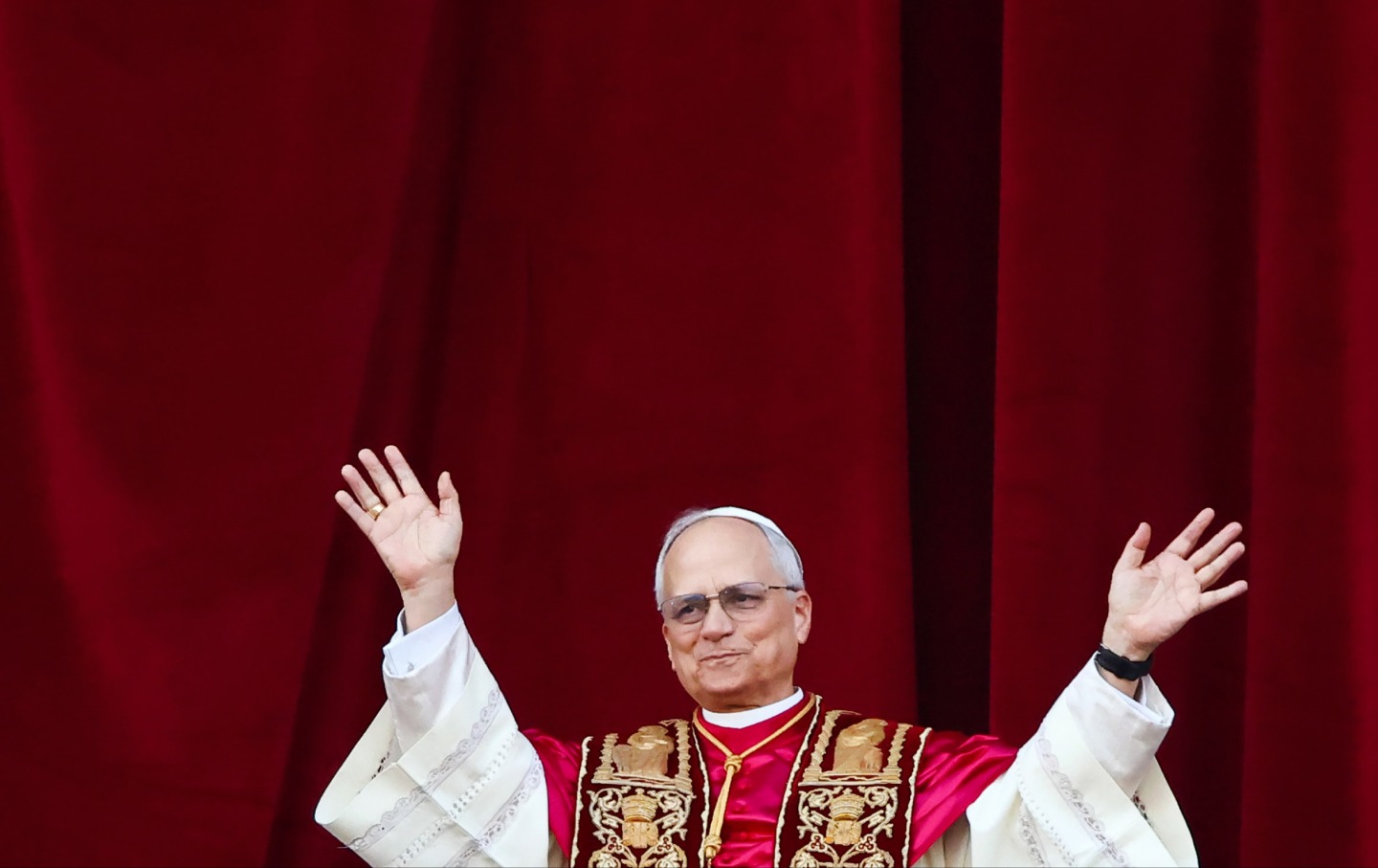
Pope Leo XIV at the Vatican on May 8, 2025.
(Beata Zawrzel / NurPhoto via Getty Images)Pope Leo XIII, the leader of the Catholic Church from 1878 to 1903, came to be known as ”The Pope of the Workers” because of his groundbreaking 1891 encyclical on the Rights and Duties of Capital and Labor, which provided the outline for modern Catholic social justice teaching. Taking its name, Rerum Novarum, from the Latin phrase for “of revolutionary change,” the encyclical recognized that a “remedy must be found quickly for the misery and wretchedness pressing so unjustly on the majority of the working class.”
With its embrace of trade unionism and its sharp critiques of capitalism, the encyclical was a transformational message for its time. It did not embrace socialism, as the former pope explained. But its championing of the labor movement and condemnation of robber-baron abuses resonate to this day.
So it was notable indeed that Robert Francis Prevost, the Chicago-born Augustinian priest who served for many years as the Bishop of Chiclayo in Peru, chose to take the name Pope Leo XIV when he was proclaimed as the 268th leader of the Catholic Church on Thursday. As Dr. Sr. Gemma Simmonds CJ, the past president of the Catholic Theological Association of Great Britain, was quick to point out, the new pope’s name can be read as an association of his papacy with that of “the great champion of the poor, the great builder of Catholic social teaching.”
Former House speaker Nancy Pelosi, a devout Catholic, made a similar observation, writing, “For many of us, the name Leo XIV happily brings to mind Leo XIII’s Rerum Novarum, which was a blessing for working people.”
There were other echoes of social justice language in the new pope’s Thursday announcement to the crowd in St. Peter’s Square: “To all you brothers and sisters of Rome, Italy, of all the world, we want to be a synodal church, walking and always seeking peace, charity, closeness, especially to those who are suffering.”
Leo XIV hailed his predecessor Francis, who made the future pope a bishop in 2014 and then an archbishop and cardinal in 2023. Francis was outspoken in his support for economic, social, and racial justice, for environmental action, and for peace in Gaza and around the world. The new pope, who served in the Vatican as a close ally of Francis, is known to share his predecessor’s deep concern for immigrants. And Leo XIV echoed the late pope’s message of liberal inclusiveness in his remarks from the balcony, calling for “a united Church searching all together for peace and justice, working together as women and men, faithful to Jesus Christ.” He also said, “We have to look together at how to be a missionary Church, building bridges, dialogue, always open to receiving with open arms for everyone, like this square, open to all, to all who need our charity, our presence, dialogue, love.”
The theologian and veteran Vatican watcher Rich Raho, who has met the new pope, announced, “In Pope Leo we can expect a social justice warrior.” Raho referenced a Twitter (X) account that drew considerable attention after the decision of the papal conclave was announced on Thursday. “New Pope previously shared criticism of Trump administration on social media,” read the headline in Washington’s The Hill , which reported, “Prevost, now known as Pope Leo XIV, shared columns that disputed Vice President Vance’s interpretation of Christian ‘ordo amoris,’ ranking order of love, in February; linked to an article that lambasted Trump’s “anti-immigrant rhetoric’ as dangerous in 2015; and reposted messages against the death penalty, migrant deportations and Congress’s inaction on gun laws after deadly shootings.”
There will be many assessments of the sentiments expressed regarding everything from Catholic doctrine to global politics in past statements from the Augustinian who is now pope. There will be even more intense assessments of what Leo XIV says going forward. Progressive Catholics are hoping that the new pope will extend Francis’s commitment to synodality—the process of “walking together”—and other steps that have, at their best, recognized the urgent need to adopt more welcoming and inclusive approaches towards women, LGBTQ+ Catholics, and other communities.
There is much still to be learned about the pastor in whom Pope Francis placed so much trust. But a case can be made that Leo XIV’s boldest statement came in the selection of his name, and its association with Leo XIII, who championed trade unionism by writing 134 years ago of “a dictate of natural justice more imperious and ancient than any bargain between man and man, namely, that wages ought not to be insufficient to support a frugal and well-behaved wage-earner,” and who challenged capitalism’s excesses with the observation that “If through necessity or fear of a worse evil the workman accept harder conditions because an employer or contractor will afford him no better, he is made the victim of force and injustice.”