
Russophobia—an Epidemic Disease?
It is right to be suspicious of Putin’s intentions without falling for the idea that he will never stop.
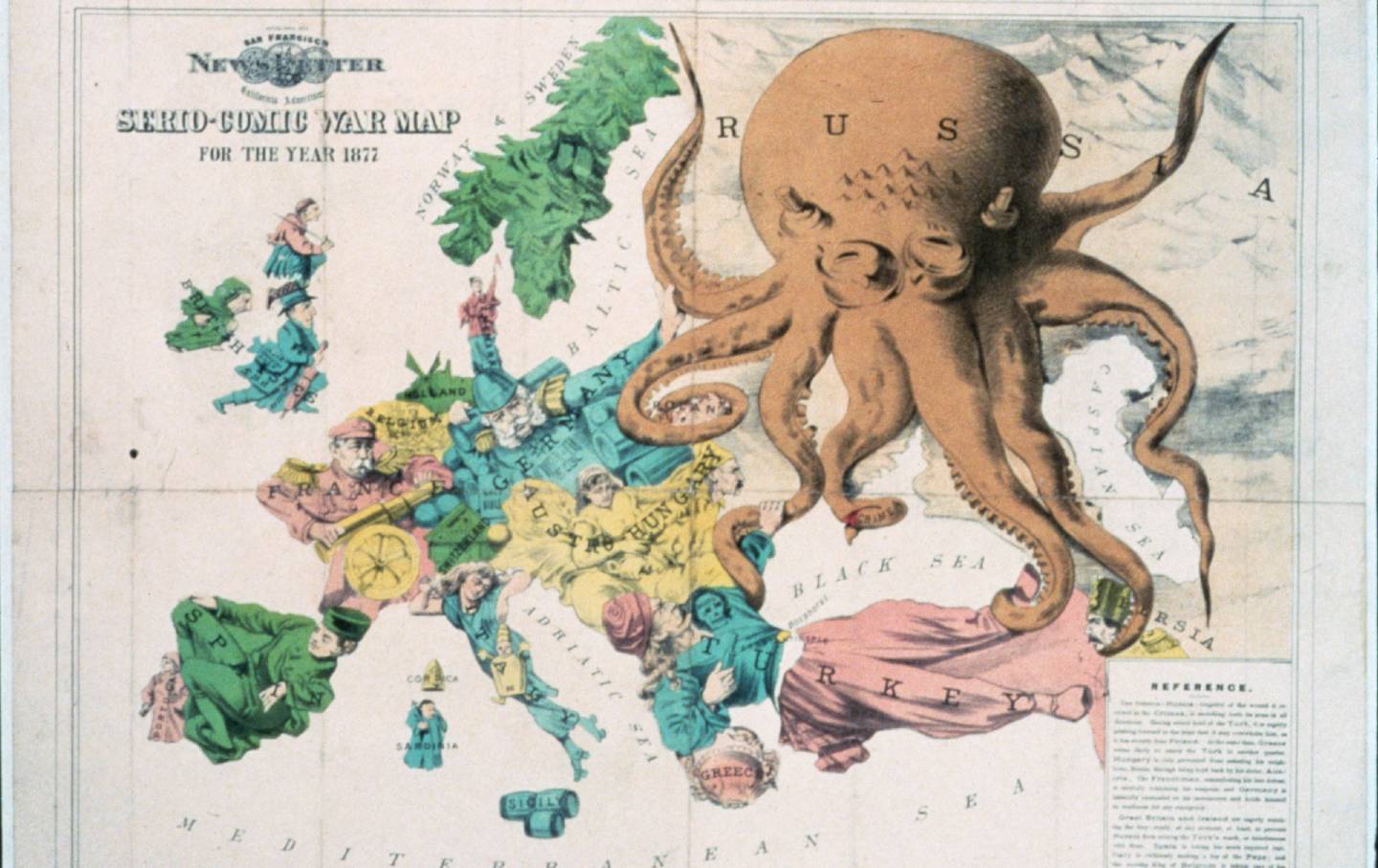
A political cartoon from 1877 depicting Russia expanding into Europe.
(Library of Congress)
In 1836 the liberal philosopher John Stuart Mill claimed that Lord Melbourne’s government was smitten with the “epidemic disease of Russophobia,” an irrational panic that had triggered an unnecessary increase in defense spending.
Mill’s dissent undermines the view of conventional historiography that 19th-century Anglo-Russian rivalry was a purely geopolitical contest—the so-called Great Game—for control over central Asia, Britain’s motive being to protect its Indian Empire against a southward Russian thrust to the Indian Ocean. For Britain’s propping up the decaying Ottoman Empire was considered crucial to the defense of India.
In Jonathan Parry’s reworking of the 19th-century story, the recurring British conviction that Russia was inherently expansionist owed less to any concrete Russian project than to the liberal democratic belief that autocracies were expansionist and aggressive by nature. In short, the roots of the rivalry were ideological, not geopolitical, with clashes of interest (which did exist) being interpreted in civilizational terms.
The 19th-century record also shows that Russophobia was recurrent rather than continuous, with intense bouts of moral outrage interrupted by functional alliances and compromises. But the underlying British ideological hostility to the Russian autocracy prevented any warmth in the relationship or trust in its permanence.
This seems to me to be an illuminating lens through which to view the whole history of Anglo-Russian relations from the 1830s to the present. British Russophobia is not an unbroken constant but a durable repertoire of ideas and images that politicians, soldiers, and journalists repeatedly invoke when three conditions align: ideological incompatibility, imperial or security friction, and domestic political utility.
In the 19th century, the dual drivers of Russophobia were the Indian defense lobby and liberal outrage at Russia’s brutal suppression of the Polish uprising of 1830 and the Hungarian uprising of 1848. Polish and Hungarian exiles in London fed the popular image of Russia as the barbaric would-be policeman of Europe. The Crimean War of 1854–56 refracted far-off Russian actions through British imperial anxieties and liberal morality. The Balkan crisis and second Afghan war of 1878 are examples of Russophobia-fueled overreach.
The wartime alliance with Imperial Russia from 1914 to 1918 ended with the Bolshevik Revolution and the Zinoviev Letter scare, which cost Labour the 1924 general election. Bolshevism rather than autocracy now became the threat to be guarded against. The Anglo-American partnership with Stalin that defeated Nazi Germany in 1945 foundered on Churchill’s famous speech at Fulton, Missouri, in 1946 declaring, “From Stettin in the Baltic to Trieste in the Adriatic, an iron curtain has descended on the Continent.” The years 1946–1991 saw the institutionalization of Russophobia in the NATO alliance, but also détente in the 1970s, echoing 19th-century cycles of moral epidemics and pragmatism.
The fall of Communism, the end of Russian control over Eastern Europe, the dissolution of the Warsaw Pact, and the breakup of the Soviet Union itself brought about the honeymoon of the 1990s, based on the belief that Russia had at last joined the civilized world. But this did not survive the 2000s. The 2006 Litvinenko, cyber-attacks, the 2008 Russian incursion into newly independent Georgia, Putin’s championship of multipolarity and attacks on NATO expansion, and the fear of energy dependency on Russia brought about the first spike of post-communist Russophobia.
Russia’s annexation of Crimea in 2014 revived the Victorian language (“Russian bear,” “Great Game 2.0,” freedom versus autocracy). The 2018 Skripal poisoning cemented public distrust. Full-scale Russophobia reemerged with Russia’s 2022 invasion of Ukraine, with Britain taking the lead in arming Kyiv, imposing economic sanctions, and banning cultural and sporting exchanges. With this went the familiar cry that Western Europe must rearm to defend itself against a Putin who was routinely likened to Hitler.
The bald narrative of Russophobia raises the question raised by John Stuart Mill in 1836: How justified have been the fears of Russian expansion and to what extent has Russophobia been used to justify rearmament programs? Russia in the 19th century was undoubtedly an autocracy, but it sought “weak neighbours” rather than conquest. The British and Americans saw the Cold War as an ideological battle between democracy and totalitarianism, whereas the Soviets, with the experience of two invasions from Germany, were mainly interested in establishing buffers in Eastern Europe against what Stalin believed would be an inevitable American-led assault. The United States was encouraged by Latvian, Ukrainian, and Polish lobbies in Washington to believe that Soviet insistence on making Eastern Europe a sphere of influence was only a prelude to the attempt to subjugate all of Europe. (On these misperceptions, see Sheila Fitzpatrick’s review of Sergey Radchenko’s To Run the World: The Kremlin’s Bid for Global Power and Vladislav Zubok’s The World of the Cold War 1945–1992.)
Exactly the same faulty reasoning is employed today to justify Europe’s rearmament. Buffer zones, spheres of influence may be repugnant to our “rules-based international order” but they do not portend dangerously expansionist aims. It is right to be suspicious of Putin’s intentions without falling for the idea that he will never stop.
To conclude: Russophobia in Britain is best understood as a recurrent syndrome triggered by the convergence of ideology, security friction, and domestic incentives, not a rational response to objective threats. Its history illuminates the appeal to democracies of moral rhetoric, the instrumental use of fear, and the ultimate capacity of hard-nosed diplomacy to reset relations. Recognizing the patterned nature of Russophobia can help policymakers avoid panic while remaining vigilant remembering that neither uncritical hostility nor naïve reset will be “permanent.”
Become a Sustaining Donor This September
Between the reemergence of right-wing red-baiting and Donald Trump’s use of the chilling National Security Presidential Memorandum–7 to criminalize left political organizing, we’re seeing McCarthyism reborn before our eyes.
This assault on democracy cannot be ignored or wished away. Resisting it requires bravery in the face of threats and repression, a steadfast commitment to the truth, and the unwavering belief that we can—and will—overcome this darkness.
We must have an independent media that sets the record straight, unearths corruption and abuses of power, and advances a politics of justice and dignity for all if we’re to win this fight.
That’s why I’m writing to you today. This September, The Nation needs to add 100 monthly donors to sustain our progressive journalism. Your contribution makes the next investigative report, the next truth-speaking column, and the next pathbreaking essay all possible.
I hope you’ll support our work with a recurring donation today. If you donate $10 or more a month, we’ll send you a brand new “Hands Off the Free Press!” sticker to recognise your commitment to our cause. Please, donate today.
Onward,
Katrina vanden Heuvel
Editor and Publisher, The Nation
More from The Nation

Israel’s Election Can’t Fix What Netanyahu Broke Israel’s Election Can’t Fix What Netanyahu Broke
The fundamental problem is not the name of the prime minister, but rather the actions of the Israeli government and the urgent issues that need to be addressed.
The AfD’s Rise Isn’t Just About East Germany The AfD’s Rise Isn’t Just About East Germany
The Alternative für Deutschland has a stable national poll lead, including in the former West Germany. Its rise owes to much more than Eastern grievances.
Chinese Development Is the Betrayal Washington Cannot Forgive Chinese Development Is the Betrayal Washington Cannot Forgive
The prospects for Xi Jinping’s visit are dim because American leaders are blaming China for the failures of globalization.

Pinochet: The Verdict of History in the Letelier-Moffitt Case Pinochet: The Verdict of History in the Letelier-Moffitt Case
An act of international terrorism on the streets of Washington, DC, still reverberates 50 years later.

How to Arrest Benjamin Netanyahu How to Arrest Benjamin Netanyahu
Make no mistake: The United States can seize Netanyahu for crimes under US law and prosecute him in US courts when he is in New York City this week.
In the Age of AI, Nuclear Weapons Abolition Is a Renewed Imperative In the Age of AI, Nuclear Weapons Abolition Is a Renewed Imperative
As long as we have nuclear weapons, the job of ending humanity will continue to be as easy as the push of a button—or an AI agent hacking into a nuclear command-and-control system...

