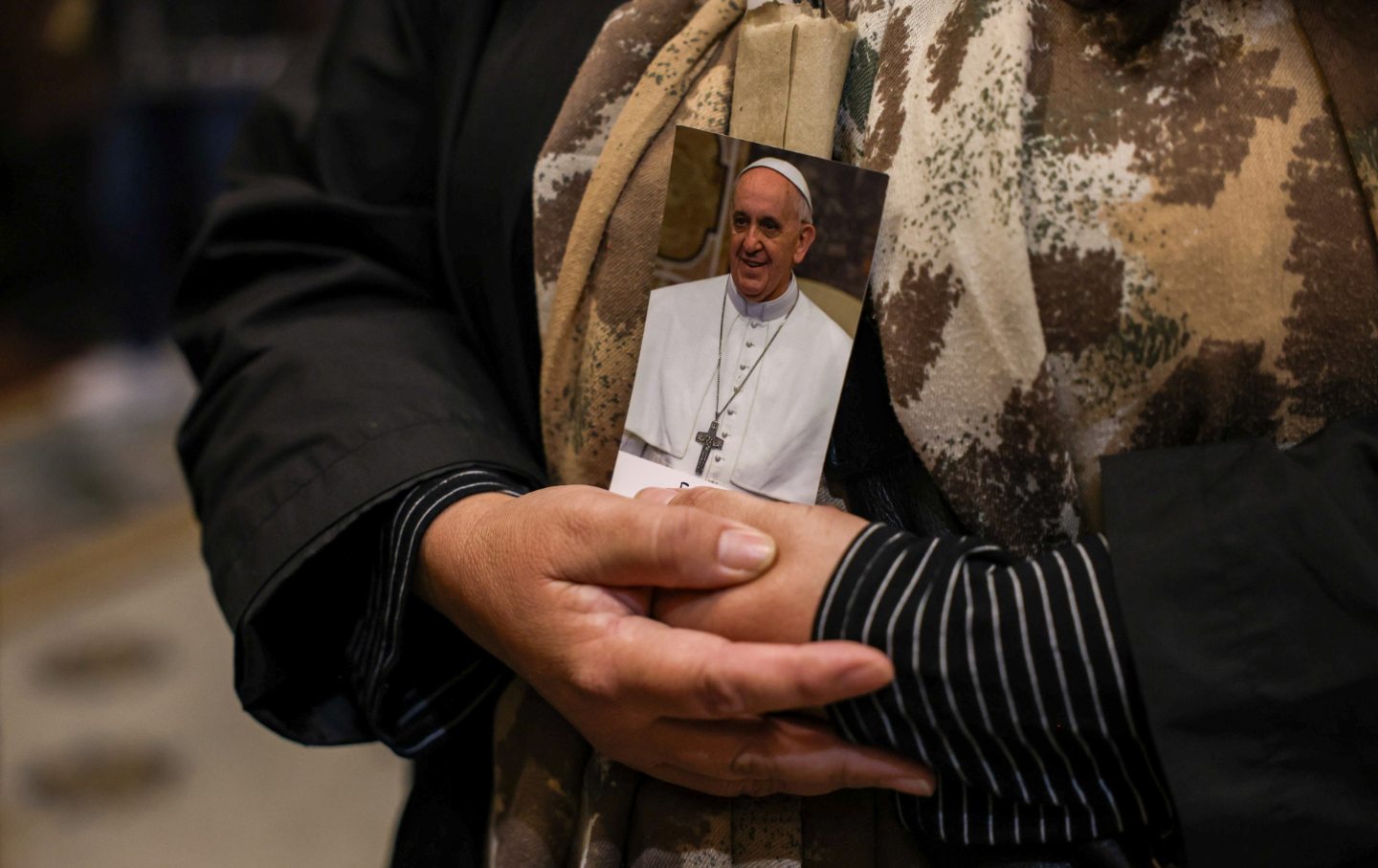
A worshiper holds a small picture of the late Pope Francis during a service in Buenos Aires Cathedral on April 21, 2025.
(Cristina Sille / picture alliance via Getty Images)Pope Francis, who died Monday at age 88, used his dozen years as the head of the Catholic Church, and arguably the most prominent religious leader in the world, to advocate for peace (especially in the Middle East), for bold responses to the climate crisis, for humane treatment of refugees, for responsible uses of increasingly out-of-control technologies and, with a consistency that distinguished him from the corporate and political elites of his time, for economic justice.
That final commitment extended from a spiritual and practical concern for the poor on the part of the first Latin American and the first Jesuit to be chosen to serve as the pope in the church’s 2,000-year history. It was central to Francis’s mission over the course of his remarkable pontificate. Indeed, in the announcement of Francis’s death on the morning after Easter Sunday, Cardinal Kevin Farrell, the Vatican camerlengo, said, “He taught us to live the values of the Gospel with fidelity, courage and universal love, especially in favor of the poorest and most marginalized.”
That teaching was bold and instructive. It began early and never stopped.
Just months after he became the head of the Catholic Church in 2013, Pope Francis condemned the “new tyranny” of unfettered capitalism and the “idolatry of money.” In an apostolic exhortation issued in the fall of that year, he argued, “As long as the problems of the poor are not radically resolved by rejecting the absolute autonomy of markets and financial speculation and by attacking the structural causes of inequality, no solution will be found for the world’s problems or, for that matter, to any problems.”
The pope took a side in the debates about capitalism that had been sparked by Occupy Wall Street and other movements of the period—not just in his manifesto but in interviews, warning, “Today we are living in an unjust international system in which ‘King Money’ is at the center.”
Francis encouraged resistance to “the absolute autonomy of the marketplace and financial speculation” that creates “a throwaway culture that discards young people as well as its older people.”
“What I would tell the youth is to worry about looking after one another and to be conscious of this and to not allow themselves to be thrown away,” he told a television audience in his native Argentina.
“So that throwaway culture does not continue, so that a culture of inclusion is achieved.”
The reference to a “culture of inclusion”—as opposed to a market-driven “culture of exclusion”—was not casual. In his 2013 faith-based assessment of moral issues relating to capitalism, and across the ensuing years of his service, Pope Francis decried the “economy of exclusion and inequality.” It was a message that he took to the far corners of the planet and the corridors of global power—including the US Capitol, where he delivered a challenging and visionary address to a joint session of Congress in 2015.
At the root of his preaching across the years was a humbly spoken, yet intellectually and emotionally profound, worldview. Capitalism without limits, he said, created pain without limits.
“Such an economy kills,” he said in his 2013 apostolic exhortation.
How can it be that it is not a news item when an elderly homeless person dies of exposure, but it is news when the stock market loses two points? This is a case of exclusion. Can we continue to stand by when food is thrown away while people are starving? This is a case of inequality. Today everything comes under the laws of competition and the survival of the fittest, where the powerful feed upon the powerless. As a consequence, masses of people find themselves excluded and marginalized: without work, without possibilities, without any means of escape.
What made Pope Francis’s contribution to the global dialogue about the economy so significant was his explicit rejection of the basic underpinnings of the broken economic models that have created the current crisis. He did not tolerate ideas and approaches that in 2013 were promoted by fiscal fabulists like House Budget Committee chairman Paul Ryan and conservative leaders in Europe. And he did not tolerate them in the years that followed, as figures even crueler than Ryan took the stage in the US and around the world.
“Some people continue to defend trickle-down theories which assume that economic growth, encouraged by a free market, will inevitably succeed in bringing about greater justice and inclusiveness in the world,” wrote the then-new pope in his manifesto.
Popular
“swipe left below to view more authors”Swipe →This opinion, which has never been confirmed by the facts, expresses a crude and naïve trust in the goodness of those wielding economic power and in the sacralized workings of the prevailing economic system. Meanwhile, the excluded are still waiting. To sustain a lifestyle which excludes others, or to sustain enthusiasm for that selfish ideal, a globalization of indifference has developed.
As a spiritual leader with a mass following and an ability to speak to political and corporate elites, Pope Francis’s voice was heard where others were dismissed. It was well-noted, for instance, when he met with figures such as US Senator Bernie Sanders, who was welcomed at the Vatican for an audience during the Vermont senator’s 2016 presidential bid.
The fact that Pope Francis embraced a critique of capitalism that came from progressive economists, dissident political figures, and activists in the streets—as opposed to accepting the apologias issued from the suites of the billionaire class—opened up the debate. No one expected the more radical economic elements of the economic vision of a religious leader, even so prominent a figure as Pope Francis, to be fully embraced by Wall Street or Washington—and that did not happen.
But the pope succeeded over the past dozen years in helping an alternative argument to take shape. In the United States, new voices were added to the chorus of complaint about an austerity agenda that threatened universal guarantees such as Social Security, Medicare, and Medicaid, cut food stamps, and bartered off basic services such as the Post Office. And established figures became clearer and bolder in their recognition that restructuring tax and regulatory policies in order to redistribute wealth upward was a recipe for disaster.
Critical economic and political fights were lost, but they were also sometimes won.
Pope Francis understood from the beginning of his tenure that there was a need for a debate about “the dictatorship of an impersonal economy lacking a truly human purpose.” That debate is far from finished. But, as powerful and aggressive as the billionaire class and its political servants may have been, and may continue to be, there was a pope who taught that “money must serve, not rule!”