Elite Capitulation and Craven Cowardice
Columbia and Paul, Weiss are reprising the gutlessness last seen in the McCarthy era.
Returning to the United States in June 1951 after two years in Europe, I.F. Stone—The Nation’s former Washington correspondent—couldn’t help noticing that “the land of the free and the home of the brave” was rapidly becoming “the land of the belly-crawler and the home of the fearful.”
Stone himself had good reason to be nervous. Though Joseph McCarthy had barely launched his eponymous “ism,” under President Harry Truman (who’d issued his infamous Loyalty Order in 1947) the American Inquisition was already in full cry. Witch hunts targeting communists, homosexuals, and fellow travelers claimed ever more careers—and lives. Sailing into New York Harbor with his wife and children, Stone thought, “Oh boy! Here’s where I lose my passport.” Instead, the customs official offered him a warm “Zie gur gezint!” (Go in good health)—although, three months later, the State Department did refuse to renew it. Within a year, Stone was out of work—and unemployable, until he launched his one-man newsletter, I.F. Stone’s Weekly.
Like the blacklisted screenwriter Dalton Trumbo, Stone had earned the right to pass judgment on what, in a nod to Émile Zola, Trumbo dubbed “the Time of the Toad”:
in which the nation turns upon itself in a kind of compulsive madness to…exalt all that is vile, and to destroy any heretical minority which asserts toad-meat not to be the delicacy which governmental edict declares it…. [H]eralds of the Time of the Toad are the loyalty oath [and] the compulsory revelation of faith.
Reflecting back on that era in an issue marking The Nation’s 100th anniversary, Trumbo wrote:
They know the power of their weapon, and our fear of it, and even a small crisis is better than none. But what they especially dream of is a profound crisis, that anguished crisis of the spirit which tears us to pieces every thirty or forty years, one that will soften our hearts to the tall fierce strangers who stand outside the door and cry salvation.
So, yes, we—the country, our democracy, and this magazine—have all been here before. What have we learned? Judging by the epidemic of belly-crawling radiating from Wall Street to the flock of (borrowing again from Trumbo) “sheep in a sheepskin” at Broadway and 116th Street, not much.
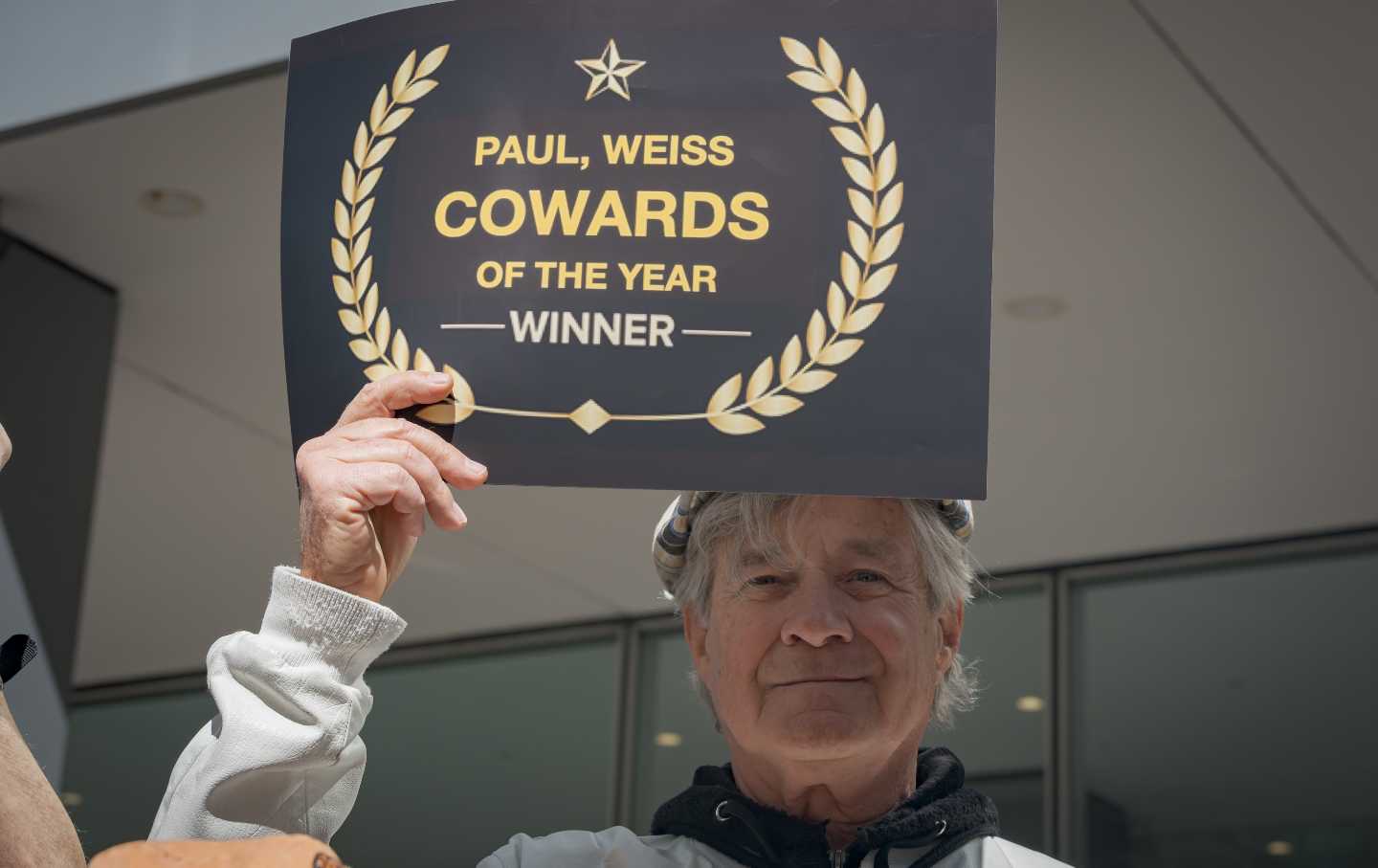
Perhaps we shouldn’t be surprised that an Ivy League university would cave at the threat of losing $400 million in federal funds—though given Columbia’s $15 billion endowment, that’s a smaller bite than many New Yorkers pay in income tax. Identifying, conditioning, and credentialing the ruling class is what Ivy League universities are for. But as someone profoundly shaped by my own encounter with Columbia’s core curriculum, I do find it shocking—and shameful—that its administration sees more virtue in placating Caesar than in defending democracy. As for the craven conduct of the law firm Paul, Weiss, while (as Orson Welles put it) Hollywood’s cowards betrayed their friends “not to save their lives, but to save their swimming pools,” the firm’s leadership sold out its partners, and the rule of law, not to save the country but to protect its rainmaker. Those white shoes may never come clean.
Fortunately, as Vincent Bevins reports in our cover story, the leaders of Brazil’s Landless Workers’ Movement were braver, and ultimately managed to rescue their country from oligarchy. Closer to home, we offer you Regina Mahone’s inspiring account of the abortion storytelling movement, Bryce Covert’s hard-hitting follow-up to her 2020 cover story on the fight of McDonald’s workers against sexual harassment, Kali Holloway on what happened to non-white voters, and Jess McAllen’s gripping investigation of the latest therapy cult.
This being the Spring Books issue, we’ve assembled a bumper bouquet of reviews: John Banville on the Irish famine, Edna Bonhomme on Zora Neale Hurston’s lost epic, Sarah Chihaya on Sigrid Nunez, John Ganz on the young Trump, Vivian Gornick on Murray Kempton, and Olúfé.mi O. Táíwò on Agnes Callard. Plus dazzling dispatches, intriguing interviews, and a selection of our stellar columnists. Do stick around—and make sure your subscription is up-to-date. The Nation turns 160 in July, and you won’t want to miss the festivities!
D.D. Guttenplan
Editor
Become a Sustaining Donor This September
Between the reemergence of right-wing red-baiting and Donald Trump’s use of the chilling National Security Presidential Memorandum–7 to criminalize left political organizing, we’re seeing McCarthyism reborn before our eyes.
This assault on democracy cannot be ignored or wished away. Resisting it requires bravery in the face of threats and repression, a steadfast commitment to the truth, and the unwavering belief that we can—and will—overcome this darkness.
We must have an independent media that sets the record straight, unearths corruption and abuses of power, and advances a politics of justice and dignity for all if we’re to win this fight.
That’s why I’m writing to you today. This September, The Nation needs to add 100 monthly donors to sustain our progressive journalism. Your contribution makes the next investigative report, the next truth-speaking column, and the next pathbreaking essay all possible.
I hope you’ll support our work with a recurring donation today. If you donate $10 or more a month, we’ll send you a brand new “Hands Off the Free Press!” sticker to recognise your commitment to our cause. Please, donate today.
Onward,
Katrina vanden Heuvel
Editor and Publisher, The Nation