
The Cossacks Work for the Czar—and Musk Works for Trump
The president’s narcissistic management style is at the root of cabinet infighting.
Distance can often bring clarity of vision. As Washington currently obsesses over reported fights between Trump’s right-hand man Elon Musk (who holds a nebulous position guiding the Department of Government Efficiency, or DOGE) and cabinet members such as Marco Rubio, the most clear-eyed view of the current turmoil comes from faraway France. Dr. Claude Malhuret, a member of the French Senate, is not normally a figure inclined to give vent to bitter words about American politics. His politics are squarely center-right and Atlanticist, geared toward keeping the continent united under NATO and the European Union and oriented toward the United States. But like many traditional Atlanticists, he’s become deeply pessimistic about the reliability of the United States as an ally in the era of Donald Trump.
On March 4, Malhuret gave a much-noticed speech where he lamented that “Washington has become the court of Nero: an incendiary emperor, submissive courtiers, and a buffoon on ketamine tasked with purging the civil service.” The “buffoon on ketamine” is an unkind swipe at Musk, whose use (or abuse) of illicit drugs—including LSD, cocaine, ecstasy, and mushrooms, as well as ketamine—has been reported by such reputable outlets as The Wall Street Journal.
Malhuret’s sweeping jeremiad provides a useful framework because it locates the source of the problem squarely as stemming from the mad emperor (the Nero-like Trump) with merely a secondary, accomplice role played by his lackeys and by the addled Musk.
When a government goes off the rails, there’s a long tradition among those who defer to power of deflecting blame on advisers, who make easy and useful scapegoats. The proverbial Russian phrase “if only the tsar knew” captures this mindset. But as the economist Brad DeLong likes to say, “the Cossacks work for the Czar.” In other words, the blame for misdeeds rests with the top man, who often uses seemingly uncontrollable minions such as the cossacks as a shield for his own policy.
Musk certainly is an ideal distraction, falling into the tradition of prominent courtiers such as Thomas Cromwell (who flourished under the English king Henry VIII). But as powerful as Cromwell was as an adviser, he served at the sufferance of his king—and, like many other courtiers, found himself eventually discarded and executed.
Even more than Trump, the tech lord is a seeming outsider to Washington (despite the fact that his key firms such as Tesla and SpaceX have benefited from more than $38 billion in government largess). Musk’s murky position at DOGE is perfect for an eminence grise who thrives in the shadows of power; the agency he heads has not been authorized by Congress but exists by presidential fiat. Given a broad mandate to weed out supposed inefficiency, it has become a government-within-the-government, with Musk enjoying—and exercising—the powers of a super-cabinet member (with executive power over not just one department but in effect all) without any constitutional or legal mandate. This has already caused a constitutional crisis, with many courts—including recently the Supreme Court—deciding that DOGE has overstepped the law.
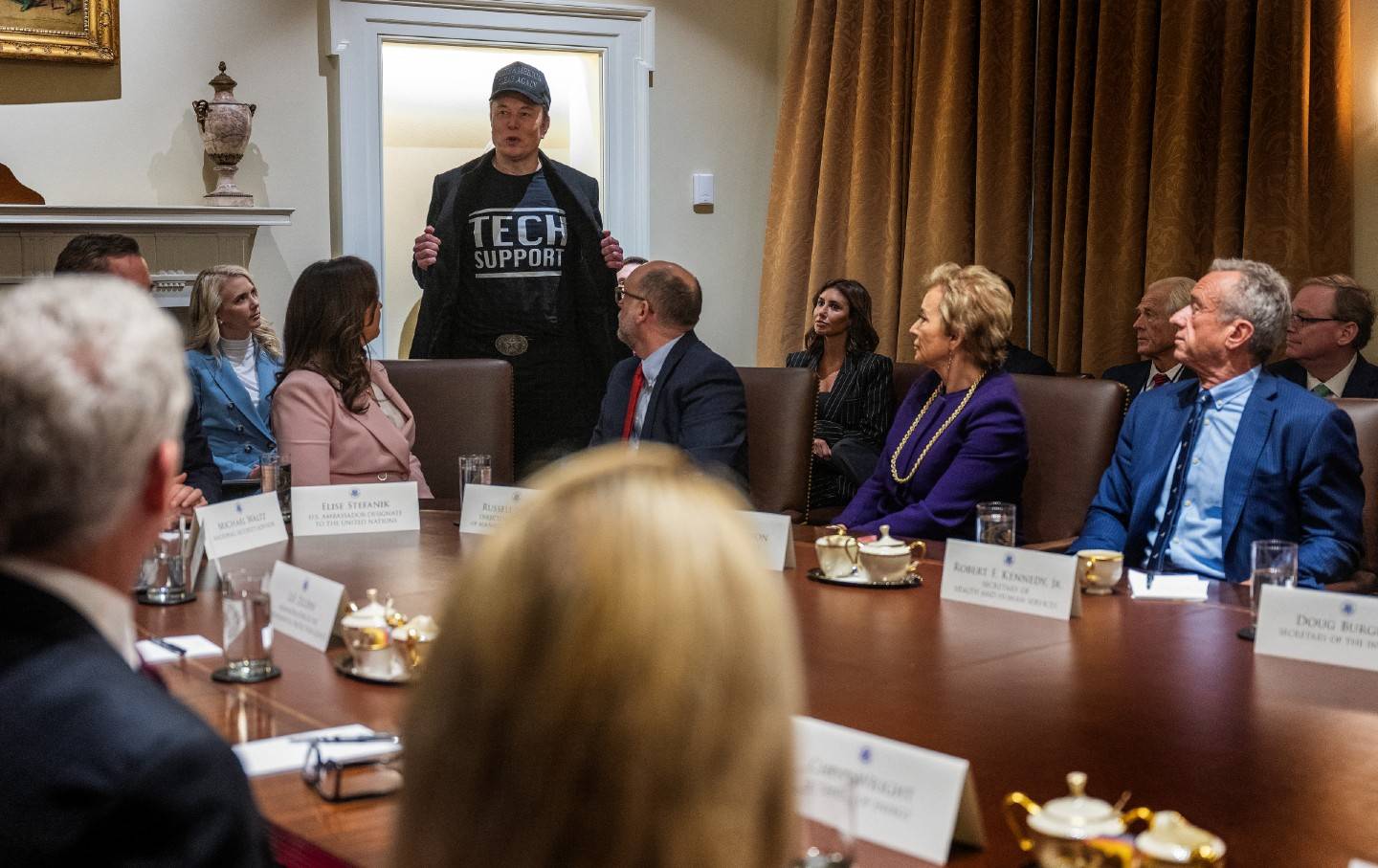
Musk’s shadow government is also provoking pushback from Trump’s own cabinet. On Friday, an explosive New York Times report detailed a recent tense cabinet meeting where Musk squared off not just against Rubio but also Secretary of Transportation Sean Duffy. The meeting was clearly designed to let the members of the cabinet air their grievances against Musk, who made a sop to Trump’s taste for traditional (if rarely elegant) men’s fashion by wearing a suit rather than his customary T-shirt and jeans. According to the Times, the argument with Rubio went like this:
Seated diagonally opposite, across the elliptical mahogany table, Elon Musk was letting Mr. Rubio have it, accusing him of failing to slash his staff.
You have fired “nobody,” Mr. Musk told Mr. Rubio, then scornfully added that perhaps the only person he had fired was a staff member from Mr. Musk’s Department of Government Efficiency.
Mr. Rubio had been privately furious with Mr. Musk for weeks, ever since his team effectively shuttered an entire agency that was supposedly under Mr. Rubio’s control: the United States Agency for International Development. But, in the extraordinary cabinet meeting on Thursday in front of President Trump and around 20 others—details of which have not been reported before—Mr. Rubio got his grievances off his chest.
Mr. Musk was not being truthful, Mr. Rubio said. What about the more than 1,500 State Department officials who took early retirement in buyouts? Didn’t they count as layoffs? He asked, sarcastically, whether Mr. Musk wanted him to rehire all those people just so he could make a show of firing them again. Then he laid out his detailed plans for reorganizing the State Department.
Musk zinged Rubio as a shallow administrator who was good on television but with little other skill while Rubio underscored Musk’s erratic behavior.
The spat allowed Trump to play the peacemaker. “Mr. Rubio has a lot to deal with, the president said,” The New York Times reported. “He is very busy, he is always traveling and on TV, and he has an agency to run. So everyone just needs to work together.” This slightly condescending comment is in keeping with Trump’s comments at his address to Congress on Tuesday where he said Rubio had a tough job and added, “Good luck, Marco.”
The same cabinet meeting featured an exchange between Musk and Sean Duffy that was even more alarming given the precarious stage of transportation safety in America:
Just moments before the blowup with Mr. Rubio, Mr. Musk and the transportation secretary, Sean Duffy, went back and forth about the state of the Federal Aviation Administration’s equipment for tracking airplanes and what kind of fix was needed. Howard Lutnick, the commerce secretary, jumped in to support Mr. Musk.
Mr. Duffy said the young staff of Mr. Musk’s team was trying to lay off air traffic controllers. What am I supposed to do? Mr. Duffy said. I have multiple plane crashes to deal with now, and your people want me to fire air traffic controllers?
After Duffy and Musk went back and forth about the firing of air traffic controllers, who were hired back, Trump intervened with a bizarre and unhelpful suggestion: “The exchange ended with Mr. Trump telling Mr. Duffy that he had to hire people from M.I.T. as air traffic controllers.” Trump added that these new air traffic controllers should be “geniuses.”
If Trump’s cabinet is a circus, the fault lies not with Musk—or any of the other clowns—but with the ringmaster, Trump. He is running his cabinet the same way he ran his failed businesses such as Trump Casinos and Trump University: as a snake pit where competing managers have to fight each other to please the boss. Trump is an inveterate narcissist, and this is his natural mode of management.
In 2016, during Trump’s first presidential run, the AP reported, “When Donald Trump acquired a pair of Atlantic City casinos in the mid-1980s, he pitted his managers against each other in a ferocious competition over everything from booking entertainers to attracting high-rolling gamblers.” Musk is a problem—but only because Trump is a much bigger problem. At some point, as many liberals gleefully hope, Trump is likely to grow tired of Musk, as Henry VIII grew tired of Thomas Cromwell. But that will only mean the court of the mad king will get a new buffoon, not that any real problem will be solved. The infighting in the cabinet will continue because that’s how Trump runs the show.
Become a Sustaining Donor This September
Between the reemergence of right-wing red-baiting and Donald Trump’s use of the chilling National Security Presidential Memorandum–7 to criminalize left political organizing, we’re seeing McCarthyism reborn before our eyes.
This assault on democracy cannot be ignored or wished away. Resisting it requires bravery in the face of threats and repression, a steadfast commitment to the truth, and the unwavering belief that we can—and will—overcome this darkness.
We must have an independent media that sets the record straight, unearths corruption and abuses of power, and advances a politics of justice and dignity for all if we’re to win this fight.
That’s why I’m writing to you today. This September, The Nation needs to add 100 monthly donors to sustain our progressive journalism. Your contribution makes the next investigative report, the next truth-speaking column, and the next pathbreaking essay all possible.
I hope you’ll support our work with a recurring donation today. If you donate $10 or more a month, we’ll send you a brand new “Hands Off the Free Press!” sticker to recognise your commitment to our cause. Please, donate today.
Onward,
Katrina vanden Heuvel
Editor and Publisher, The Nation
More from
Jeet Heer 

Susan Collins Is Corrupt. She Still Might Be Reelected. Susan Collins Is Corrupt. She Still Might Be Reelected.
Despite being embroiled in scandal, the Maine senator is benefiting from Democratic Party divisions.
Even Republicans Are Figuring Out That Pete Hegseth Is a Disaster Even Republicans Are Figuring Out That Pete Hegseth Is a Disaster
Hegseth was always a horrible choice for defense secretary. At long last, some in the GOP are admitting it.
Why Aren’t We Talking About the Warmongering Lies of Mike Rogers? Why Aren’t We Talking About the Warmongering Lies of Mike Rogers?
The media’s relentless focus on Hasan Piker allows the dishonest GOP hawk (and actual Michigan Senate candidate) to evade scrutiny.

MAGA Is Exploiting the Lindsay Clancy Case to Try to End Voting for Women MAGA Is Exploiting the Lindsay Clancy Case to Try to End Voting for Women
As Trump subverts elections, his most ardent fans want to overturn the 19th Amendment.

Accountability for the Gaza Genocide Can’t Focus on Netanyahu Alone Accountability for the Gaza Genocide Can’t Focus on Netanyahu Alone
Getting rid of one bad leader won’t bring justice.
In Trump’s Mafia, Even Goons Can Do Billion-Dollar Shakedowns In Trump’s Mafia, Even Goons Can Do Billion-Dollar Shakedowns
Corey Lewandowski is a disposable underling, but he’s protected enough to scorn the law.

