A Warning About the Dangers of Executive Orders—From 40 Years Ago
In 1983, as Ronald Reagan went on an executive-order spree, The Nation sounded the alarm about very kind of presidential overreach we’re seeing from Trump today.
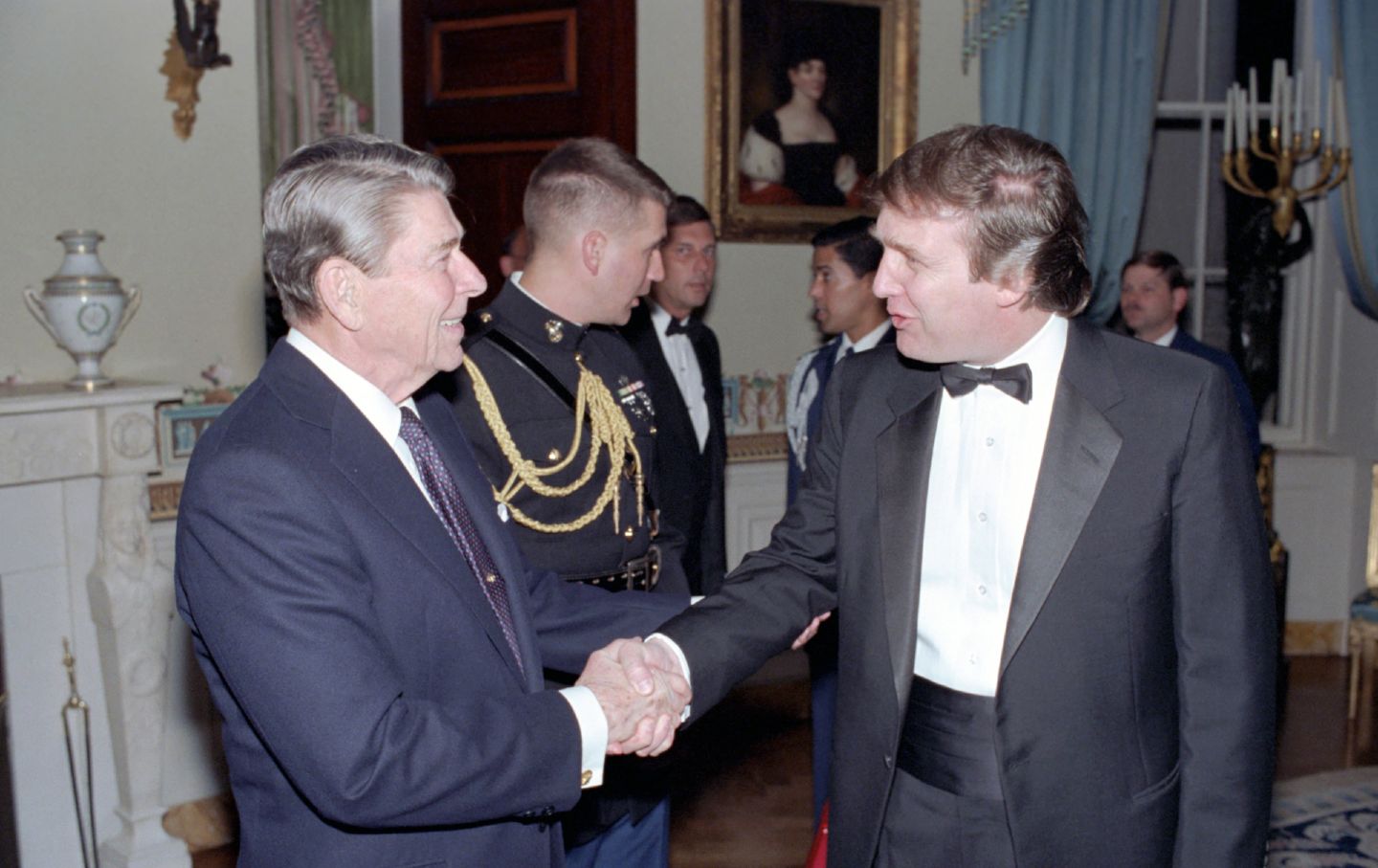
President Ronald Reagan shakes hands with Donald Trump in a reception line in the White House’s Blue Room, Washington DC. November 3, 1987.
(White House Photo Office / PhotoQuest / Getty Images)
Donald Trump’s second term has begun with a barrage of executive orders, each more audacious than the last. Through them, he is openly attempting to govern not by law but by fiat. Their sheer volume and scope—in the absence of any resistance from Congress or speedy pushback from the courts—put the very foundations of constitutional government to the test as they have not been since the Civil War.
Throughout its 160-year history, The Nation has, unsurprisingly, celebrated some executive orders and opposed others. The magazine’s opinion of such actions has been generally focused on the merits of the policy change, rather than larger constitutional questions about the limits of presidential authority. A 1951 editorial note, for instance, cheered an order by President Harry Truman seeking to advance racial integration in the defense industry as “a gesture of support for civil rights,” while just a few years earlier, another Truman order aimed at stamping out “disloyalty” in the executive branch was described by eminent historian Henry Steele Commager as “an invitation to precisely that kind of witch-hunting which is repugnant to our constitutional system.” (What might Commager have made of Trump’s efforts to get federal employees to inform on colleagues whom they suspect of concealing DEI initiatives?)
On occasion, however, objections to the content of executive orders have shaded into full-throated critiques of presidential overreach—precisely on the grounds that such authority might be abused someday by an unscrupulous president with no respect for constitutional limits on his power.
In the June 11, 1983, issue of The Nation, John Shattuck, a lawyer with the American Civil Liberties Union, wrote a front-page story headlined “Executive Ordermania: Cutting Back on Freedom by Fiat.” Over its first two and a half years, Shattuck observed, the Reagan administration had used executive orders not merely to institute new policies, as other administrations had, but to make the White House “a de facto legislative branch of the government.” One function of Reagan’s executive orders, Shattuck noted, was to “provide an aura of legitimacy for Presidential actions that might otherwise be challenged as illegal.” By openly asserting these actions in presidential orders, Reagan was giving a sheen of legality to the kinds of covert domestic operations against political opponents that Nixon had ordered secretly just a decade before.
Shattuck was especially troubled by Reagan orders allowing the CIA to conduct surveillance within the United States, a practice formerly banned by law, and compelling federal agencies to declare more information as classified. Other orders loosened affirmative-action requirements for federal contractors—a precursor to Trump’s war against DEI—and required birth-control clinics to inform the parents of patients under 18 who sought reproductive care. Most alarming to Shattuck were the executive actions that took aim at individual rights protected under the First Amendment, including one that effectively censored public speech by former government officials. Shattuck also feared that loosening restrictions on domestic surveillance operations would be used against advocates of a freeze on the testing and manufacture of nuclear weapons.
While some of the topics of the Reagan orders that Shattuck denounced have more to do with that time than our own, the larger question of how such actions could be used to chisel and then break the pillars of constitutional government could not be more relevant today. As Shattuck wrote, “This spreading pattern of Presidential lawmaking could eventually become a usurpation of power at least as great as that which occurred during the Imperial Presidency a decade ago”—a reference to Nixon. The rampant proliferation of executive orders as a substitute for actual legislation, he warned, might empower a future president to weaponize the government and persecute his personal and political enemies. Already, Reagan was showing the path ahead.
“[O]n the eve of 1984,” Shattuck wrote, “the Great Communicator, a master of Orwellian doublespeak, tells the country that his executive orders are law, and therefore government by executive order is not lawless. Big Brother could not have stated the case more concisely.” Nor more usefully for the current president, who has gone far beyond anything Reagan ever contemplated by explicitly declaring his intention to rule solely by autocratic decree.