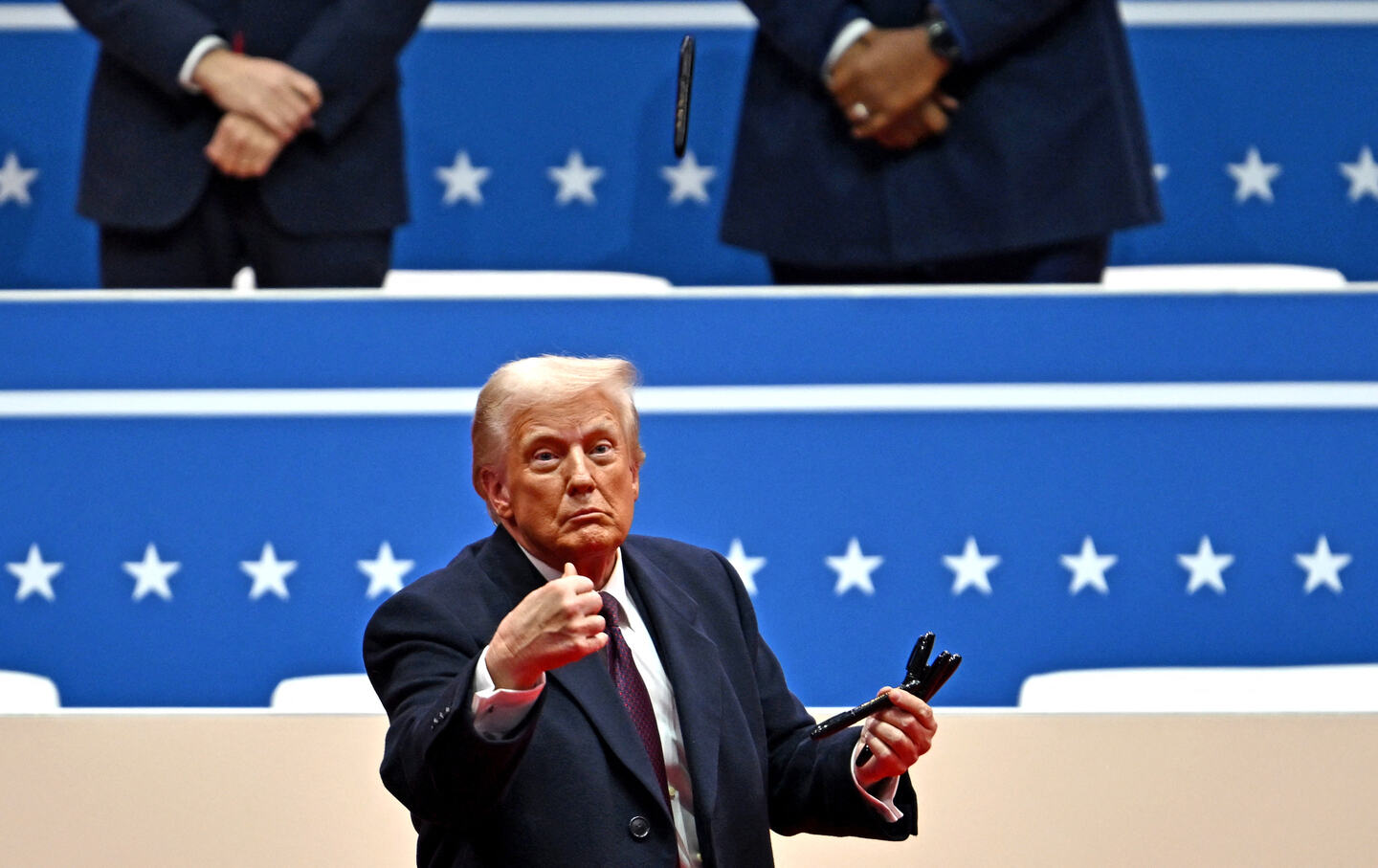
President Donald Trump throws sharpies to the crowd after signing executive orders during the inaugural parade inside Capital One Arena, in Washington, DC, on January 20, 2025.
(Angela Weiss / AFP via Getty Images)
Dozens of lawsuits have been filed to block Trump’s executive orders, and he has lost virtually every case thus far. Courts have enjoined his freezing of funds, enjoined his efforts to shut down USAID, enjoined his efforts to buy off government officials by paying them till September to do nothing, enjoined his orders barring transgender women from being put in women’s prisons for their safety, enjoined his effort to overturn birthright citizenship. Basically, the courts are doing their job—thus far. But what if he defies them? Or what if the Supreme Court reverses all the lower court actions? We asked David Cole, who recently stepped down as National Legal Director of the ACLU to return to teaching law at Georgetown. He writes for The New York Times, The Washington Post, and The New York Review of Books, and he’s legal affairs correspondent for The Nation.
This interview has been edited and condensed—you can read the full transcript here.
—Jon Wiener
Jon Wiener: What if the courts continue to rule against Trump, which seems likely, and he defies them? The New York Times recently ran a five-column headline in their print edition after a federal judge said the White House had defied his order to release billions of dollars in federal grants to the states. This is the first time a judge has expressly declared that Trump was disobeying a judicial mandate. In this case, the court agreed with the attorneys general of 22 states that the Trump administration had to give the states money that had been allocated by Congress for Medicaid, school lunches, low-income housing subsidies, and other essential services. What’s your analysis of the judge’s action in this case at this point?
David Cole: I think people are making a lot more of this than it warrants. Essentially, what the judge did was issue an order stopping the freeze on certain funds, based on one executive order, and the government came in and said, “Well, we had other executive orders that weren’t at issue in this case that you didn’t enjoin. And so we had an alternative legal basis to cut off funding in these various contexts.” And the court said, “No, you’re wrong. The scope of my order was broader than that. It encompassed what you are saying.” That’s like a routine litigation dispute in the wake of an initial order. One side says “it didn’t require us” to do something, the other side said “it did.”
But there was no argument made by the Trump administration lawyers that “we understand that you barred us from doing this, but you can’t and we’re going to defy your order.” No. They said, “We think there’s an alternative legal basis that justifies what we’re doing.” They made traditional legal arguments, and the court rejected those traditional legal arguments. So we have not come to the point, anywhere close to the point, of defying court orders.
JW: Shortly after that ruling, the Trump administration appealed it to the First Circuit Court of Appeals. The White House spokesperson said, “Each executive order will hold up in court because every action of the Trump-Vance administration is completely lawful.” The New York Times called that “defiance.” Is that what you would call it?
DC: No. First of all, I think that’s false to say that everything they have done is lawful. But they have the right, as does any defendant, to appeal, first to the Court of Appeals and then to the US Supreme Court. Biden took those actions when his decisions were deemed unlawful. Obama took those when his decisions were deemed unlawful. That’s just ordinary business in the courts of the United States.
JW: Our biggest worry is that the Supreme Court will support Trump. But maybe not. Trump has lost some big cases at the Supreme Court.
DC: Last time around I was at the ACLU. I started at the ACLU nine days before Trump took office. We filed over 400 legal actions against the Trump administration. He lost a lot of those, and some really big ones: The effort to put a citizenship question on the Census, to depress responses from immigrant communities; the effort to not report on noncitizens in the Census, even though you’re supposed to report on all people who respond to the Census; the effort to terminate DACA relief for the Dreamers—all enjoined by the United States Supreme Court. And he followed those rulings. I’m sure he was not happy with those rulings, but he followed those rulings.
JW: People say, yes, the Supreme Court ruled against Trump five or six years ago, but the court has changed since then.
DC: Yes, Trump appointed a number of people to the current court, but that court ruled against him 7–2 in 2020 on the subpoena cases, where he sought to challenge both a New York prosecutor and Congress’s efforts to subpoena his tax records. His own appointed justices ruled against him in those cases. So I think it’s just too cynical to say they’re just going to whitewash whatever he does, they’re on Trump’s team. That’s just not how it works.
JW: The New York Times suggested that the Supreme Court could issue what they called “an early splashy ruling against Trump” to send a signal about their own power and independence, and they suggested that upholding birthright citizenship, which the Trump administration says is unconstitutional, would be a good candidate—and that they might actually do that. What do you think about that?
DC: I have very little doubt that they will strike down his effort to undermine birthright citizenship. It’s there in the text of the Constitution, the 14th Amendment. The court has already ruled on it and said that it is a constitutional guarantee for all people who are born here and “subject to the jurisdiction thereof.” And that “subject to the jurisdiction thereof” they’ve read very, very narrowly to apply only to people like diplomats who are actually not subject to our laws. But everybody else is subject to our laws. So I think they will rule against the president on that when it eventually gets there.
JW: Our friends who worry the most about this point to the Supreme Court granting him immunity from criminal prosecution. If Trump is immune from criminal prosecution, they say, doesn’t that mean he can do anything he wants, and nothing can stop him?
DC: No, it doesn’t mean that. The criminal prosecution case was, I think, an abomination. There was no basis in the text or the history of the Constitution for the immunity that they granted to the president. But they made very clear there are all sorts of other checks in place. We’ve had 200 years plus of presidents. None of them have been prosecuted for criminal activity. The vast majority of them have not even been alleged to have engaged in any criminal activity, with the exception of Nixon and Trump himself. I don’t think that’s because they were afraid of getting prosecuted after they left office. I think that’s because there are a whole host of checks in the system that ensure that presidents don’t engage in blatantly criminal conduct. Those checks include the ability to sue the president, the fact that the Supreme Court has clearly established power to order the president to stop doing what he’s doing, Congress’s power to cut off funding for anything that it disagrees with, or to refuse to pass a budget bill if they’re unhappy with what the president has done, Congress’s ability to subpoena the president and call his folks to testify before Congress; and ultimately impeachment.
Of course, when Congress is controlled by the Republican Party, those latter congressional checks are unlikely to play that much of a role, if any, but there are still a host of checks in place that I think explain why we have not seen rampant criminal conduct by presidents. And I don’t think we will going forward, with the possible exception of President Trump, who has already shown himself capable of engaging in criminal conduct, even when he thought—and his attorneys argued—that he could be prosecuted after the fact. He made that argument in the second impeachment trial. He said, “Don’t impeach me because I can be tried after the fact.”
And then when he got off on the impeachment, he then turned around and said, “Oh no, I can’t be tried after the fact.” Trump is thankfully a unique case in our history and we’re going to have to deal with that unique case. But there are a lot of checks in place.
JW: Some of our friends say it’s a big mistake for people to think “the courts will save us.”
DC: I think people can be too cynical about the courts, and that’s based on my experience of repeatedly suing President Trump and winning—for example, reuniting thousands of families separated by the president in his family separation policy, because we sued in court and won. So I’ve seen the evidence, and I think it’s there.
But I do not believe that we can just sit back and rely on the courts to save us. The courts work when the American people are standing up for their rights, advocating, joining together, and standing up for the values that they believe in. If we all sit back and wait for the courts to save us, they won’t. But if we step forward, if we act, if we join in organizations that are committed to upholding the rule of law and the basic principles of our constitutional democracy, that is how the Constitution is made meaningful, through that kind of civil society action—by nonprofits, by unions, by the media, by the academy, all the nongovernmental institutions that are strong in this country, supporting the sacrosanct principle of an independent judiciary.
JW: I would add one last thing. What Trump is doing is not popular. All incoming presidents have the famous honeymoon period, but Trump already has the highest disapproval rating of any president at this point in their presidency. The Pew opinion poll last week asked, “Does Trump respect the country’s democratic values?” Thirty-one percent said yes. Fifty-three percent said no. They asked, “Does Trump act ethically in office?” Twenty-nine percent said yes. Fifty-four percent said no. So we are not alone. We represent the majority.
DC: Absolutely. What will undermine us is cynicism and despair. If we stand up, if we fight back, we have the tools available to defend our values. We pushed back the last time. It made a big difference. A lot of people’s rights were protected. A lot of harm was prevented. And then the midterms were a disaster for Trump, and he didn’t have a majority in the House in his last two years, so he couldn’t do anything in Congress. This is a country in which, thankfully, we have a lot of tools for the people to use to speak out and fight back against abuse, including appealing to the courts; and we need to use them, not demean them or diminish them.
Become a Sustaining Donor This September
Between the reemergence of right-wing red-baiting and Donald Trump’s use of the chilling National Security Presidential Memorandum–7 to criminalize left political organizing, we’re seeing McCarthyism reborn before our eyes.
This assault on democracy cannot be ignored or wished away. Resisting it requires bravery in the face of threats and repression, a steadfast commitment to the truth, and the unwavering belief that we can—and will—overcome this darkness.
We must have an independent media that sets the record straight, unearths corruption and abuses of power, and advances a politics of justice and dignity for all if we’re to win this fight.
That’s why I’m writing to you today. This September, The Nation needs to add 100 monthly donors to sustain our progressive journalism. Your contribution makes the next investigative report, the next truth-speaking column, and the next pathbreaking essay all possible.
I hope you’ll support our work with a recurring donation today. If you donate $10 or more a month, we’ll send you a brand new “Hands Off the Free Press!” sticker to recognise your commitment to our cause. Please, donate today.
Onward,
Katrina vanden Heuvel
Editor and Publisher, The Nation