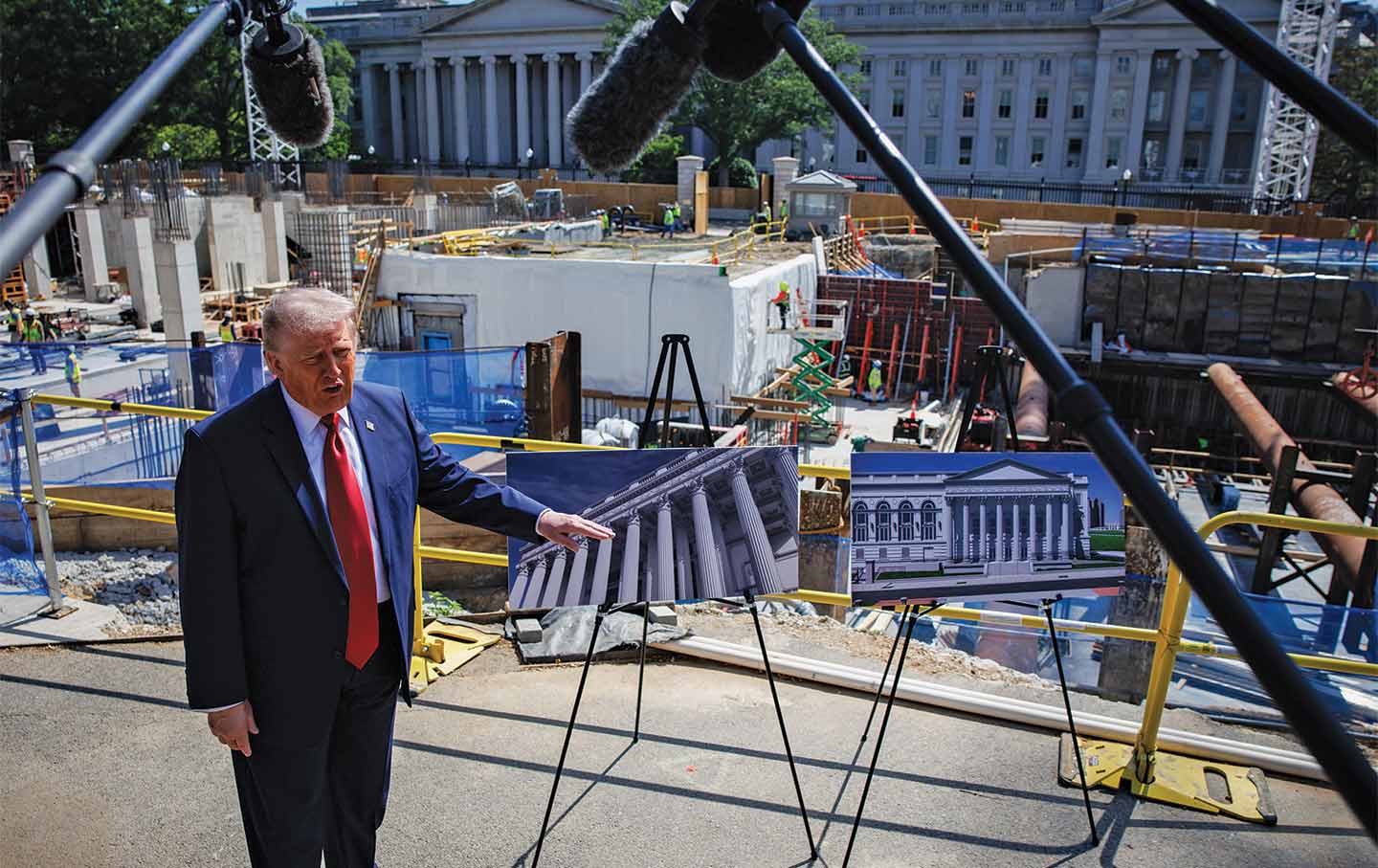
The Real Problem With Trump’s Cheesy Neoclassical Building Fetish
Sure, it’s a dog whistle for “retvrn” types and the results are tacky—but that’s not the worst part.
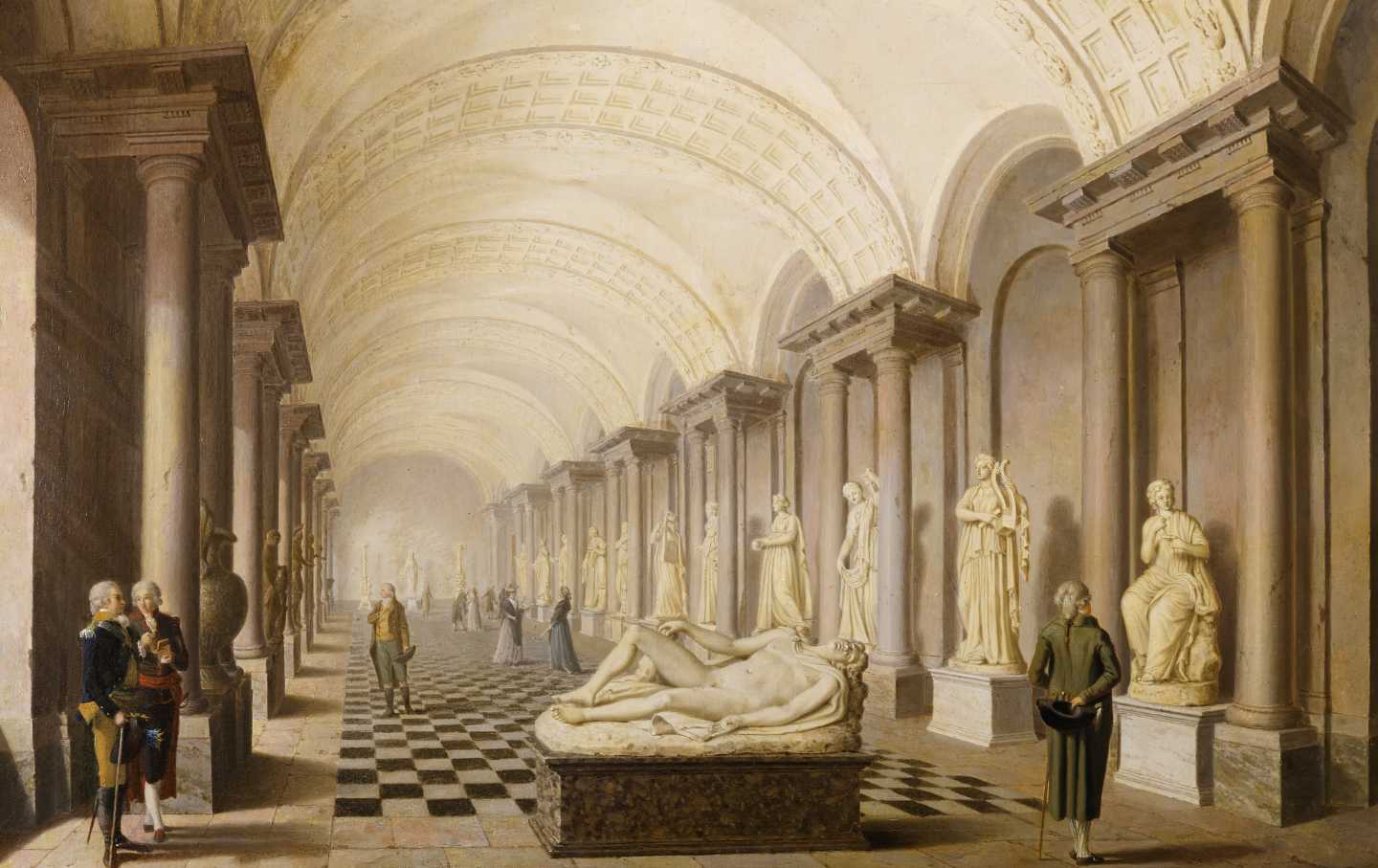
In his raft of day 1 executive order signings, President Trump revived an old hobbyhorse from his previous term: “traditional” architecture. In a brief memo, he declared that the General Services Administration (or GSA, the agency that, among other things, is in charge of government buildings) and other federal agencies have 60 days to submit
recommendations to advance the policy that Federal public buildings should be visually identifiable as civic buildings and respect regional, traditional, and classical architectural heritage in order to uplift and beautify public spaces and ennoble the United States and our system of self-government. Such recommendations shall consider appropriate revisions to the Guiding Principles for Federal Architecture and procedures for incorporating community input into Federal building design selections.
For the uninitiated, the GSA’s “Guiding Principles for Federal Architecture” were issued in 1962 and state that “an official [architectural] style must be avoided” for federal buildings and that new buildings should be exemplary of the time in which they are built. It’s déjà vu: Trump is stoking the culture war embers with a redux of the neoclassical architecture diktat from his first term. The new mandate rehashes the “Make federal buildings neoclassical again” executive order he issued in 2020, which was repealed by Joe Biden when he became president. Like its 2020 predecessor, the new order has little to do with classical architecture in any meaningful way—which itself has been decontextualized from its ideologies, aesthetics, spatial origins, and material conditions and flattened into a kind of “Deus vult” meme for people overly concerned with their haplogroup type. Trump uses history and its symbols for his own ends, and we’re wasting our breath insisting that the symbols are being used wrong. The left shares some of the blame for failing to properly mobilize around the reality that a lot of new buildings are ugly, that they are ugly because they are cheap, and that they’re cheap because architecture has devolved into a shitty job more and more alienated from things like materiality and the building site, and because developers and investors care only about the bottom line.
It doesn’t matter to Trump et al. that actually building in a traditional style is astronomically more expensive and wasteful, or that adding another layer of bureaucracy to aesthetic production smacks of Albert Speer–style despotism (here one can’t help but think of Musk’s alleged Hitlergruß). Any building that comes out of such a program will have a distinctly McMansion-like appearance, because we possess neither the trade labor nor the natural resources that supplied the architectural revivals of the 19th century. For at least 50 years now, ours has been the era of engraved concrete and foam columns covered in plastic.
Trump’s latest executive order does differ in telling ways from the last one. The 2020 version was far more detailed, articulating specific methods of controlling architectural production. It included a directive to create a President’s Council on Improving Federal Civic Architecture to enforce the mandate to “traditionalize” new construction. The order explicitly discounted the opinion of “artists, architects, engineers, art or architecture critics, members of the building industry or any other members of the public that are affiliated with any interest group or organization” involved in architecture. Essentially that left, well, Tucker Carlson.
The new memo, by contrast, is merely a call for proposals instead of a proposal itself. It gives no instructions, merely suggestions. Neither “regional,” “traditional,” or “classical” architecture are even defined. This speaks to a broader difference between the last Trump administration and this one: He’s far more organized now. Trump is doing a smash-and-grab on the whole federal government and needn’t waste his time on minutiae, and I’m sure the vague language of the order makes it easier for whatever private companies are going to get kickbacks from this to join in. So while the new executive order is concerning, it is, above all, a distraction. Aesthetics are obviously political and matter in and of themselves; however, in this case, they effectively divert our attention away from the policies that Trump is fomenting—policies that will have far-reaching consequences for the built environment. His tariffs, if they go into effect, will have a devastating impact on the construction industry, as will his draconian immigration policies, which will target both white-collar workers within architecture and the primary labor force that builds the country’s architecture. His rabid anti-DEI measures also target federal contractors, including in construction. Trump has filled his cabinet, including the GSA, with tech and finance lackeys who have vowed to crush the Green New Deal and any and all environmental programs. These outcomes will be worse for architecture than the mandate of a few cheesy columns that may or may not ever get built. It’s not just aesthetics that Trump is turning back the clock on—it’s any and all progress. Ours will be a time of mass chaos and inexhaustible graft.
Architects and firms should start thinking now about how these huge upheavals in government contracts and further funding cuts and directives will affect them. Long have I argued in these pages for acts of refusal against despotic regimes like Benjamin Netanyahu’s in Israel and Mohammed bin Salman’s in Saudi Arabia. But it’s time to revive those Trump 1.0–era acts of refusal, especially within one’s own workplace. Trump’s plans require compliance to come to fruition, and as an industry, frankly, architecture is all too willing to acquiesce in the name of profit. Actions in the field should be focused less on aesthetics than on what work is being done, for whom, and—ever more important as our neighbors are targeted for deportation—by whom. We need to talk again about saying no, not simply because something is tacky and creativity-destroying, but because it is wrong. Trump’s actions are making it clear that things are not going back to normal.