
Donald Trump Is Building a Bridge to 1896
The president-elect promises to rule with robber baron tactics and imperial belligerence—just like his role model, William McKinley.
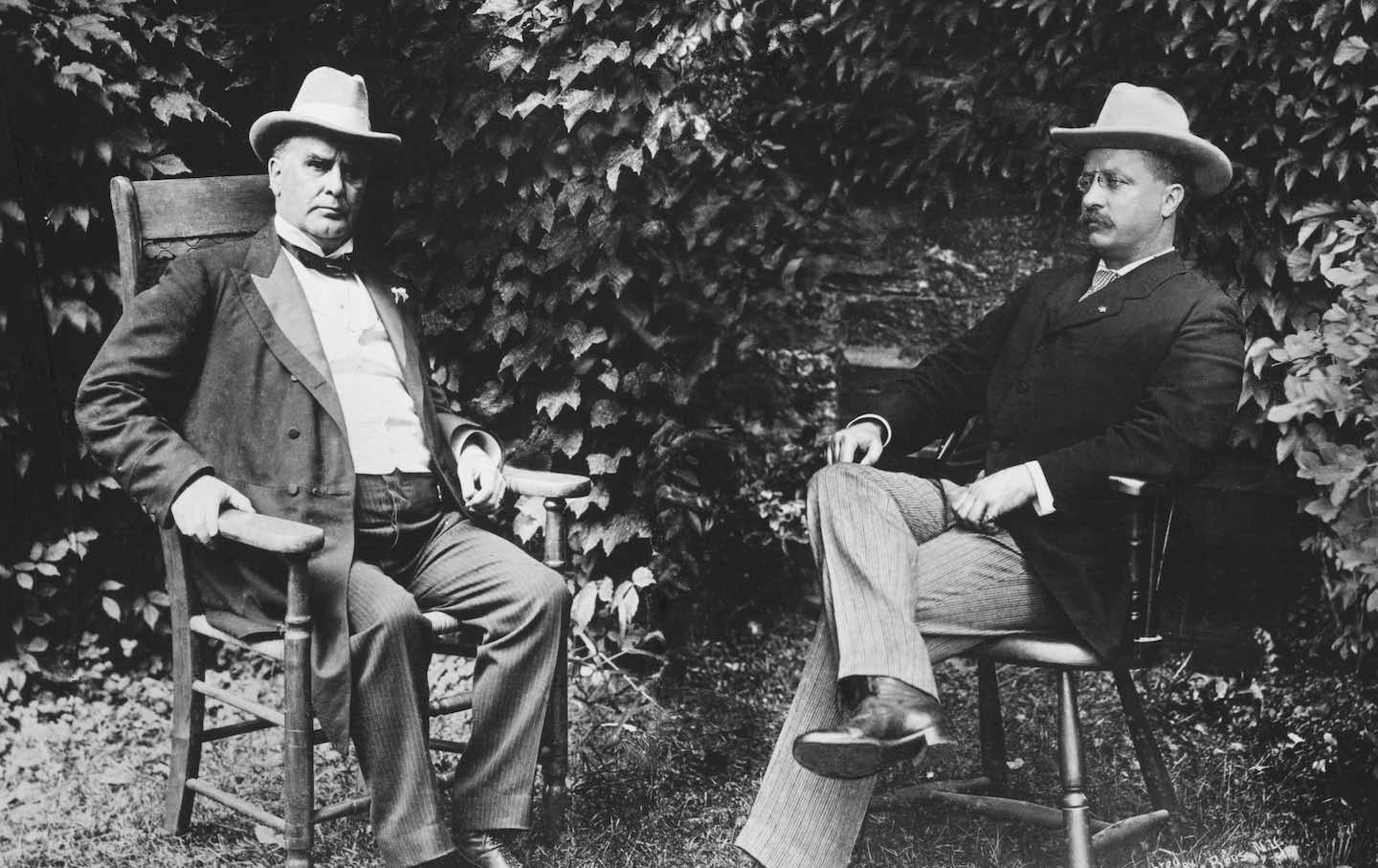
President William McKinley and Vice President Theodore Roosevelt.
(Bettmann / Getty)For at least two decades now, social critics and commentators have been proclaiming that America is in a second Gilded Age. Like the similar fascism debate, the invocation of the late 19th century’s summit of freebooting capitalism to characterize our own age of rampaging inequality obscures as much as it illuminates. Yet, here on the cusp of Donald Trump’s second administration, at least one Gilded Age analogue is warranted: the presidency of William McKinley, which neatly distilled the outlook of the American ruling class in its self-assured prime.
Trump has invited some superficial comparisons to McKinley’s predecessor, the conservative Democrat Grover Cleveland, chiefly because he’s the only other president to serve nonconsecutive terms. But in most every feature of his governing agenda, Trump is a proud McKinleyite—and most especially in his vision of an executive branch that functions as a helpmeet to private business interests.
Trump’s most high-profile affinity with McKinley is his aggressive tariff plan. “In the 1890s, our country was probably the wealthiest it ever was because it was a system of tariffs,” Trump declared from the 2024 campaign stump. “We had a president, you know McKinley? Remember Mount McKinley?” The president-elect’s aggrieved longing for the former name of the Alaskan mountain Denali, the highest point in North America—a site with scarcely any historical connection to McKinley, who never even visited it—runs deep. Over the past month, he has included the renaming of Denali in McKinley’s honor—an idea he first floated during his 2016 campaign—in his grab-bag effort to imprint old American imperial prerogatives across the globe. More important, Trump’s McKinley nostalgia is centered around a completely mangled historical reference—the 1890s only produced unprecedented wealth for the 1 percent, and broad immiseration for the country’s working majority; indeed, in 1897, the 4,000 families representing the top 1 percent of wealth and asset ownership controlled more of the economy than the country’s 11.6 million remaining families.
Trump’s exuberant lurch into imperial fancy—with plans to annex Canada and Greenland alongside a demand to reclaim US sovereignty over the Panama Canal and, what the hell, a ploy to rename the Gulf of Mexico as the Gulf of America—is another tribute to McKinley, who transformed the United States from a territorial empire into a globe-bestriding one via the Spanish-American War. McKinley was initially ambivalent about entry into the conflict, which would place Cuba, the Philippines, and the Hawaiian Islands under America’s far-from-benevolent authority. But he eventually came around, claiming that Filipino citizens were clamoring for American control of the island nation as a means of realizing basic civic freedoms—an assertion roughly as plausible as Trump’s recent declaration that Canadian Prime Minister Justin Trudeau was forced to resign in the face of a mass movement demanding the country’s admission into the flailing American republic as the 51st state.
Imperial hubris, of course, is never detained by mere considerations of fact, which is why nearly all subsequent American interventions abroad, from Vietnam and Grenada to Iraq, were rationalized on slight variations on McKinley’s fond reverie that Filipinos—and Cubans and Hawaiians—were sure to greet their American occupiers as liberators.
If anything, Trump is showing himself to be a much more hair-trigger imperialist than his predecessor. He’s already signaled that he won’t rule out military force to gain new territory, which would seem to align his imperial profile more with the demented jingoist worldview of McKinley’s vice president and successor, Theodore Roosevelt. The first presidential Roosevelt vastly overcompensated for a pampered and sickly childhood with a swashbuckling adherence to what he called “the martial spirit”—staging a charge up San Juan Hill in Puerto Rico, embarking on big-game safari tours in Africa, and laying claim to US sovereignty over the Panama Canal during its construction. It’s thus entirely fitting that, more than a century later,Trump is trying the same imperial gambit to rally expansionist sentiment behind him.
McKinley, on the other hand, once reassured that his business backers were on board with the new American imperium, reverted to standard-issue political appeals, campaigning for reelection in 1900 under the slogan “a full dinner pail .”His past support for protectionism gave way to the imperial project of opening up global markets for American enterprise. In an 1897 address before the Cincinnati Commercial Club, he announced that “it should be our settled purpose to open trade wherever we can, making our ships and our commerce messengers of peace and amity.”
Trump, for his part, also ran on a vague promise to restore mass prosperity, but he’s gearing up to turn his second administration into both a personal and national vanity project, leaving basic guarantees of economic security an afterthought at best. He has already made it clear that he’s unlikely to lower the prices of basic staples—a central pledge of his 2024 campaign. And his aggressive tariff policies, along with the trade wars they’d likely touch off, are likely to create fresh inflationary spirals.
Trump has also auctioned off regulatory giveaways to oil industry executives in exchange for campaign donations, and promised a parallel free ride through the permitting process for big-ticket foreign investors. None of these measures are expected to improve the standing of ordinary Americans struggling to get by; they are, rather, designed to advance government by and for the rich. That’s also the clear brief before Trump’s administration-in-waiting, which boasts 13 billionaire nominees.
McKinley was elevated to the presidency in the first place largely because he was the consensus candidate for America’s robber-baron caste. His de facto campaign manager, Mark Hanna, was the head of the Republican National Committee—but far more consequentially, Hanna was a well-connected rich industrialist who tapped major donations for McKinley from the fortunes of John D. Rockefeller, J.P. Morgan, and other financial titans spooked by Populist lawmaker William Jennings Bryan’s capture of the Democratic nomination in 1896. “There are two things that are important in politics,” Hanna famously remarked. “The first is money, and I can’t remember what the second one is.”
Hanna’s role has been reprised in Trumpworld by the excitable racist Elon Musk, whose $277 million subsidy to the 2024 Trump campaign represents the biggest donation from a single source in American history. Musk already reaped a major return on his investment by browbeating Trump and the GOP into rescinding enhanced oversight of US investments in China—where Musk-owned auto plants account for roughly one-fourth of all revenues for his Tesla electric-vehicle empire—during last month’s shutdown battle in Congress. But Musk’s role as the White House’s plutocracy czar has yet to begin in earnest: His extra-cabinet post as cochair (with fellow hack billionaire Vivek Ramaswamy) of the new Department of Government Efficiency will likely normalize the corrupt profiteering off of government operations on a scale that Mark Hanna could only dream of.
Mainstream political coverage has largely overlooked the deep affinities between the McKinley and Trump models of governance, thanks in no small part to the American press’s inattention to the basics of political economy, not to mention its endemic historical illiteracy. More than that, though, Trump’s cultish regard for McKinley gives the lie to the corporate media’s central narrative about Trump and the MAGA movement—that it’s a populist insurgency aimed at toppling sinister networks of elite influence.
The specter of Trump extolling the legacy of an American president recruited by the ruling class to smite a genuine populist rebellion from below exposes the hollowness of a story that has disfigured the basic coordinates of political causation for the past decade. That’s why we should not only be prepared for a Trump term that doubles as a plutocratic feeding frenzy, but also the glum sequel of JD Vance taking up the mantle of Teddy Roosevelt in the wreckage. Only here, too, the Trumpian variation on the theme is sure to be a major step downward: Vance shares TR’s imperial-racist worldview, but is a neoreactionary traitor to his working-class roots, whereas Roosevelt forsook his patrician birthright in favor of trust-busting Progressivism. History, in short, won’t repeat itself; it will only get worse.
Become a Sustaining Donor This September
Between the reemergence of right-wing red-baiting and Donald Trump’s use of the chilling National Security Presidential Memorandum–7 to criminalize left political organizing, we’re seeing McCarthyism reborn before our eyes.
This assault on democracy cannot be ignored or wished away. Resisting it requires bravery in the face of threats and repression, a steadfast commitment to the truth, and the unwavering belief that we can—and will—overcome this darkness.
We must have an independent media that sets the record straight, unearths corruption and abuses of power, and advances a politics of justice and dignity for all if we’re to win this fight.
That’s why I’m writing to you today. This September, The Nation needs to add 100 monthly donors to sustain our progressive journalism. Your contribution makes the next investigative report, the next truth-speaking column, and the next pathbreaking essay all possible.
I hope you’ll support our work with a recurring donation today. If you donate $10 or more a month, we’ll send you a brand new “Hands Off the Free Press!” sticker to recognise your commitment to our cause. Please, donate today.
Onward,
Katrina vanden Heuvel
Editor and Publisher, The Nation
More from The Nation
In Memory of Gloria Steinem In Memory of Gloria Steinem
A spontaneous memorial honoring Gloria Steinem (March 25, 1934–September 2, 2026), an extraordinary woman, leader, and lifelong force for equality. New York City, September 2026.
Electric Shocks for Kids and the Push to Militarize Schools Electric Shocks for Kids and the Push to Militarize Schools
Electric-shock gloves used on students in Nebraska are the latest sign of how policing, surveillance, and military technology have entered American schools.
Assault Weapons Are Banned in Massachusetts. These Leftists Want to Change That. Assault Weapons Are Banned in Massachusetts. These Leftists Want to Change That.
The Liberal Gun Club, which has chapters in more than 30 states, reported a spike in interest as ICE raids ratcheted up early this year.
MAGA Is Exploiting the Lindsay Clancy Case to Try to End Voting for Women MAGA Is Exploiting the Lindsay Clancy Case to Try to End Voting for Women
As Trump subverts elections, his most ardent fans want to overturn the 19th Amendment.
Artificial Intelligence: Who Is Giving Birth to the Future? Artificial Intelligence: Who Is Giving Birth to the Future?
What are the dangers of surrendering too much of our humanity to technology?

The US Had a Choice After 9/11. It Chose Wrong. The US Had a Choice After 9/11. It Chose Wrong.
In this week’s Elie v. U.S., our justice correspondent reflects on September 11. Plus: the stupidity of the "Trump Dividend" and the threat of AI.

