The Media Is Giving Away Its Rights Even Before Trump Tries to Take Them
Recent events have shown that Trump does not have to impose a new regime of censorship if the press censors itself first.
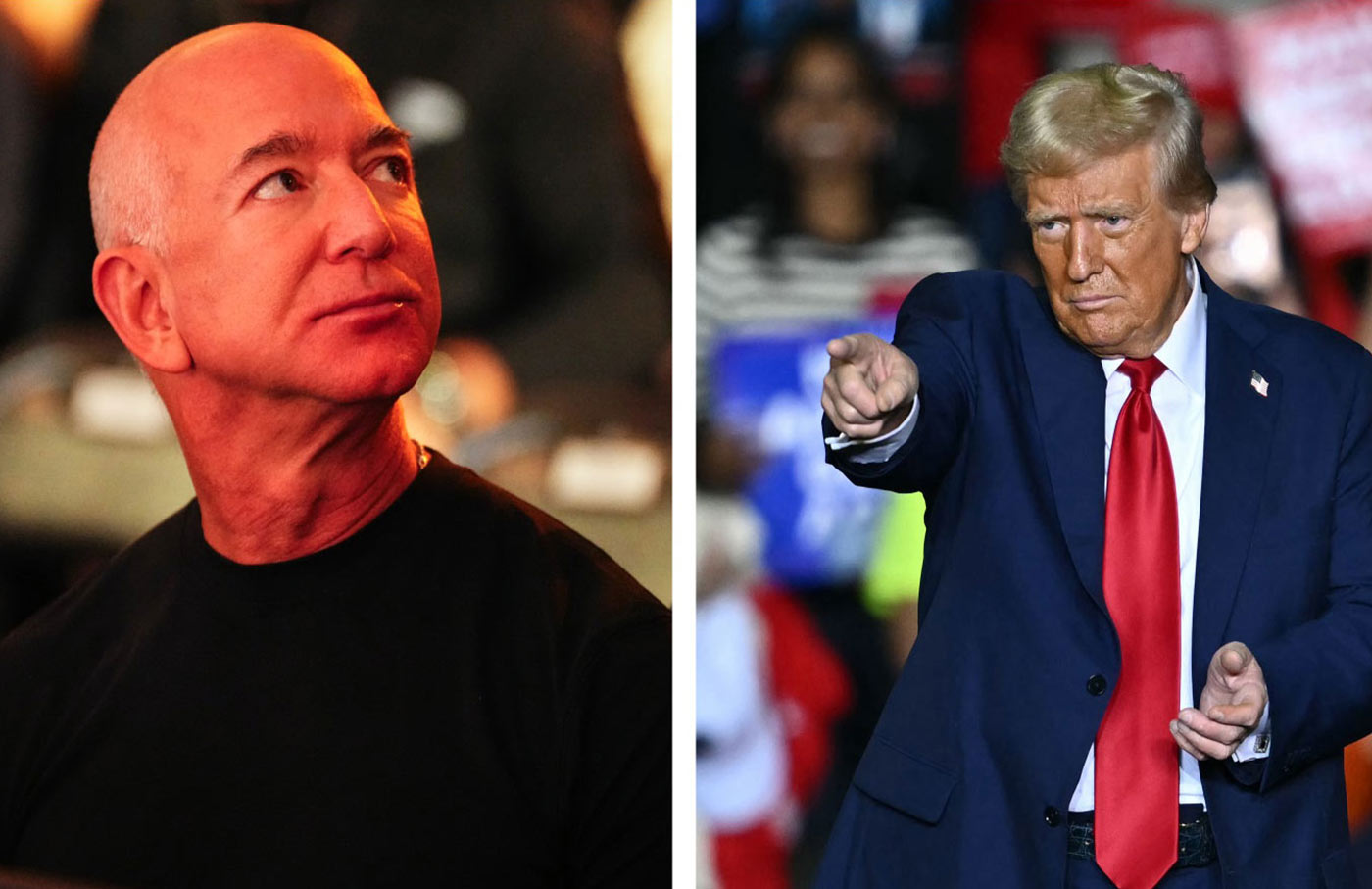
Donald Trump is a clear and present danger to the freedom of the press. He tells his violent and rabid supporters that the media is an “enemy of the people,” sues news outlets over coverage he doesn’t like, and constantly threatens to change the laws to limit freedom of the press. Still, for all of his rhetorical bluster and real legal aggression, he is not the greatest danger to the press. That dystopian honor goes to the people who own the press themselves.
In December, ABC News settled a defamation lawsuit brought by Trump, agreeing to offer a written apology and make a $15 million “charitable contribution” to Trump’s future presidential foundation and museum. The settlement was rightly viewed as a major legal victory for the grifter in chief, but it also, and more crucially, represented a massive failure by a news media that is simply unwilling to defend itself against Trump’s attacks.
Trump’s lawsuit concerned comments made by This Week anchor George Stephanopoulos. During a March 2024 interview, he referred to the case brought against Trump by E. Jean Carroll, noting that “judges and two separate juries have found [Trump] liable for rape and for defaming the victim of that rape.”
Stephanopoulos’s use of the term rape was technically inaccurate. The jury in the Carroll case found Trump liable for sexual abuse and awarded her $5 million, but it did not find him liable for rape. Under New York State law, rape requires penetration by a penis, while sexual abuse does not. But in the common parlance, the events Carroll described for which Trump was held liable are often referred to as rape. You don’t have to take my word for it. In 2023, Judge Lewis Kaplan (a Bill Clinton appointee) dismissed a defamation lawsuit Trump had brought against Carroll, writing: “Indeed, the jury’s verdict in [Carroll] establishes…the fact that Mr. Trump ‘raped’ her, albeit digitally rather than with his penis. Thus, it establishes against him the substantial truth of Ms. Carroll’s ‘rape’ accusations.”
Kaplan’s ruling could have been applied to the Trump lawsuit against Stephanopoulos, but in July 2024, Judge Cecilia Altonaga (a George W. Bush appointee) refused to dismiss Trump’s case, arguing that “Stephanopoulos’s statements dealt not with the public’s usage of that term [rape], but the jury’s consideration of it during a formal legal proceeding.” While I found Altonaga’s ruling dubious, it nonetheless set the stage for a discovery process (during which Trump’s legal team would have had access to internal ABC News e-mails), a trial, and perhaps a lengthy appeals process, by which point Trump would be a sitting president again.
Instead of fighting Trump, ABC News and its parent company, Disney, decided to capitulate. Never mind that Trump’s case was weak, even after Altonaga’s ruling. The bar to defame a public figure is very high in this country; indeed, First Amendment protections are arguably at their strongest when talking about politicians and certainly the president. To win, Trump’s legal team would have had to prove not only that Stephanopoulos’s statement was false and defamatory—something that would be up to a jury to determine—but also that Stephanopoulos acted with malice.
Never mind also that Disney is a global behemoth with a market cap of more than $200 billion, meaning that, even if Trump had ultimately been successful in his claims, the legal damages would not have been financially crippling. Trump is already widely regarded by people likely to be watching Stephanopoulos as a man of low character who can’t be trusted. While defaming such a person is possible, it’s hard to come up with a theory of how Stephanopoulos’s words damaged Trump’s already scummy reputation beyond “slap on the wrist” money.
What makes the ABC case so troubling is that, as craven a display of preemptive obeisance as it was, it was hardly singular. We have seen a lot of this cowardice from the media these past few months—from the decisions of the owners of the Los Angeles Times and The Washington Post to forgo endorsing a presidential candidate to the choice of morning-show hosts Joe Scarborough and Mika Brzezinski to travel to Mar-a-Lago to kiss Trump’s ring. The most powerful forces in the media seem to have decided that keeping Trump happy is their prime mission.
Of course, Trump has taken all this media genuflecting as license to go farther. Just before the election, he filed a $10 billion lawsuit against CBS, claiming that the network had edited its 60 Minutes interview with Kamala Harris to make her look good. And in December, he sued The Des Moines Register; its parent company, Gannett; and the pollster Ann Selzer for publishing her poll suggesting Trump was going to lose Iowa. That poll turned out to be incredibly wrong, but threatening a news organization because its polling was wrong illustrates just how fiercely Trump plans to harass media outlets that don’t give him the narratives he wants.
Still, as bad as harassment is, it’s not the same as changing the law to weaken press freedoms. Before his first term, Trump talked about “opening up the libel laws” to make it easier for people like him to sue the press. He did not, however, make good on that promise (admittedly a hard task, given that libel laws are determined primarily by the states), and while some judges appear squishy about press freedoms, there hasn’t been a major recision of First Amendment protections since Trump emerged on the scene. The law, in broad strokes, has not changed on core free-press issues.
But the law does not have to change if the press will not fight for its freedoms. If Jeff Bezos, Disney, and Warner Bros. Discovery (which owns CNN) simply cower in the face of Trump, he and his loyal Supreme Court justices do not have to change the laws to silence the press. Trump does not have to impose a new regime of censorship if the press censors itself first. And that, I believe, is what we are witnessing now: a press that gives away its First Amendment rights before Trump takes them away. A press that will not speak truth to power if power threatens to kick their owners off a cocktail party list or gum up their operations.
The debasement of the press will continue until readers and viewers reject the media that would rather lie to them than tell the truth to Trump. The people who run these publications and news organizations are betting that we won’t.