
GOP-Backed Arizona Polls Have It Wrong
Republican-funded polling is simply not credible; the presidential race will be nail-bitingly close.
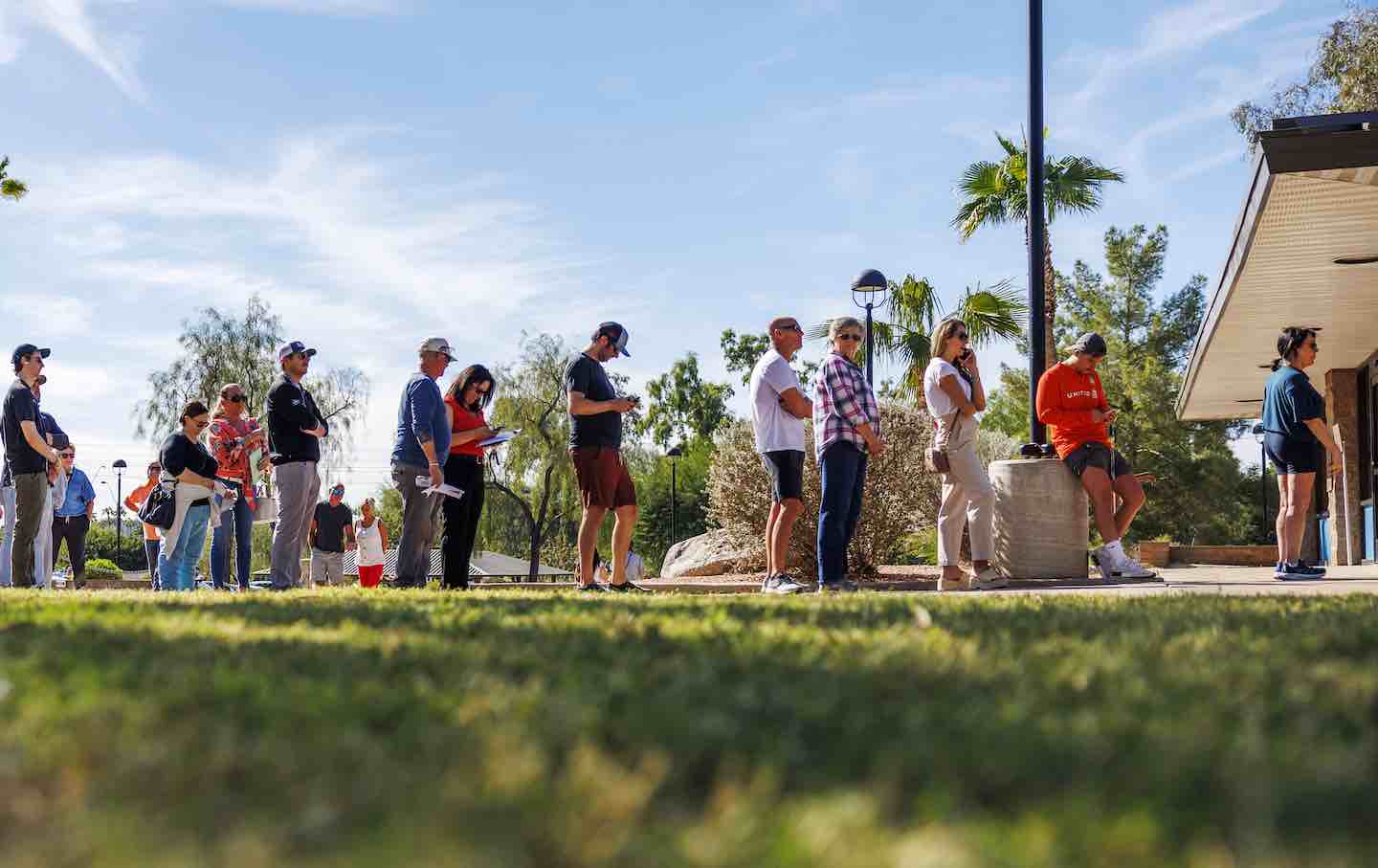
Arizona residents wait in line to vote early at the Indian Bend Wash Visitor Center on October 30, 2024,, in Scottsdale, Arizona.
(Gina Ferazzi / Los Angeles Times via Getty Images)
GOP-funded pollsters and polling groups with outlier results continue to flood the zone with polls of, at best, dubious credibility. Arizona—which Ad Impact now rates as the second-most-spent-on state in the country, after California, for media ads on political races—remains the ground zero of this misinformation game. The most recent example: Data Orbital, which has been awarded a diamond mark of credibility by FiveThirtyEight, published a poll earlier this week showing Donald Trump up eight in Arizona. It also shows Kari Lake ahead of Ruben Gallego in the US Senate race.
This polling is simply not credible, flying in the face of dozens of other surveys over the past year that have shown the presidential race in the state to be a dead heat and Lake to be considerably behind Gallego in the Senate contest. If I were into conspiracy theories—which, of course, I’m not—I’d say this one was shaping up to be a doozie: The GOP pumps bad data into the polling universe to create a false sense of momentum, and then, when the election result doesn’t go the way those polls suggest it will, the GOP and its election-denying base cries foul, launches a whole bunch of phony investigations, files lawsuits, and does everything it can to gum up the certification process, making it more likely that a Democratic-leaning Arizona won’t be able to certify its electors in time for Congress to count them.
Mike Noble, an Arizona-based pollster I have talked to several times in this cycle who believes the GOP is deliberately skewing the numbers with bad polling data, is furious. All the evidence that he and his team have gathered shows that the Arizona race is incredibly tight, and nothing they have seen suggests it broke decisively for Trump this week. They published their last statewide poll of the election cycle on Thursday, alongside a national poll that shows Harris up three points. In Arizona, Noble’s data has Trump up only 1 percent, with 48 percent to Harris’s 47, and with Gallego up four points.
All of the Arizona presidential polls showing such a close outcome leave open the possibility that the Democrats can overcome the Trump lead through a stronger ground game and a rigorous get-out-the-vote operation that they have spent years developing.
The last couple of election cycles provide precedent for just this scenario. Noble points out that in 2022 Data Orbital published poll after poll showing Lake significantly ahead in the governor’s race. It may or may not have been a coincidence that, as local media reported, Lake’s campaign had employed the father of George Khalaf, founder of the polling firm, as its treasurer.
Khalaf’s numbers helped to skew the averages toward the Republican; in the end, however, the Democratic candidate, Katie Hobbs, won the election. In the final poll of that season, the company predicted clear wins for the GOP election-deniers running for secretary of state and for attorney general. Those predictions also turned out to be wrong; the Democrats won both of those races as well. In other words, just because a pollster throws a bunch of numbers into the mix that make it look like the GOP is surging, that doesn’t mean there’s a real surge.
As Mike Tomasky recently wrote in The New Republic, the GOP bad-poll gimmick isn’t just an Arizona phenomenon. Similar manipulation of data has occurred in many of the swing states, rendering the rush of last-minute polls little more than a campaign prop.
Yet The New York Times continues to fall for the GOP strategy hook, line, and sinker, building into their rolling averages numbers from Data Orbital, the right-leaning Redfield & Wilton Strategies, and the Trafalgar Group. Of the last six polls in Arizona, four have come from these groups, with Data Orbital’s being given a disproportionate weight. That average, as a result, now puts Trump up 3 percent, roughly the same as the lead Lake supposedly had just before she lost the governor’s race to Katie Hobbs. Presumably, many of those supposedly reliable Republican voters who rejected Lake as being too extreme are, at the very least, having reservations about casting their ballots for the equally extreme Trump, meaning it’s more than likely Trump’s lead in Arizona is as much a desert mirage as was Lake’s two years ago.
Meanwhile, on the ground, away from the noise of the polls, the SEIU, the culinary workers, and the hotel workers’ unions are putting together their most ambitious door-knocking campaigns ever in both Arizona and in Nevada, with hundreds of canvassers, data analysts, and logistics experts saturating the large metropolitan areas in both states in a huge effort to identify likely Harris voters and then get them to actually vote.
According to Ted Papageorge, the secretary-treasurer of the culinary workers’ union in Nevada, his outfit alone has fielded 600 people: “room cleaners, house cleaners, cooks, and servers…workers talking to workers,” he said. “We’ve got boots on the ground—an army of workers.” In several recent elections, that huge effort in Las Vegas has ultimately made the difference, helping push Democrats such as presidential candidate Joe Biden and Senator Catherine Cortez Masto to narrow victories.
In Arizona, UNITE HERE! Local 11 and the affiliated 501c4 group Workers’ Power have combined to put several hundred union canvassers on the ground in Phoenix, looking to convert promises to vote for Harris into actual ballots cast. Susan Minato, the union local’s copresident and chair of Worker Power’s Board of Trustees, explains that their A-team canvassers—union members who have taken months of leave from their jobs to knock on doors in Phoenix—are reaching out to huge numbers of these voters over the coming days. “Moving the yes vote. Identify them and then move them,” Minato says of the challenge facing the canvassers in the crucial last days before Election Day. “It’s a tight, tight race, but this is the best we can do. We have more than 250 people on the ground.” There are also hundreds of volunteers supplementing the paid canvassers, fanning out across Phoenix to explain the stakes in an election in which Trump has embraced a harsh anti-democracy, and anti-immigrant, message.
It’s true that early voting numbers in both states have skewed Republican, unlike in 2020, when Trump all-but-ordered his supporters not to cast ballots early. But in both states, roughly a third of the electorate is independent, and there’s no evidence that independents have decisively broken for Trump. Papageorge thinks the result is going to be close—likely closer than in 2020, when Biden beat out Trump in Nevada by roughly 30,000 votes—but he believes that ultimately the union effort will win out.
My prediction? Ruben Gallego will win his Senate race in Arizona, and Jackie Rosen will win hers in Nevada. Neither of these elections will be particularly close. If the union canvas and Democratic Party’s ground game over the next several days work as planned, one, and possibly two, Arizona congressional seats could flip to the Democrats, which, in tandem with a couple likely pickups in California (in the Central Valley and in Orange County), as well as a smattering of pickups in other states, ought to be enough to give the Democrats control of the US House of Representatives come 2025. And with an abortion access measure on the ballot that is likely to drive progressives to the polls in high numbers, it isn’t beyond the bounds of the possible that at least one of the two Arizona legislative chambers will either go from being controlled by the GOP to being a tie. Conceivably, they might even flip to the Democrats.
Popular
“swipe left below to view more authors”Swipe →As for the presidential race, it will, clearly, be nail-bitingly close; for reasons that I find utterly unfathomable, Trump and his fascist messaging continue to hold a cultlike death grip over a huge part of the electorate. But at the end of the day, the unions’ get-out-the-vote effort is extremely well-organized—far better than the chaotic ground game of the Republicans and of late-entry allies such as Elon Musk—and has a proven track record in both states. And there is, as a result, Data Orbital’s latest numbers notwithstanding, a narrow pathway to victory for Harris in Nevada and Arizona.
So if you’re reading this and know people in those states still sitting on the fence or pondering not voting, get on the phone and explain to them exactly what is at stake in this election. Oftentimes, it’s hard to see how an individual’s vote matters. In Nevada and Arizona over the coming days, every vote could end up being the margin between victory and defeat.
Become a Sustaining Donor This September
Between the reemergence of right-wing red-baiting and Donald Trump’s use of the chilling National Security Presidential Memorandum–7 to criminalize left political organizing, we’re seeing McCarthyism reborn before our eyes.
This assault on democracy cannot be ignored or wished away. Resisting it requires bravery in the face of threats and repression, a steadfast commitment to the truth, and the unwavering belief that we can—and will—overcome this darkness.
We must have an independent media that sets the record straight, unearths corruption and abuses of power, and advances a politics of justice and dignity for all if we’re to win this fight.
That’s why I’m writing to you today. This September, The Nation needs to add 100 monthly donors to sustain our progressive journalism. Your contribution makes the next investigative report, the next truth-speaking column, and the next pathbreaking essay all possible.
I hope you’ll support our work with a recurring donation today. If you donate $10 or more a month, we’ll send you a brand new “Hands Off the Free Press!” sticker to recognise your commitment to our cause. Please, donate today.
Onward,
Katrina vanden Heuvel
Editor and Publisher, The Nation
More from The Nation

The US Had a Choice After 9/11. It Chose Wrong. The US Had a Choice After 9/11. It Chose Wrong.
In this week’s Elie v. U.S., our justice correspondent reflects on September 11. Plus: the stupidity of the "Trump Dividend" and the threat of AI.


Trump Wants Voters to Pretend He’s on the Ballot Trump Wants Voters to Pretend He’s on the Ballot
But Republican midterm candidates are hoping everyone forgets he exists.

Remembrance: 25 Years Since the September 11 Attacks Remembrance: 25 Years Since the September 11 Attacks
On September 11, 2001, coordinated terrorist attacks carried out by the extremist group al-Qaeda killed 2,977 people and injured more than 6,000 others in the United States.

How The Nation Covered 9/11 How "The Nation" Covered 9/11
Our phone lines were down. People were weeping. But we got an issue out the door with morality, justice, and nuance.

James Talarico’s Leap of Faith James Talarico’s Leap of Faith
The Democratic Senate candidate in Texas is reviving a long-neglected tradition of left-leaning American religiosity.

