The Press Needs to Start Taking Trump Literally
The former president’s threats may seem outlandish. But his agenda is genuinely dangerous.
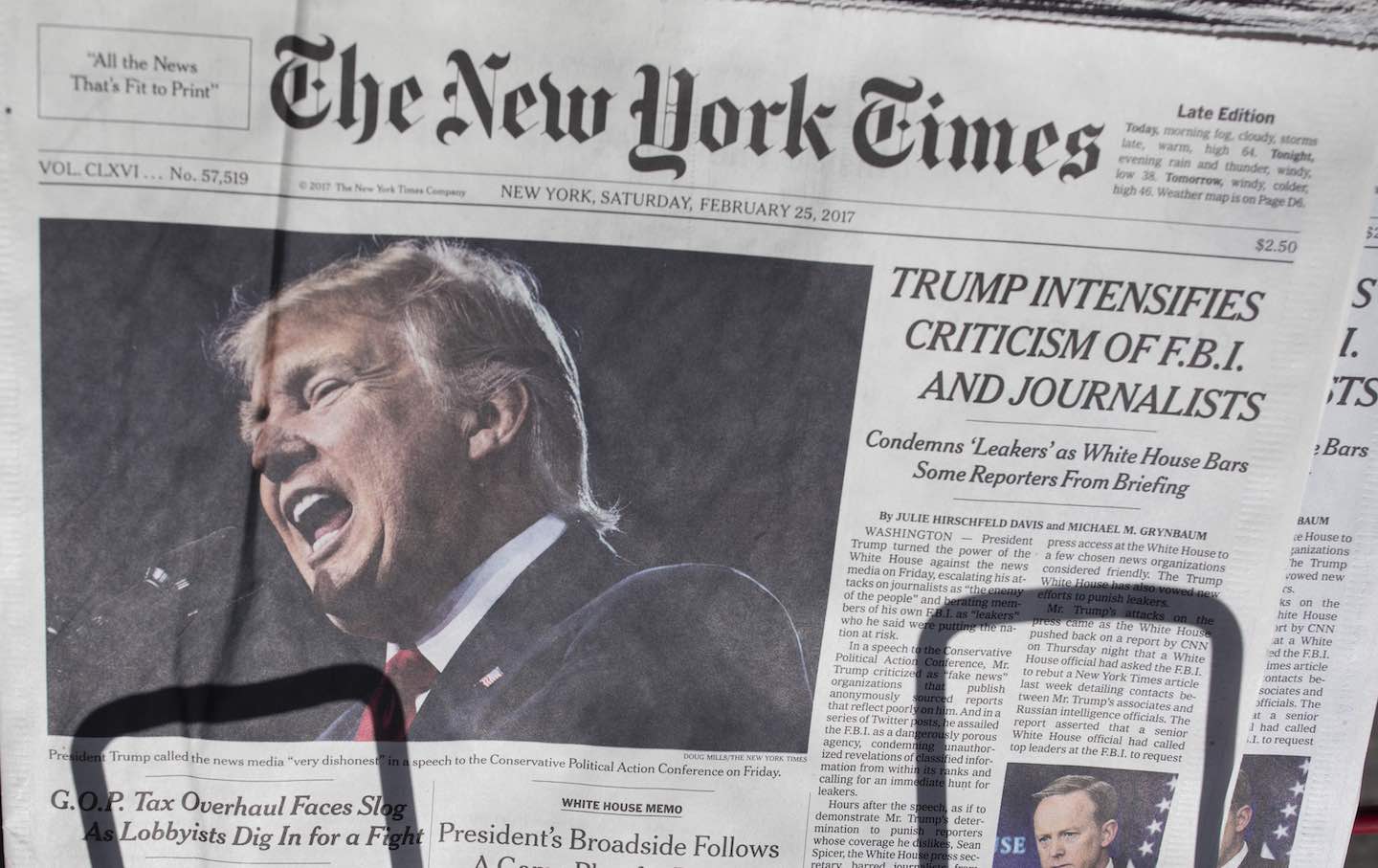
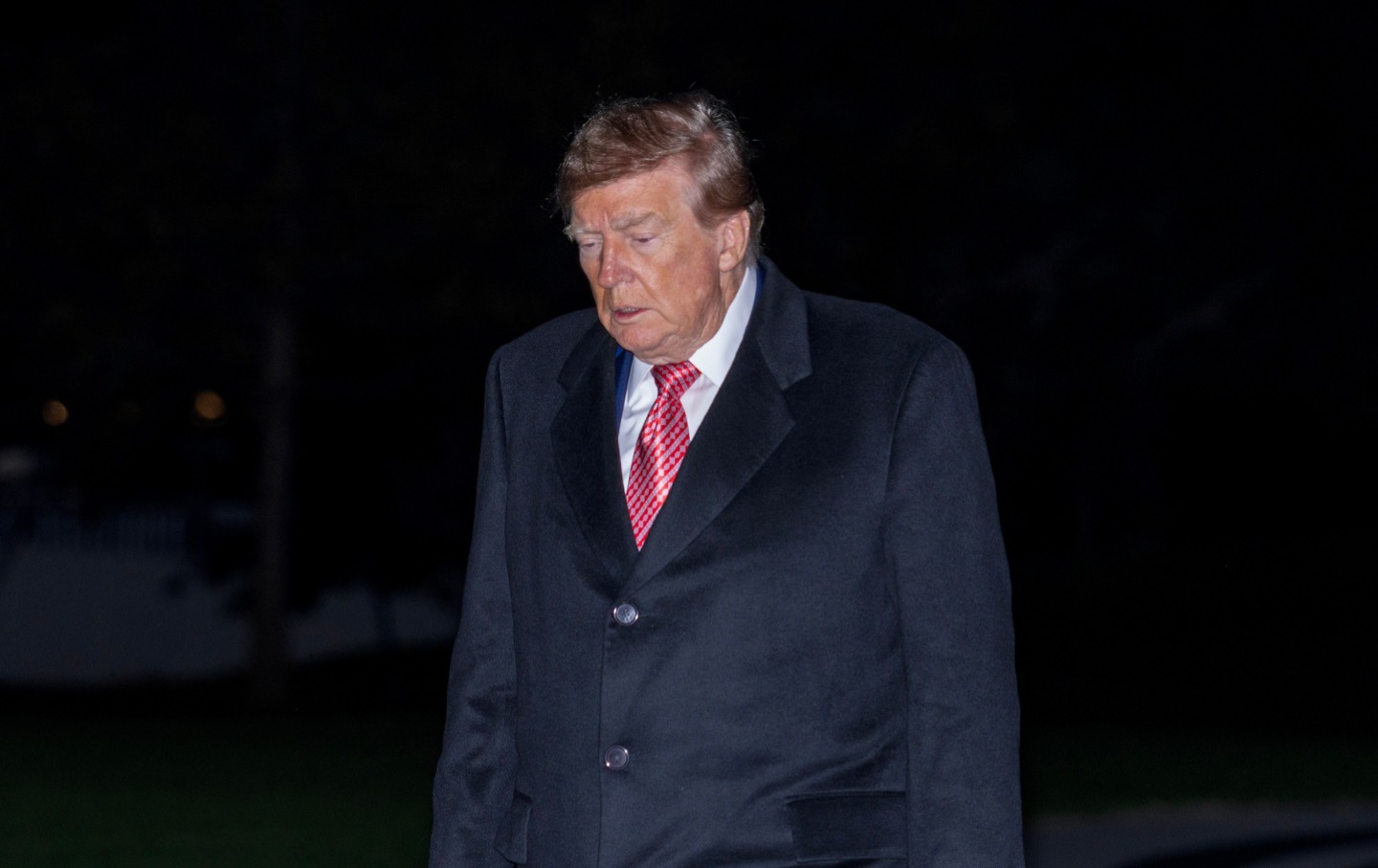
The front page of The New York Times carries a picture of President Donald Trump, a day after he criticized in a speech the FBI and journalists in New York City.
(Robert Nickelsberg / Getty Images)As Donald Trump muses about shutting down media outlets he doesn’t like and bringing military force to bear on dissenting critics, the national political press comes bearing a soothing message, one it patented during his 2016 run: He’s probably not serious about any of this. That’s the brunt of New York Times reporter Shawn McCreesh’s campaign dispatch “The Trump Supporters Who Don’t Believe Trump.” As Trump unleashes a blizzard of authoritarian threats and incitements to racist political violence, McCreesh canvasses MAGA enthusiasts who believe there’s not much to see here.
Yes, Trump did deliver on many of his ugliest 2016 campaign threats, from the Muslim immigration ban to the legal badgering of political opponents (you know, the phenomenon that he and his supporters call “weaponization” out of the other sides of their mouths) to the attempted coup on January 6. But all the talk this cycle of a Purge-style show of unlicensed police force? The specter of mass deportation of millions of immigrants, regardless of their legal status? It’s all just for show, McCreesh’s informants say; after all, Trump never went after Hillary Clinton the way he threatened to during the 2016 campaign, and as McCreesh puts it in clunky, faux wised-up pundit-ese, “a lot of his strongman jaw-jaw remained just that.”
“I think the media blows stuff out of proportion for sensationalism,” Michigan-based publishing executive Mario Fachini told McCreesh after Trump’s speech on economic policy before the Detroit Economic Club earlier this month. Retired financial officer Tom Pierce from Northville, Michigan, echoed the same jaded refrain, as he dismissed the candidate’s vows of mass deportations and 200 percent tariffs: “He may say things, and then it gets people all upset, but then he turns around and says, ‘No, I’m not doing that.’ It’s a negotiation. But people don’t understand that.”
This late-campaign discovery of Trump backers who dismiss and distance themselves from his fascist appeals is a reprise of the oft-cited 2016 directive from the Trump-sympathizing pundit Salena Zito, to take Trump “seriously, but not literally.” (That disastrous counsel, as it happened, surfaced at another swing-state economic forum during Trump’s first campaign, a shale-industry summit in Pittsburgh; it’s fair to say that something about heartland gatherings of the chieftains of industry inspires prestige commentators to view all truth claims as mere social constructions.) At the moment when threats of a Muslim travel ban and of Mob-style political retribution from a Trump Justice Department should have prompted alarm among the gatekeepers of political discourse, they instead reverted to the phoned-in narrative they deployed during Trump’s siege of the Republican primary cycle. This was all a glorified reality-TV spectacle, they told themselves, and it therefore didn’t oblige them to exercise the kind of due diligence reserved for more conventional presidential candidates. Trump was playing a different game, and the basic rules of candidate accountability simply didn’t apply.
This first-order failure of journalistic responsibility enabled Trump to shred fundamental demands of openness and disclosure for presidential aspirants—from withholding his tax returns to permitting the family trust administering his business to wildly profiteer off his presidency, in flagrant violation of the emoluments clause of the Constitution. In the final stretch of the campaign, with the leak of the infamous Access Hollywood tape that documented Trump bragging of his record as a serial sexual assaulter—a revelation that would have proven fatal to any other candidate—Trump was able to ride out the scandal. He even manged to milk it for more credulous press coverage by inviting women who’d accused Bill Clinton of sexual assault to sit in the crowd for his final debate with Hillary Clinton. The toxic tape had become just another sideshow in the 2016 spectacle, as the reporters and producers who enabled it were suddenly baffled by Trump’s Teflon candidacy.
That befuddlement was inexcusable then, and it’s doubly so now, as Trump runs on an explicitly fascist platform that proposes overhauling the entire federal government under the dictates of the Heritage Foundation’s Project 2025. With Election Day just over three weeks away, no civic and journalistic purpose is served by transcribing the alibis of Trump supporters who will gladly throw over the remaining protections of our formal democracy for more tax cuts.
Indeed, McCreesh’s dispatch is especially egregious in glossing over the actual substance of Trump’s Economic Club appearance, which was an incoherent mishmash of gimmicks posing as an economic agenda. Trump again brandished tariffs as the panacea for the country’s economy, even though they would likely slow down economic growth and spike inflation while enacting a de facto consumer tax for ordinary Americans of nearly $4,000 a year. (McCreesh only briefly touches on Trump’s fantasies of a 200 percent tariff, chiefly to quote the candidate’s own rationale for confecting them on Fox News: “I’m using that as just a figure. I’ll say 100, 200, I’ll say 500. I don’t care.”) He also touted a tax deduction for auto loans—a policy that would overwhelmingly benefit wealthy Americans, since they are the filers who most frequently itemize their loan transactions, and since Trump had already limited deductions available to lower-income earners in his 2018 tax package. As for Trump’s next round of proposed tax cuts, they too, are designed to benefit the economic power elite, with no discernible gains to the economy at large. As the Columbia Journalism Review’s Bartholemew Jem writes, “Overall, Trump’s funfair economic proposals would amount to, on average, a tax increase for every income group except the top 5 percent of earners, according to the Institute on Taxation and Economic Policy.” This is to say nothing, of course, of Trump’s Mitch McConnell–like impersonation of a statue for five full minutes prior to his remarks, or his derision of Detroit as an unlivable dystopia at an event in Detroit.
No, the Paper of Record’s principal takeaway from this latest Trump showcase of gibberish, dementia, and resentment is that Trump’s savvier followers know what he really means, and what he’s really going to do if he’s once again graced with the most powerful job in the world. If our elite press weren’t so doggedly amnesia-prone and idea-resistant, McCreesh and his editors might have paused to recall that Salena Zito’s own career as a heartland MAGA whisperer was founded on bullshit. When she published her 2016 reportage in a 2018 book called The Great Revolt, it came to light that she’d lifted some of her accounts from other sources without attribution, and repeatedly quoted GOP political operatives as disillusioned regular-folks voters. Lately, she’s taken to pimping Elon Musk as an apostle of the Trumpian “ethos of the American working man” and speculating on divine intervention on Trump’s behalf in the Butler, Pennsylvania, assassination attempt. Such are the wages of taking Donald Trump seriously and not literally, and the wish-fulfillment fantasies of Midwestern business boosters, duly parroted by the Gray Lady’s stenographers, only work to further enable them.