Meet Dan Osborn, the Heartland Populist From Nebraska Who’s Running for the Senate
He knows the breadbasket of the country and has a record of helping working people put food on the table.
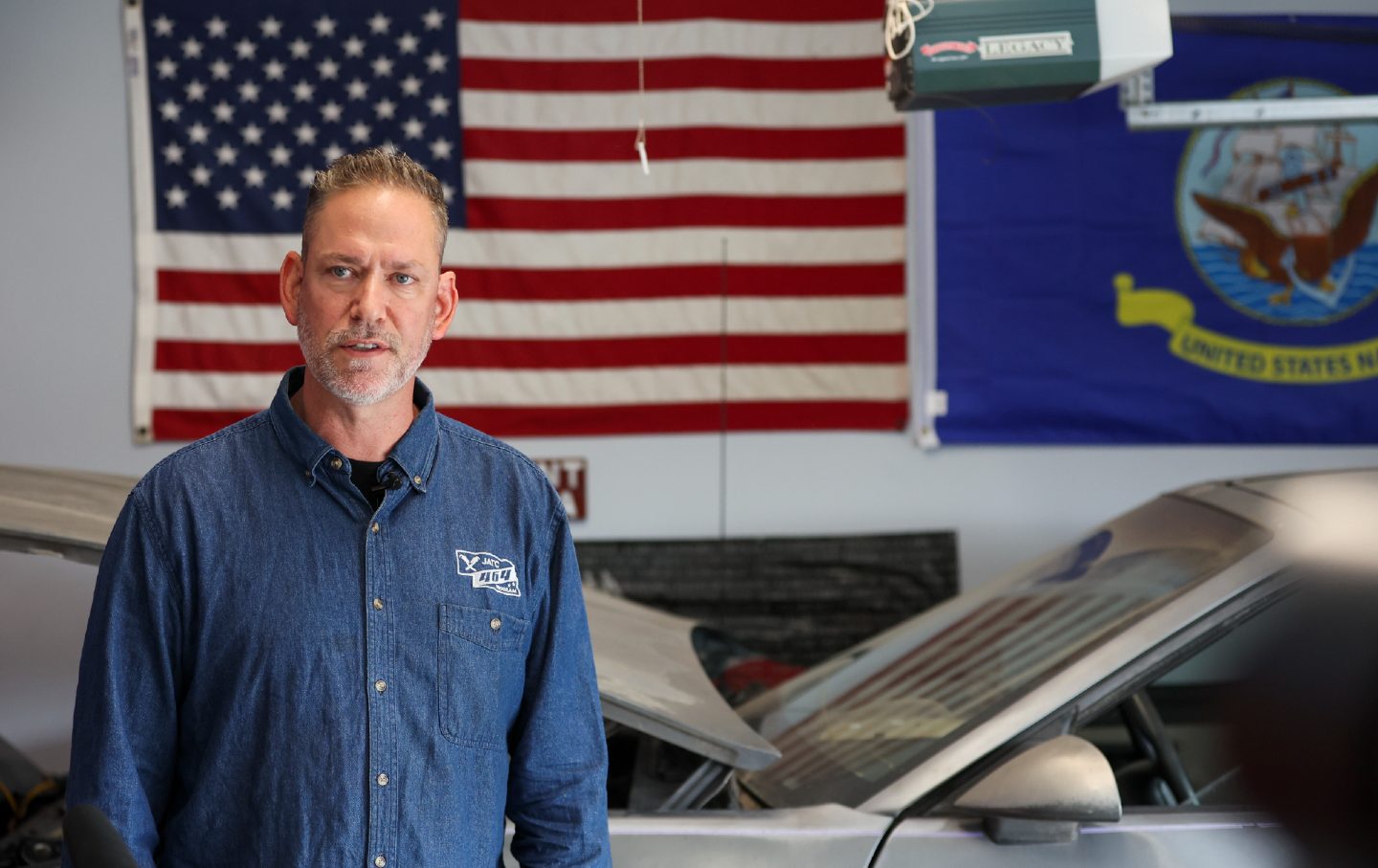
A guy in his garage, just outside of Omaha, dressed in denim, proclaims that he wants nothing to do with the Democratic Party. If that sounds like the median Nebraska voter, then the fact that it also describes Dan Osborn, the independent candidate running to unseat incumbent US Senator Deb Fischer (R-NE), might be promising for his chances.
Sure enough, Osborn—a Navy veteran, steamfitter, and union leader—is giving Fischer a run for her money in a deep-red state. The two are locked in a dead heat in a race where the Democratic Party opted not to run a candidate. Osborn has staunchly declined the Democrats’ endorsement and distanced himself from either camp. His declaration of independence understandably upset Democratic party officials, and yet Osborn’s obstinacy may still benefit progressives in the long run amid an otherwise bleak Senate map. And it has allowed Nebraskans to hear from, and perhaps even vote for, a leader whose platform works for them precisely because he’s worked alongside them.
Osborn has held only one previous office: the presidency of his local union. But he used this supposedly minor position to notch a major victory, organizing a strike at a Kellogg factory in Omaha that rescued 500 jobs. While his insurgency may seem like a glitch in the political simulation, his simple approach—focusing on the most important issues for the working class and having a credible background to back it up—has a venerable history in heartland America. In so-called “flyover” states, emulating this tactic could go a long way toward reviving progressive hopes where conservatives have taken voters for granted.
Nebraska is the birthplace not only of Democratic VP nominee Tim Walz but modern American populism. William Jennings Bryan, the Great Commoner and 1896 People’s Party presidential nominee, began his political career in the Cornhusker State. Over the next century, US senators across the Midwest would follow Bryan’s creed and take their pro-farmer, pro-worker, and pro-consumer convictions to Congress, including Fred Harris in Oklahoma, Birch Bayh in Indiana, and George McGovern in South Dakota. The breadbasket of the country, it turns out, has a record of helping working people put bread on the table.
Along with this grand tradition, Osborn’s campaign fits into a more recent trend of bold attempts to crack conservative strongholds. The weapons of choice in these campaigns? Civility, credibility, and championing the needs of working-class constituents. Representative Mary Peltola’s (D-AK) 2022 victory over Sarah Palin, which I covered at the time, exemplified this approach. Unlike Palin, Peltola didn’t run to represent herself. She ran to represent fishermen and rail workers, blue-collar parents and caretakers, and union members and public school teachers. She neatly captured this ethos in her campaign slogan: “Fish, Family, and Freedom.” That same hyperfocus on everyday voters’ needs was at the heart of Kansas Governor Laura Kelly’s triumph in 2018, the first blue norther in years to blow through solid-red Tornado Alley.
Despite supporting Trump by almost 20 points in 2020, Nebraska has a political landscape with deeper quirks that could favor Osborn’s campaign. The state is home to the nation’s only nonpartisan, one-house legislature, which has fostered successful bipartisan coalitions for abolishing the death penalty and allowing DACA recipients to obtain driver’s licenses. The “Unicam,” as Nebraskans endearingly call it, is also where a single GOP state senator recently held his ground against instituting a winner-take-all electoral system, one that would have inevitably favored Trump this fall. Despite Republicans’ claiming two-thirds of its seats, Nebraska’s legislature—and, by extension, the state—doesn’t suffer from the toxic polarization that abetted Trump’s rise in the first place.
And though Osborn has held the Democratic Party at arm’s length, he may nevertheless indirectly benefit from the small but strong contingent of progressive state activists who have been selflessly organizing against long odds for years. Jane Kleeb, the populist leader of the Nebraska Democratic Party, has risen as one such force to be reckoned with. Known for her fierce activism against the Keystone XL pipeline, Kleeb has long called for Democrats not just to mobilize long-ignored rural voters but to mobilize for them. She’s written extensively on what Democrats can do to re-inspire the trust of rural voters who have long found the party both unresponsive and unrelatable, insights that are embodied by Osborn’s campaign strategy, even if without an official “D” insignia.
To be sure, Osborn has his work cut out for him. Over the past few years, independent US Senate candidates like Alaska’s Al Gross and Utah’s Evan McMullin have put up remarkable fights, only to be considerably knocked out by GOP incumbents. But even if Osborn’s campaign falls short, his efforts won’t be for naught. He doesn’t need to win the hearts of all heartland voters—he just needs to open them. No matter the result in November, Osborn is making electoral inroads that will pave the way for real victories in 2026 and 2028. With the right long-term strategy, a more progressive Senate—one that can actually work for the working class—just might be in striking distance.
Osborn himself believes his candidacy could inspire future campaigns by and for working Americans. “Imagine…the ramifications on American politics if Nebraska elects an independent mechanic to the United States Senate,” he said in a recent interview. “Teachers, and nurses, and plumbers, and carpenters… they could also realize that they could run for higher office.”