Donald Trump’s Weak Ground Game Could Be His Undoing
There is growing concern within the GOP that the Trump campaign’s get-out-the-vote operation is dangerously anemic.
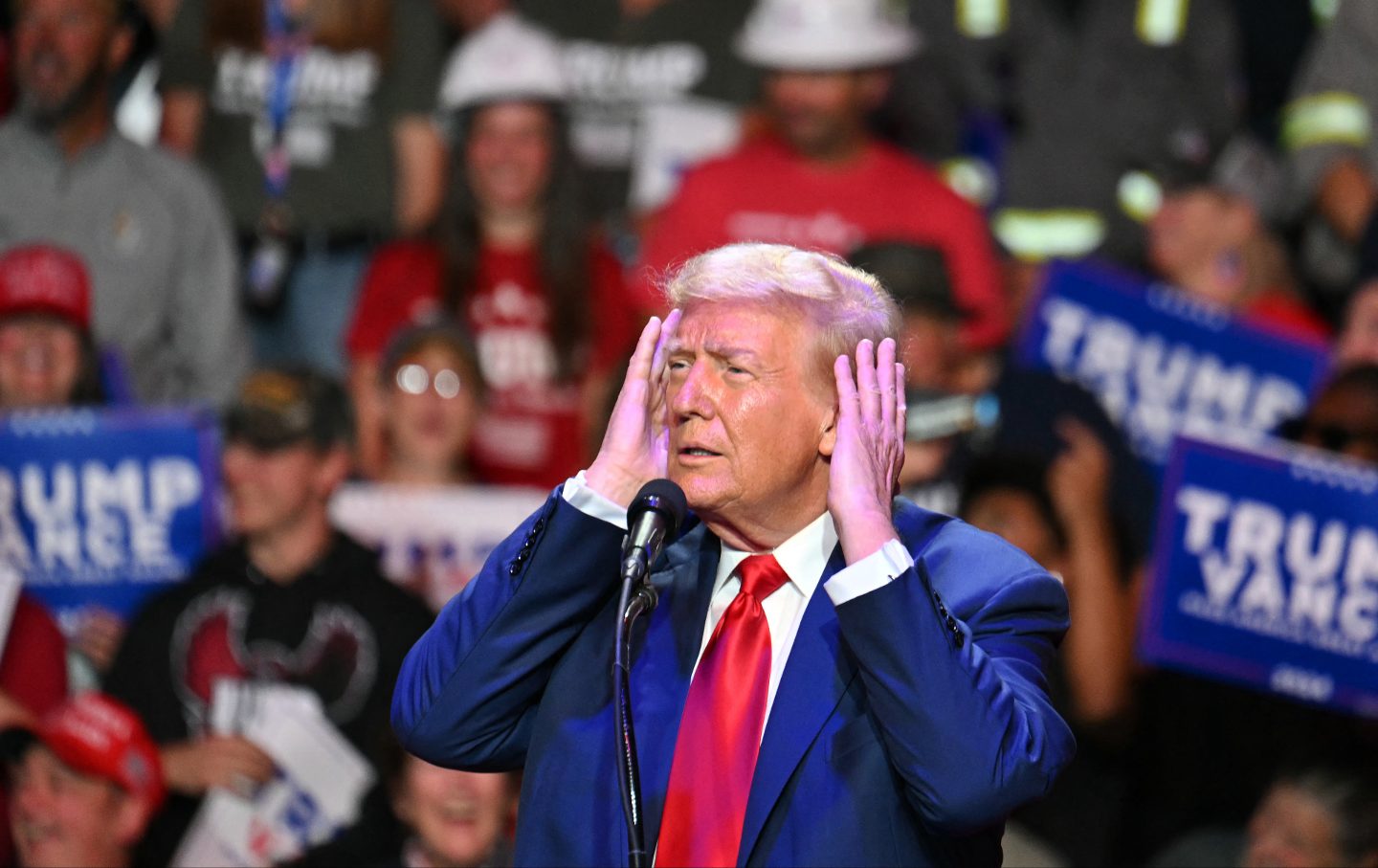
Donald Trump during a campaign rally at Ed Fry Arena in Indiana, Pennsylvania, on September 23, 2024.
(Jim Watson / AFP via Getty Images)Alongside enduring enigmas such as “Vivek Ramaswamy: why?” and “What exactly does RFK Jr. think he’s doing?,” one bewildering legacy of the 2024 election cycle will be the Donald Trump campaign’s decidedly anemic ground game.
A recent flurry of news reports have noted how tardy and tightfisted the Trump operation has been in allocating field workers and resources to pivotal swing states—particularly as the far-better-funded and keenly focused Kamala Harris campaign homes in on the same battlegrounds. The Harris campaign has dispatched 375 paid staff coordinators to the must-win state of Pennsylvania; the Trump team has somewhere between 50 and 90 there, according to the UK Guardian.
The disparity is playing out in all the battleground states, as Trump’s operation relies on get-out-the-vote efforts managed by right-wing super PACs, such as Charlie Kirk’s Turning Point Action and Elon Musk’s America PAC, that are comparatively new to the rigors of canvassing and door-knocking. Musk’s committee cashiered the firm it retained to oversee door-knocking initiatives in Nevada and Arizona, just seven weeks out from Election Day. And the group’s outreach efforts have been notably low-key in other swing states, such as Michigan, North Carolina, and Wisconsin.
“I don’t know what the PACs are doing,” Mark Forton, GOP chair in Michigan’s Macombe County, home of fabled swings, told the Associated Press. “I don’t know if they are going door to door.” Nate Wilkowski, the party’s field director for nearby Oakland County, said in reference to America PAC. “Nobody’s given me a heads-up that they’re around in Oakland County areas.”
To understand how such critical campaign operatives appear to have gone AWOL at a pivotal moment, it’s important to review the Trump team’s strategic thinking in the now-distant-seeming days when he was facing off against President Joe Biden. Going back to the outset of the GOP primaries, the Trump campaign developed a single-minded focus on “low-propensity” voters—that is to say, Republicans who leaned MAGA but weren’t reliable likely voters. In the Iowa caucuses, they adopted an approach dubbed “10 for Trump,” which identified 10 likely influencers in each caucus site who could nudge these voters toward their candidate.
That tactic yielded a strong 51 percent win for Trump in Iowa—albeit on a low-turnout caucus night when temperatures plunged to 40 degrees below zero. “Our opponents were spending tens of millions of dollars paying for voter contacts for people to knock on doors,” Trump campaign cochair Chris LaCivita gloated to The Atlantic. “And we were spending tens of thousands printing training brochures and pretty hats with golden embroidery on them,” referring to the headgear sported by MAGA-anointed precinct captains.
When the Trump team removed the leaders of the Republican National Committee in March and replaced them with its own operatives, the campaign’s vision of a leaner, tightly controlled ground game became the new party orthodoxy. And the cash that the RNC would save by outsourcing GOTV operations to the super PACs commandeered by Musk and Kirk would be devoted to Trump’s Ahab-like obsession with the phony MAGA crusade of “election integrity”—i.e., dispatching poll watchers to voting sites, and preparing for court challenges in contests won by Democrats. “The marching orders were clear,” Atlantic correspondent Tim Aberta writes. “Trump’s lieutenants were to dismantle much of the RNC’s existing ground game and divert resources to a colossal new election-integrity program—a legion of lawyers on retainer, hundreds of training seminars for poll monitors nationwide, a goal of 100,000 volunteers organized and assigned to stand watch outside voting precincts, tabulation centers, and even individual drop boxes.”
As of early June, just prior to Biden’s decision to drop out, the campaign’s plan was to shore up the awkwardly yoked GOTV and “election integrity” initiatives via a gamble on micro-targeting the same sort of erratically engaged supporters the Trump team had harvested in Iowa. It was a longshot strategy when Biden was their opponent, and it’s looking even more so now, against a surging Haris campaign.
Back then, LaCivita reckoned that there were only four true battleground states: Wisconsin, Michigan, Pennsylvania, and Arizona; Nevada, North Carolina, and Georgia then looked out of reach for the Democrat. Now that that’s plainly no longer the case—LaCivita’s four chosen swing states are very much in play for Harris—the GOP’s targeted, lean-and-mean ground-game strategy is spurring growing alarm among state and local election workers on the right. Turning Point Action and America PAC have been charged to deliver the ground-game results that had been a strength of the RNC in the 2016 and 2020 cycles—so far with precious few signs of success. The Kirk-led GOTV effort is confined to a very small slice of potential voters; an official with the PAC told Semafor reporters Shelby Talcott and Burgess Everett that it’s “narrowly focused on low-propensity, disengaged Republican voters—a universe that comprises 300,000+ in Arizona and 300,000+ in Wisconsin, and then 40,000 in Michigan 7[th district] and 30,000 in Nevada’s 3rd.”
Even with that limited mission, the group has also reportedly fallen well short of its $108 million fundraising goal, which may well explain why so few state and local party officials have spotted Turning Point Action canvassers in the wild. Then again, another GOP official has a more pithy explanation: Kirk’s super PAC is “a total grifting operation,” he told the Semafor writers. Another Republican operative focused on GOTV efforts in several states offered a similarly glum appraisal to Dispatch Politics: “Big press releases, big tweets, lots of smoke, very little work.”
Meanwhile, Musk’s America PAC operation, like all Musk endeavors, has a bigger cash reserve, but also suffers from insufficient direction and focus, as witnessed by its abrupt reversals in Nevada and Arizona. It’s captained by Generra Peck and Phil Cox, late of Ron DeSantis’s epic failure of a presidential campaign—which is principally notable for burning through some $100 million in super PAC dosh in fruitless voter-mobilization schemes. These partnerships of high capitalization and low results on the right are nothing new—Jeb Bush’s 2016 primary debacle came courtesy of millions upon millions mobilized in his laughably titled Right to Rise super PAC.
That’s why more traditionally minded GOP election hands are sounding the alarm loudly. “There is no tangible evidence that Trump and the RNC have invested in the kind of ground game that you need in a turnout election,” one swing state Republican official told NBC News. “Local Republicans aren’t being asked to knock doors, make phone calls, text voters or even harvest mail-in ballots. Instead, they’re being asked to be poll watchers in Republican counties or localities with Republican clerks.”
What makes such warnings especially urgent is that Trump’s surprisingly strong showing in 2020 was due in no small part to an absent Democratic ground game, since Biden’s party was reined in by Covid social-distancing protocols that played no part in Republican GOTV efforts. Now that Democrats are unshackled from such concerns, they’ve been ramping up their own ground-game operations in swing states, and outspending the Republicans at a clip of $5 million per day. Under such conditions, you can see why GOP operatives on the ground in swing states are frustrated with a clutch of RNC officials’ telling themselves that Charlie Kirk and Elon Musk will somehow innovate their way out of the holes they are digging.