
Kamala Harris Has a Chance to Electrify the Court Reform Debate
After a century-long fight to make Supreme Court justices more accountable, 2024 might finally see voters empower a president and a Congress to end “judicial oligarchy.”
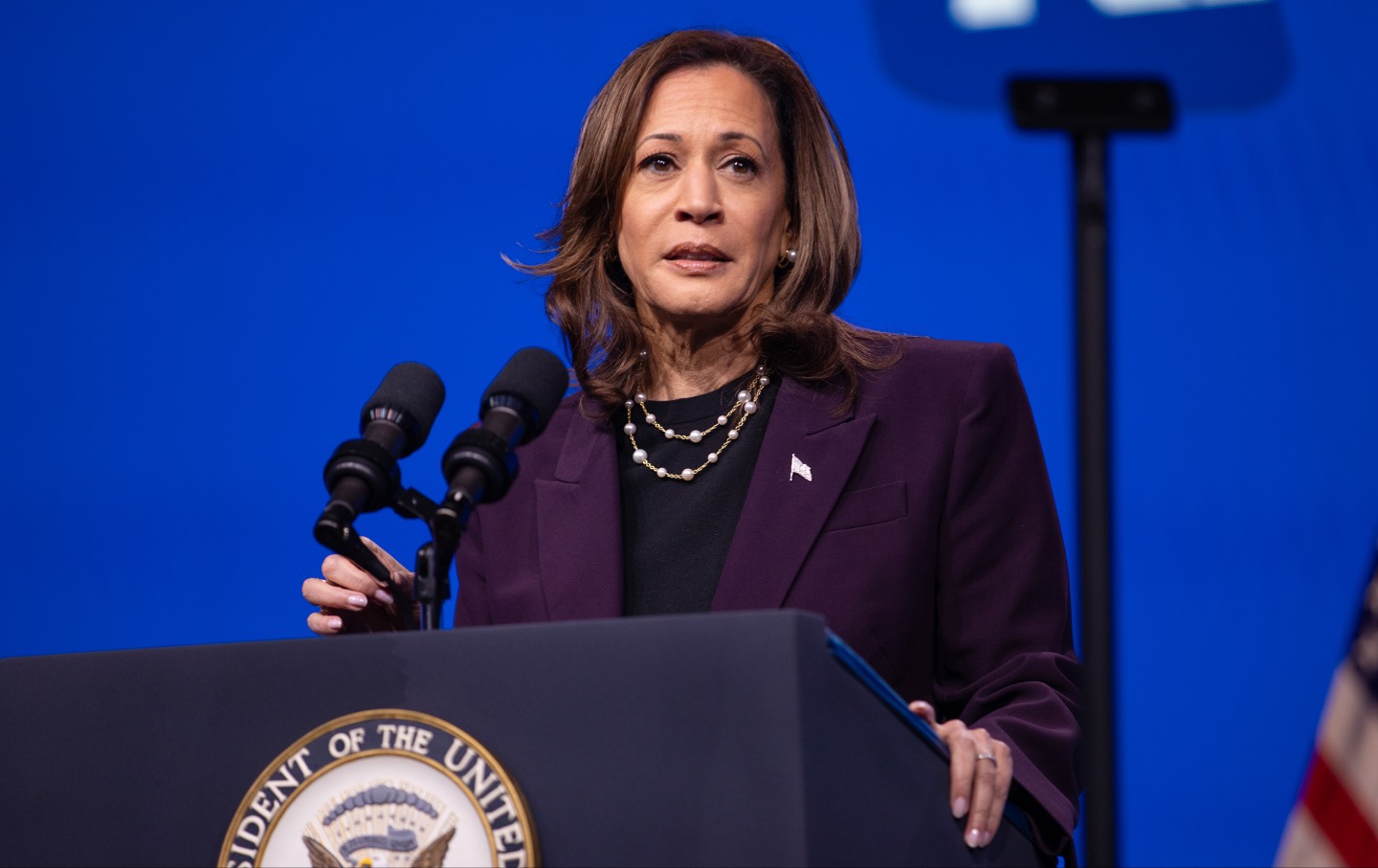
Vice President Kamala Harris speaks at the American Federation of Teachers’ 88th National Convention on July 25, 2024, in Houston, Texas.
(Montinique Monroe / Getty Images)Vice President Kamala Harris has signaled that Supreme Court reform will be a focus of her surging bid for the presidency, aligning her candidacy with a tradition of progressive campaigning to tackle what former Wisconsin Senator Robert M. La Follette once referred to as “judicial oligarchy.”
Harris, a former San Francisco district attorney, California attorney general, and member of the Senate Judiciary Committee, is no newcomer to debates about how to address the right-wing judicial activism of the nation’s highest court. She has not hesitated to challenge the extremism of a court majority that this year afforded kingly powers to presidents with a decision extending presidential immunity; that two years ago upended decades of precedent in order to undermine long-established reproductive rights; that has openly been at war with the rights of workers to organize unions and collectively bargain; and that, for decades, has chipped away at voting rights and democracy protections.
But Harris added new energy—and a new sense of possibility—to that fight on Monday when she formally embraced the court reforms proposed on the same day by outgoing President Joe Biden. Biden, who ended his reelection bid on July 21 and handed the mantle to Harris, continues to serve boldly as president—as he illustrated with Monday’s announcement of a plan to impose term limits on Supreme Court justices, establish binding ethics rules, and undo the current court’s worst abuses.
It was no surprise that his vice president welcomed the agenda. But, as the presumptive Democratic presidential nominee, Harris’s move is highly significant for the 2024 race and perhaps beyond.
After Biden used a Washington Post op-ed to outline his plan to renew judicial “trust and accountability,” Harris issued her own statement, in which she explained that “today, there is a clear crisis of confidence facing the Supreme Court as its fairness has been called into question after numerous ethics scandals and decision after decision overturning long-standing precedent.”
With this in mind, Harris announced that she was joining the president in “calling on Congress to pass important reforms—from imposing term limits for Justices’ active service, to requiring Justices to comply with binding ethics rules just like every other federal judge. And finally, in our democracy, no one should be above the law. So we must also ensure that no former President has immunity for crimes committed while in the White House.”
Because Congress is divided—between a Republican House and a Democratic Senate, and also within the caucuses of the two parties—Biden’s plan won’t be implemented before his presidency concludes. And there’s no guarantee that a President Harris could make immediate progress either. But as a candidate whose poll numbers are climbing, the vice president can use her 2024 campaign against right-wing authoritarian Donald Trump—whose most enduring legacy might be the hard-right supermajority he created on the court during his first (and hopefully last) term in office—to put court reform on the national agenda. Indeed, she can argue that by electing her and giving progressive Democrats full control of Congress, it will be possible to implement reforms that are enormously popular with the American people.
A Data for Progress poll released this month found that 74 percent of voters support term limits for Supreme Court justices “so that they serve for a set period of time rather than for life.” Democrats back high-court term limits by an 82-12 margin, independents by a 72-17 margin, and Republicans by a 66-28 margin. On Monday, the United for Democracy coalition of more than 140 civil rights, labor, reproductive freedom, and climate organizations enthusiastically embraced the Biden-Harris reform plan.
Support for court reform has deep roots in the United States. Former president Theodore Roosevelt raised the issue in his 1912 independent progressive presidential bid. In 1924, La Follette made reform a primary focus of his Progressive Party presidential campaign, which carried Wisconsin and ran second in 11 Western states.
“Today the actual ruler of the American people is the Supreme Court of the United States,” La Follette warned in an address to the American Federation of Labor in the early 1920s that could have been made today. Citing decisions by the high court that overturned progressive initiatives to protect workers and regulate monopolies, La Follette and the progressives of 1924 made the case that the federal courts were, by design and in practice, rigidly antidemocratic institutions. Judges were not elected but appointed. Even worse, noted La Follette, they were appointed not for terms that might make them accountable but for life.
The issue took on new meaning in the 1930s, when President Franklin Roosevelt tried, without success, to address the court’s bias against his New Deal agenda by expanding the number of justices. But reformers have persevered and, today, the relatively modest changes proposed by Biden and Harris are widely recognized as necessary.
They are also doable, as US Representative Ro Khanna (D-California), a longtime advocate for term limits, has explained. “Congress can pass a bill right now limiting the term that the next justice confirmed to the Supreme Court would serve,” says Khanna.
Article 3 of the Constitution states that judges and justices “shall hold their Offices during good Behavior,” which has traditionally been understood as a lifetime appointment. But the lifetime appointment does not have to be to the Supreme Court, and it can return to a circuit court after someone completes their 18-year term. In fact, the idea of Supreme Court term limits is supported by legal scholars across the ideological spectrum because it would not require amending the Constitution.
What that means is that the election of Kamala Harris and a reform-oriented Democratic Congress could begin to make the long-deferred promise of court reform—and democracy in America—a reality as soon as 2025. And with that reality, says Khanna, will come an even longer deferred opportunity to “rebuild trust and independence in the Supreme Court.”
More from The Nation


Can James Carville Please Just Be Quietly Wrong Somewhere Else? Can James Carville Please Just Be Quietly Wrong Somewhere Else?
The omnipresent consultant-cum-tantrum-thrower has long outlived whatever relevance he once had, but cable producers, podcast hosts, and Democratic campaigns haven’t got the memo....
Abolish ICE Abolish ICE
Demonstrators take to the streets in protest against an ICE shooting in New York City. Foley Square, October 2026.

Mamdani Is Facing Heat Over the NYPD. Here’s What He Should Do. Mamdani Is Facing Heat Over the NYPD. Here’s What He Should Do.
The mayor is being given a series of false choices over his public-safety agenda. But there is another way forward.
Why Calling Anti-Trans Hate a “Distraction” Is So Troubling Why Calling Anti-Trans Hate a “Distraction” Is So Troubling
It’s a familiar line in the midterms: Anti-trans attacks are a “distraction” from “kitchen-table” issues. That sends a chilling message about whose rights are worth fighting for.
So What Is Socialism, Anyway? So What Is Socialism, Anyway?
In a world dominated by neoliberal market fundamentalism, “socialism” is what will make a more moderate, regulated form of capitalism work for most people.

