The GOP Is Pat Buchanan’s Party Now
J.D. Vance’s RNC speech signified a return to the blood-and-soil politics at the core of Buchanan’s failed presidential runs in the 1990s.
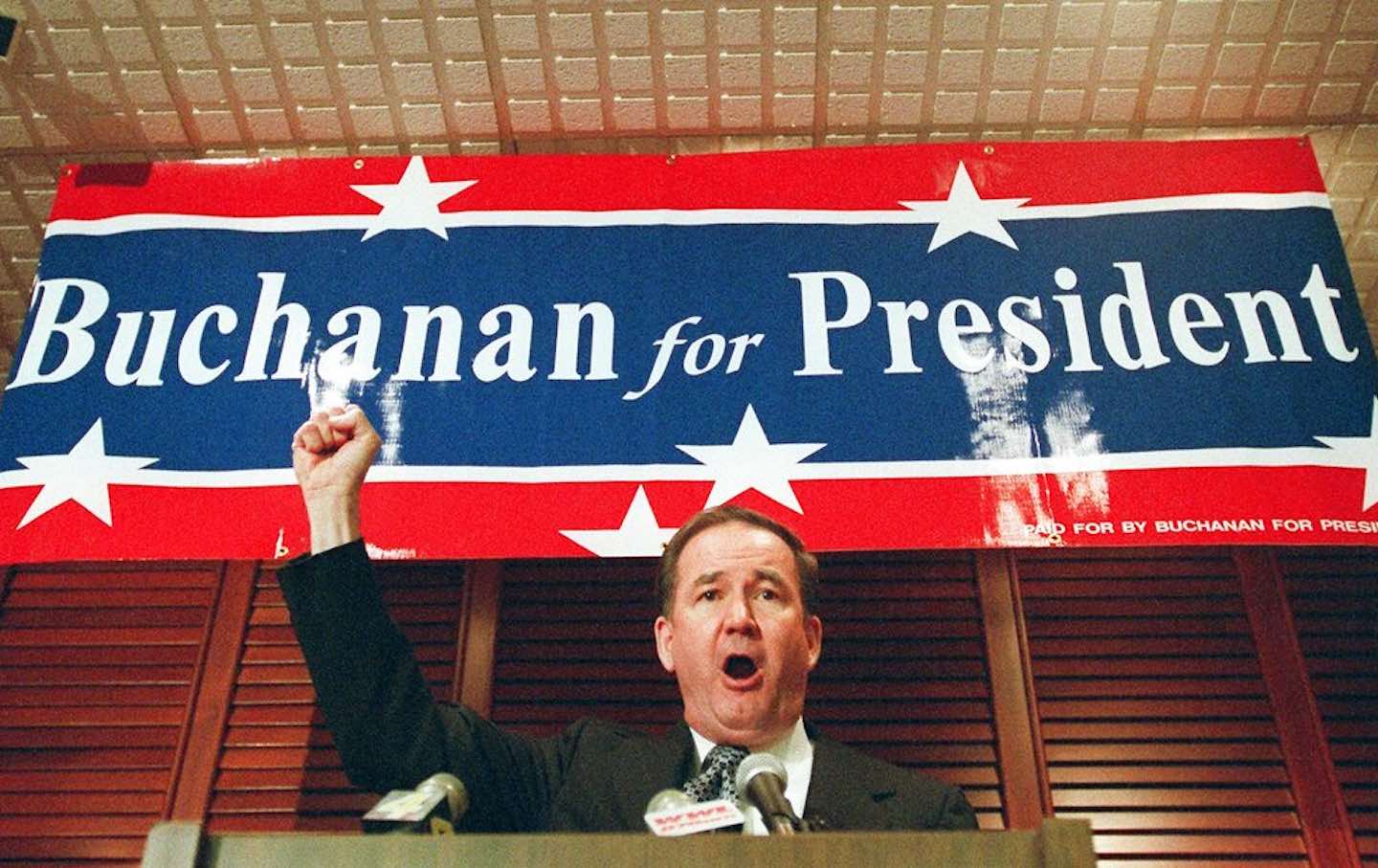
Republican presidential candidate Patrick Buchanan campaigns in Lafayette, Louisiana, in 1995.
(Eric Draper / AP Photo)
Lionel Trilling’s description of American conservatism as an assortment of “irritable mental gestures” has long seemed like a perfect fit for Trumpism, which often proved in practice to be a motley collection of personal grievances, culture-war outbursts, and persecution complexes. Even within this basic template, though, the core ideology of the MAGA movement has shifted in significant ways. In 2016, Donald Trump was still at odds with much of the GOP establishment, and keen to come across, at least in key isolated contexts, as a team player; by 2020, Covid had him backed into a corner. But as the 2024 Republican National Convention in the garrison state of downtown Milwaukee winds down, a more definitive transformation of the Trumpist creed is under way, chiefly in the selection of Ohio Senator J.D. Vance as Trump’s running mate.
Trump’s own listless, meandering, and astoundingly long acceptance speech on the convention’s last night only made it all the more clear that the MAGA torch is being passed to a more focused and clear-eyed generation of ideologues, with Vance as their de facto leader. But the party’s fulsome embrace of a blood-and-soil brand of economic nationalism, as epitomized by Vance’s speech before the convention on Wednesday, shows that it’s Pat Buchanan who is the ideological forefather of the 21st-century Republican Party.
Buchanan, of course, was the former Nixon speechwriter who harnessed the restive white-nationalist animal spirits of the conservative movement for his insurgent presidential campaigns in 1992 and ’96. Among other things, Buchanan’s presidential runs launched the culture wars, as both an expression and an organizing principle of conservative mass politics. His fiery denunciations of waves of corporate downsizing at the behest of the financial industry presaged the Trump GOP’s mythical, but tirelessly promoted, alignment with the interests of the white working class. Even his paleocon broadsides against the Israel lobby looked ahead to the open America First sympathies of the Trump movement leadership. For all the reservoirs of digital ink spilled on the hallowed self-made origins of Vance’s unique American success story, the Hillbilly Elegy author is plainly the spiritual offspring of the Buchanan movement.
That was clear the moment Vance’s speech pivoted into civics-lesson mode. Over and against the traditional liberal Enlightenment vision of America as “an idea,” Vance argued that it was, in fact, a nation, hewn from a discrete body of shared ethnic experience, and, more than that, “a homeland.” As he wound down his speech, he explained to the exultant delegates in Milwaukee that “people will not fight for abstractions, but they will fight for their home.”
Buchanan himself, who made much of his own brawling and belligerent working-class Irish roots, couldn’t have put it any better. As it happens, when Trump’s first presidential campaign took off in earnest in the summer of 2015, I wrote to Buchanan to get his assessment of all things Trump for a piece I published in Newsweek. His reply serves as a more fitting description of the MAGA movement today than it did then. I’d asked Buchanan how Trump fit into the notoriously protean tradition of US populism, and he replied that Trump was more fundamentally a nationalist:
Bernie Sanders is more in the economic populist mold. Trump, however, is plugging into nationalism, with both the illegal-immigration issue and [the] idea that we need a tough dealmaker to negotiate with the Chinese and Mexican governments, and America is in decline, and I will make her “great again.” And the fact that the elite media and his opponents are piling on, demanding he get out of the race for his “rapists” and McCain comments, has caused the Tea Party types and populist right who usually are the ones being called all the names, to rally to his defense.
The interpretation of Trumpism as curdled Buchananism is the thesis of When the Clock Broke, John Ganz’s recently published study of the backlash politics of the American right in the 1990s. Ganz’s chronicle reconstructs the strange moment when many of the certainties that formerly anchored the American right seemingly unraveled all at once—from the interventionist mandates of the Cold War to the traditional deference to the party’s business establishment to the policing of the movement’s conspiratorial and bigoted fringe elements. Buchanan emerged as the conservative movement’s most effective messenger for a revived mass politics, even though he faded back into the DC woodwork after his failed 1996 run.
When I spoke with Ganz, he was, like me, still reckoning with the deeply reactionary core message of Vance’s homeland speech, which hymned the sacred ground of the Kentucky cemetery where seven generations of his forebears were interred. “Vance was basically talking about the American people as if they are people that look and act and have the background of J.D. Vance,” Ganz said. “Usually in a campaign speech, you would imagine that this business about the Kentucky cemetery and the heartland would be put into a kind of conversation or comparison with other American stories, immigrant stories—there would be a big tent sort of overture. He talked about a big tent, but it’s a pretty small tent, really. Basically, the message we’re getting is that the country rightfully belongs to J.D. Vance and people like him.”
Vance’s oration was “a radical speech,” Ganz argues. “Conservatives have long struggled against the acceptance of the small-l liberal notion that America was based on principles and ideas of freedom and equality. And they said, no way. This is based on a specific people, a concrete past, a history. Often that gets an explicitly racial interpretation, and sometimes it has an implicitly racial interpretation. Vance has a history of playing around with racial interpretations of this in this book. This is a sub-tradition, a counter tradition within the American right, and it has now become the dominant one within the Republican Party.”
Ganz pointed me toward a postmortem of the 1992 Buchanan campaign published by one of its lead propagandists, Sam Francis, then an opinion columnist for the right-wing Washington Times. Like much of Francis’s writing, it’s oddly reminiscent of Marxist social theory, and written in the same register of dense academic abstraction. But like Buchanan’s own comments on the 2016 campaign, it’s eerily prescient:
The left offers nothing but economic redistribution predicated on egalitarian and universalist dogmas, and in practice this means that liberal-left policies reflect the interests of the nonwhite underclass and the intelligentsia that designs the formulas and policies for the left. Hence, the left is incapable of defending the specific interests and concrete cultural norms of Middle Americans. The right, though it defends (in theory) Middle-American cultural norms and institutions, offers a vision of decentralism, strict constitutionalism, economic individualism, and a minimal state that fail to speak to Middle-American material interests and the challenges that they typically encounter. What Middle Americans need is a political formula and a public myth that synthesize the attention to material-economic interests offered by the left with the defense of concrete cultural and national identity offered by the right.
Thanks to the unfathomable cunning of American political history, Francis’s prophecy has come to lavish fruition a full generation later. It’s Buchanan’s party now, and anyone outside J.D. Vance’s charmed Caucasian circle can cry if they want to.