A Brief History of Trump and Violence
The assassin’s bullet that grazed Donald Trump’s ear thankfully missed its mark. But that can’t be allowed to erase the long, ugly history of Trump’s dalliance with violence.
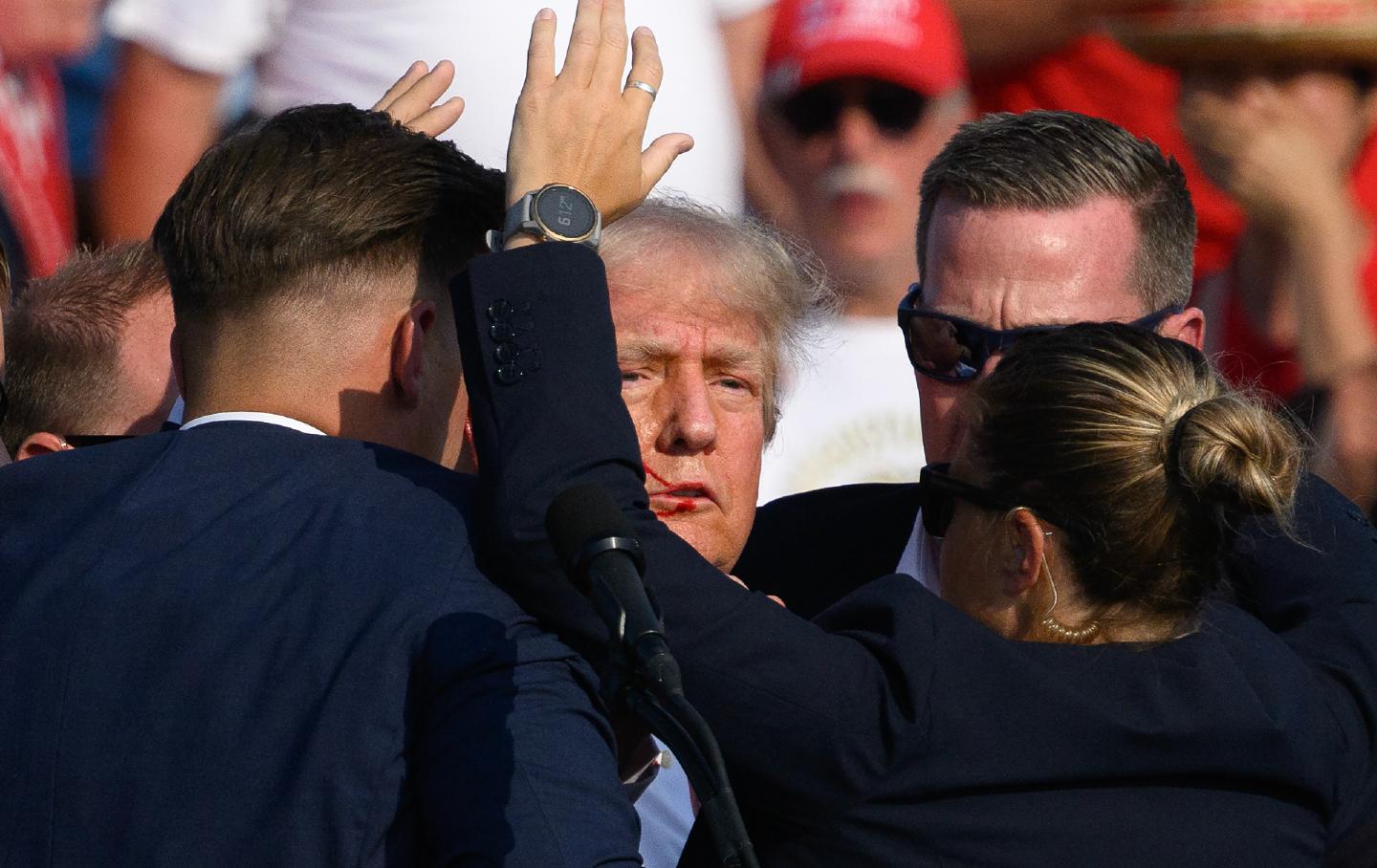
Secret Service agents surround Republican presidential candidate former President Donald Trump onstage after he was injured at a rally on July 13, 2024 in Butler, Pennsylvania.
(Jeff Swensen / Getty Images
The shooting at Donald Trump’s rally in Pennsylvania Saturday night is a chilling reminder of both the political tensions that roil today’s America and the dangers of a culture that increasingly fetishizes high powered weaponry.
This isn’t the first time, of course, that either a president or a leading presidential candidate has been shot at: Presidents Lincoln, Garfield, McKinley, and Kennedy all died at assassins’ hands. Reagan was shot in the stomach but survived. In 1950, Puerto Rican nationalists tried to kill Truman. Charles Manson’s deranged follower Squeaky Fromme made an attempt on the life of Gerald Ford. Back in 1912, former president Teddy Roosevelt, campaigning for a political comeback, took a bullet in the chest area. He was apparently saved by the thick wad of notes for the speech he was giving, which took much of the brunt of the shot—and, despite bleeding copiously from his wound, he continued on with his speech (a somewhat more flamboyant version of Trump’s shouting “Fight, fight, fight!” as the Secret Service hustled him, bleeding from a wound on his ear, into a bulletproof SUV).
Perhaps the assassination attempt that has most in common with that against Trump yesterday was the shooting of the noxious, race-baiting George Wallace in 1972. Wallace had spent years inflaming national passions against desegregation, had injected a poisonous language of violence into his political speeches, and had repeatedly flirted with paramilitaries in his opposition to court-ordered or federally mandated desegregation efforts.
I wish violence on no one, and I feel for Trump and for his family today, as they process the brush with mortality the presidential candidate experienced. Assuming it was, indeed, a bullet that grazed Trump’s ear, and not shards of glass from the shattered teleprompter as some have speculated, it must be utterly terrifying knowing that, had the bullet’s trajectory been just a few millimeters different, Trump would have taken a shot to the head. That knowledge would give anyone nightmares.
But I also know that, in the days to come, it would be a terrible mistake for Democrats to give Trump a free pass on political violence or to let the narrative take hold that Biden and the Democratic Party are to blame for this event—as J.D. Vance and others began insisting within minutes of the assassination attempt. Trump’s violent rhetoric ought to be as disqualifying tomorrow as it was yesterday; and his unfitness for office should remain as paramount an issue for voters next week and next month as it has been in all the years and months leading up to the events of this week.
To be absolutely clear, there is no politician in America today who has done more to stoke political violence than Donald J. Trump. And that is as true today as it was before the attempt on his life.
Trump has gloried in a language of political violence for the better part of a decade, demonizing his political enemies and taking politics up to and beyond the boiling point.
This is the candidate who presided over Nuremberg-styled rallies in 2016, during which he encouraged his supporters to chant that Hillary Clinton should be locked up—and then didn’t push back when some advisers and supporters took the next step and urged that she be executed.
This is a man who said there were “very fine people” among the neo-Nazi marchers in Charlottesville in 2017.
This is the political leader who mused about finding ways to shoot would-be immigrants in the legs, or feed them to alligators, as they tried to cross the southern border into the United States.
This is a man who, as president, tweeted that mobs should “LIBERATE” Democratic-run states such as Virginia and Michigan, and then pooh-poohed the seriousness of a plot to kidnap the Democratic governor of Michigan and execute her.
This is a person who tweeted, “When the looting starts, the shooting starts,” in response to protests against the killing of George Floyd.
This is a demagogue who, for political advantage, at the height of the pandemic, whipped up angry mobs against public health officers and then refused to condemn those mobs, when they picketed officials’ homes and workplaces, often heavily armed, frequently with exhortations to hang the medics for their advice on social distancing, on closing schools and businesses, or on mask and vaccine mandates. I’ve interviewed some of these public health officials in Washington State and in Northern California; years later, they still bear the trauma of these attacks, and still feel betrayed by the fact that under Trump the federal government stood by silently as vicious mobs took to the streets against them.
This is a man who refused to call off the dogs when, on January 6, 2021, participants in an insurrectionary riot that he had inspired tried to hunt down the speaker of the House, the vice president of the United States, and miscellaneous other figures. In fact, he reportedly told his advisers that Pence would have deserved his fate at the hands of this enraged, out-for-blood MAGA crowd. And it is a man who has pledged to pardon all of those involved in that insurrection that left several Capitol Police officers dead or seriously injured.
Popular
“swipe left below to view more authors”Swipe →This is a man who repeatedly flirted with paramilitary groupings during his time as president, and, during a live TV debate, urged the fascistic Proud Boys to “stand back and stand by.”
This is a felonious candidate who, along with his sons, openly mocked the Pelosi family when Nancy Pelosi’s husband, Paul, was seriously injured by a hammer-wielding would-be assassin who tried to beat his brains in, and took to social media to spread baseless rumors that Paul Pelosi had been attacked by his gay lover. There was no phone call of condolence or solidarity from Trump to Nancy Pelosi; there was no pause in political campaigning; there was no sense of ratcheting down the hate speech or the accusations of treason against his opponents.
This is a candidate who has called for the execution of former chief of staff Mark Milley. And it is a candidate who recently reposted social media calls for televised military tribunals to be held for members of the House Committee that investigated the January 6 insurrection.
The would-be assassin’s bullet that grazed Trump’s ear thankfully missed its mark. But that bullet can’t be allowed to erase all the long, ignoble history of Trump’s dalliance with violence, of his gross disrespect for civic norms and for the peaceful transfer of power after an election that he lost.
Trump and his team will, over the days to come, look to shape a martyr narrative, to paint Trump as the victim of a conspiracy reaching to the highest levels of government. As with most everything to do with the Trump campaign, it will be utter balderdash.
Political violence ought to have absolutely no place in how democracies allocate power and influence. That goes not just for the violence unleashed by would-be assassins but also for the more casual, background, daily violence that Trump has, since he first announced his candidacy in 2015, normalized among his supporters.