
Why Did a Progressive Pope Use a Gay Slur?
Given Francis’s apparent embrace of LGBTQ people, many found his use of the offensive term frociaggine confounding—blame fragile masculinity.
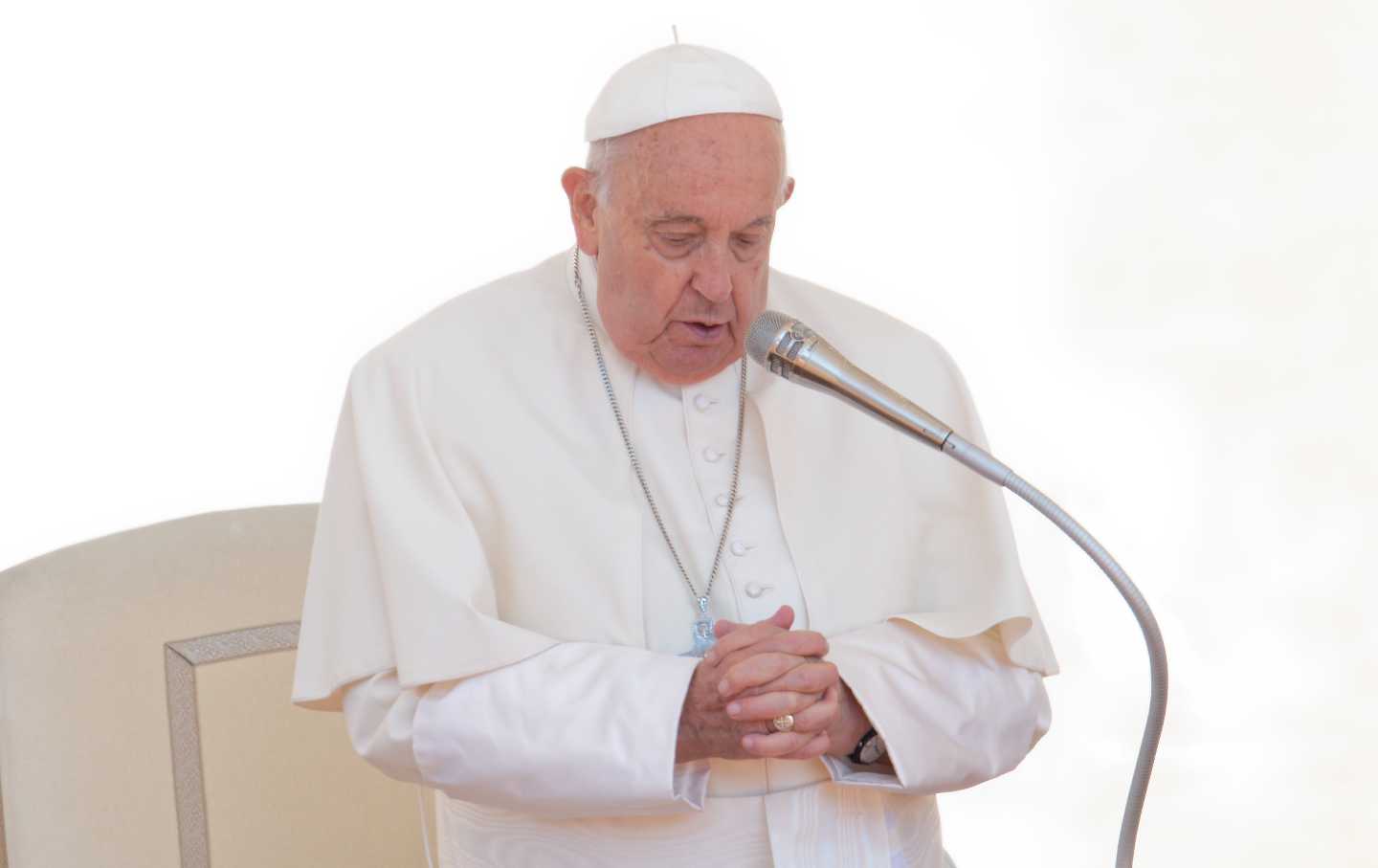
You could be excused for not seeing the immediate resemblance between Pope Francis, the elderly Argentinian leader of the Catholic Church, and Harrison Butker, the square-jawed young kicker for the Kansas City Chiefs. The two aren’t often mentioned in the same breath, though both have been roundly criticized in recent weeks for controversial statements. Francis used the word frociaggine, an Italian slur that can best be translated as “faggotry,” in a discussion about admitting gay men to seminaries during a closed-door session of the Italian Bishops’ Conference. While giving a commencement speech at a Catholic liberal arts college, Butker derided LGBTQ pride as a “mortal sin” and asserted that women’s lives really begin when they become (heterosexual) wives and mothers. Many will simply dismiss all this as the atavistic attitudes of two Catholic troglodytes.
But Francis and Butker have something far more basic in common, something they share with the protagonist of a delightful Anglo-Norman medieval romance called Lanval (hear me out). Lanval, a knight in Arthur’s court, refuses the sexual advances of the queen. When she accuses him of preferring the company of boys to her own, Lanval angrily responds that he is faithfully in love with a woman whose beauty far surpasses that of the queen. A huge mistake. Not only is the queen furious but the beautiful woman, who has been magically bankrolling his career as a knight, had sworn him to secrecy about their affair. The queen denounces Lanval, complaining that it was he who attempted to seduce her. His mysterious lover lets him languish in a dungeon until the very last moment before coming to his rescue and whisking him away on a magic horse into the land of Avalon.
The last time I taught this story, a queer young woman in the class smirked and whispered under her breath: “Fragile masculinity.”
“Exactly!” I told her. “He’s a man in a hyper-competitive environment surrounded by other men, and they’re all carrying swords. If he gets a reputation as a pansy, how long do you think it’ll be before one of those men puts a sword through him? How much more fragile can you get?”
If “male fragility” and the so-called “crisis in masculinity” are not the first things to come to mind when you think of Francis or Butker, it might be because the media has largely focused on the offense they have given to women and gay men. They’re both men, which for many audiences (with no small amount of justification) means only that they were born into a privileged position. It’s harder to see men—much less the supreme pontiff or a strapping football player—as particularly fragile.
Yet, focusing on male insecurity, rather than homophobia, makes Francis’s use of frociaggine more comprehensible to people who remember his famous statement “Who am I to judge?” Many have felt genuine confusion and betrayal, and would agree with the headline of Peter Stanford’s piece in The Independent: “With one slur, the pope has shown his true colours on homosexuality.” In contrast, Michael Sean Winters of the National Catholic Reporter dismisses the idea that “the pope has suddenly revealed his hidden bigotry towards gay persons” as “ridiculous.” The slur is less confusing when viewed as a symptom of male fragility. It aligns with his rejection of the idea that women might be ordained as deacons in the interview he gave last month to 60 Minutes, and is consistent with the fear expressed last April in Dignitas Infinita that “gender theory” denies “the greatest possible difference that exists between living beings: sexual difference.”
This isn’t to put Francis in the same category as Jordan Peterson, Andrew Tate, and other would-be “alpha” male influencers who haunt TikTok. Francis has little patience for the kind of domineering masculinity they represent, balancing a telling mistrust of “young priests trying on cassocks and hats or albs and surplices with lace” with criticism of “macho and dictatorial attitudes” among the clergy. The Vatican issued an apology of sorts for any offense caused by Francis’s use of frociaggine, and only 10 days after the Jesuit publication America ran the headline “Pope Francis says Italian seminaries should reject gay applicants,” it ran another saying that “Pope Francis encourages gay man who wants to join seminary.”
In contrast, Butker, has only doubled down on his comments, complaining that “if it wasn’t clear that the timeless Catholic values are hated by many, it is now.” As a lifelong Catholic who has been out of the closet longer than Butker has been alive and who has spent a good deal of that time studying the history of the church, I can only envy his confident discernment of these “timeless values.” Indeed, Butker and Francis embody a tension regarding male authority that has long existed in the Western church, between the married laity and the celibate clergy whose leadership they accept. The truce between these two groups last broke down at the time of the Reformation, when Protestants ditched institutional celibacy and instituted a regime of mandatory heterosexual marriage. While Butker has said that he believes priests have become too familiar with their congregations and need to reassert their authority (in stark contrast to Francis’s call for the shepherds to smell of their sheep), his words about marriage and motherhood as the natural role of women raise some questions about what he sees as the role of celibacy in the contemporary church—and raised the ire of the Benedictine nuns who founded the college at which he spoke.
If this smacks a little of American evangelicalism, that might be because the models of masculinity in US culture are still deeply shaped by conservative Protestant notions of maleness. This brings me back to poor Lanval, who found himself in competition with a bunch of armed and dangerous men. Seen from a different angle, the privileges associated with being a man come at the cost of constant surveillance and policing by other men. It’s not too much of a stretch to compare the fellow members of Butker’s football team to the knights of Arthur’s court. As a bishop among bishops, Francis too lives in a world of highly competitive males. We are told that the word frociaggine was introduced into the conversation by other bishops, and that the pontiff was merely echoing them—or, as the kids might say, matching their energy. If, in fact, this was a bit of locker room talk among brother bishops, that would suggest that whatever problems posed by the use of a word like frociaggine extend beyond Francis. Given the opposition he has faced from other clergy in the course of his pontificate, it’s worth asking whether he just didn’t tire of resisting the pressure.
But perhaps the most important thing we can learn from comparing Butker and Francis to Lanval is that the triggers for male fragility are nothing new. Arthur’s knight has to deal with financial dependence on one woman, the sexual aggression of another woman of superior social status, accusations of sexual harassment, and the risk of being called a pansy (and therefore as sexually penetrable as a woman). All of this in a 12th-century romance written by Marie de France, a woman trying to prove her intellectual and literary prowess in the court of Henry II.
Indeed, if we are going to talk about timeless truths, we might try this one: Masculinity is largely a state of fear. Peruse the library shelves of history and in no time at all you can gather a lovely bouquet of anxious males worrying that they or their fellows are not really man enough. Weave them into a garland, put them in your hair, and frolic as you will. And this might prove to be the best remedy for this kind of male fragility.
Maybe the problem isn’t that there’s too much frociaggine going around these days. Maybe there isn’t enough.
More from The Nation
The Jewish Case Against AI The Jewish Case Against AI
Haredi rabbis and the secular left agree: This technology is a threat to the entire social fabric.
The Fight for Educational Equality Is Also a Fight for a Just Supreme Court The Fight for Educational Equality Is Also a Fight for a Just Supreme Court
The court has severely weakened our ability to make an education system that fulfills the promise of Brown.

The Fall of “Scientific American” The Fall of “Scientific American”
When the beloved science publication got too political, its corporate owners stepped in. Now its future is uncertain.

The Bookstore Revolution in Taiwan’s Conservative Heartlands The Bookstore Revolution in Taiwan’s Conservative Heartlands
After Taiwan legalized same-sex marriage, gender-themed bookstores are working to build the social acceptance that the law alone couldn’t deliver.

Jalen Hurts Deserved Better. We All Do. Jalen Hurts Deserved Better. We All Do.
In a country that treats workers as expendable parts, Hurts’s playing through a blood clot is just the highest-profile example of the price workers pay in an oligarchy.

The Terrifying Future of States’ Criminalizing Pregnant People Is Already Here The Terrifying Future of States’ Criminalizing Pregnant People Is Already Here
The idea of charging people who have abortions with murder is gaining traction on the right. But a report finds that people are already being prosecuted for their pregnancy outcom...

