Pieces of the Self
Philip Glass—solo artist.
Philip Glass, Solo Artist
In his most recent album, the composer marks a new turn in his style.
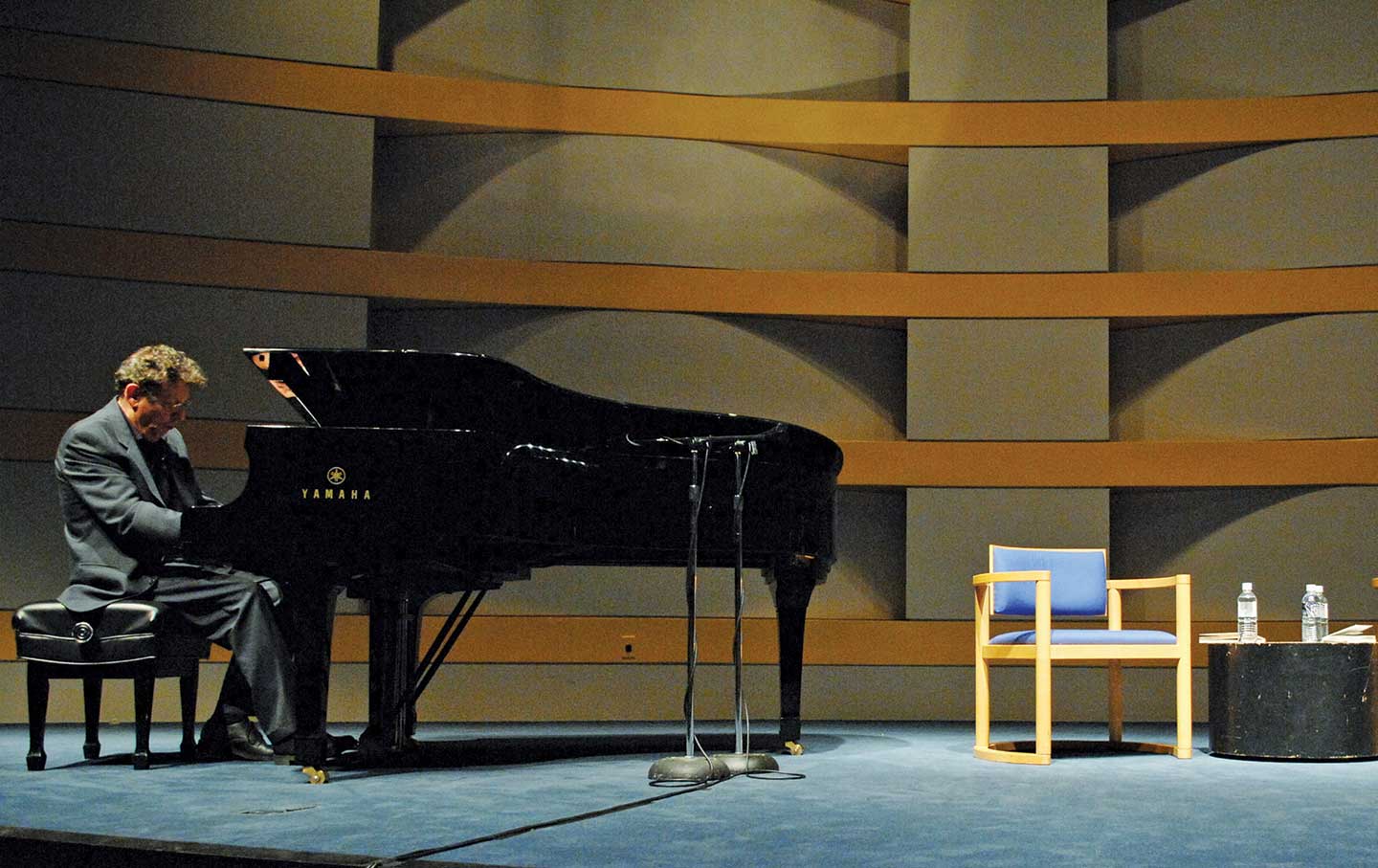
Listening to the composer Philip Glass’s latest album, Philip Glass Solo, is like entering a sculpture by Richard Serra (with whom Glass worked once upon a time). As you make your way through the music, you find that you’re all at once embraced, in the middle of an impenetrable and mazelike structure that’s been meticulously constructed to bring you from claustrophobia to transcendence. Another way to put it: Glass’s piano works surround you and can overwhelm your senses if you let them.
Philip Glass Solo revisits many of the 87-year-old composer’s most famous pieces, performed on the same piano he used to create them. The album, which was recorded during the quarantine year of 2021, has a quiet and domestic quality to it. There is an intimacy here. As Glass explained on his website: “This record is both a time capsule of 2021, and a reflection on decades of composition and practice. In other words, a document on my current thinking about the music.” Which means, in practice, that there are crucial differences in the pieces: a longer section here, a few chord changes there. They’re easy to miss if you’re not paying attention. But if you’ve been listening to Glass over the years, the difference between the earlier renditions of these works and the ones on this album can feel striking. Time crept in somewhere and changed them. They seem to say: There is always the possibility of change.
As well as a haunting marker of time and change, Philip Glass Solo is also just a good introduction to the composer’s solo piano work. It’s accessible and rhythmic, and only occasionally complex. And throughout you can feel Glass’s presence, in everything from the expert modulations to the piano’s emotive overtones. (These modulations and overtones are not on the level of, say, Keith Jarrett’s unconscious exhortations, but they feels similarly human.)
Four of the album’s seven tracks are drawn from Glass’s Metamorphosis series, famously inspired by Kafka’s novella. The tracks build rhythmically over time, and the effect is hypnotic—motifs recur; themes are thoroughly explored. Curiously, here Glass plays “Metamorphosis 1” through “Metamorphosis 3” and ends with “Metamorphosis 5,” skipping the darker fourth entry entirely.
The other three pieces are drawn from a trio of albums: “Opening,” from Glassworks; “Mad Rush,” from Solo Piano (where the complete Metamorphosis series first appeared); and “Truman Sleeps,” from the soundtrack to the 1998 film The Truman Show, which Glass co-composed. Across these pieces, you’ll find all the hallmarks of Glass’s style: the ostinatos, the arpeggios, and the trademark minimalist repetition. Glass’s music moves at what you might call geologic time, with small shifts accumulating into larger, deeper changes. It’s tectonic; the earth moves infinitesimally beneath your feet.
This approach has sometimes been called minimalism. But Glass doesn’t seem to like the term, and one can see why, since he is, in his own way, very much a maximalist: He fully indulges his musical curiosity until the idea is spent. Sometimes, uncannily, it can feel as if the music is almost incidental to his project. And Glass’s own ambitions are huge: He’s been composing prolifically since 1967, and his discography can feel a mile long.
While the compositions on Philip Glass Solo were written decades ago, it is hard not to think about how they apply to our present moment. The music has a way of magnifying your surroundings; you become aware of the flow of your breath, the things you consume. The repeating sounds are almost like a mandala, less visualized than felt. In this way, too, they are maximalist, seeming to tell a larger story.
One unintended possibility—given that these songs are from long ago—is to see them as a comment on the Internet age. Listening to Glass’s ever more powerful repetitions, I began to think of a far more enervating set of repetitions that have come to define the pervasive dullness of social media and its effect on culture. The professionalization of social media—by which I mean the codification of its rules and structure—is almost like a Glass composition in the negative: It’s all reiteration, with slight variations, alternately incentivized toward rage or blandness. Glass finds humanity in repetition, but it’s hard to say that’s true of the Internet we’ve got today. It’s a world that feels as though it mirrors the one depicted in The Truman Show, the impetus for the final track on Philip Glass Solo, “Truman Sleeps.”
There, too, the dulling qualities of Truman’s life are contrasted with the invigorating human complexity of Glass’s composition. The film’s critique of the vapidness of consumer culture can sometimes be too effective, serving as a kind of overbearing superego and stripping the film of its humanity. But Glass’s composition—with its sweet, searching melody and its chord-heavy middle—offers a reprieve.
Philip Glass Solo is many things at once: a greatest-hits collection, a study in change, an experiment in composition. But when you listen to these pieces in 2024, the album feels like something else, too: a corrective to the hysterical mundanity of American culture today. When you focus on this music—when you really listen to its repetitive structures, its gorgeous melodies and brilliant counterpoints—you start to see a different world take shape, way out there in the distance.