Can Biden Become a Pugilist for Populism?
Why it’s time to take Adam Tooze’s advice and “re-politicize the economy.”
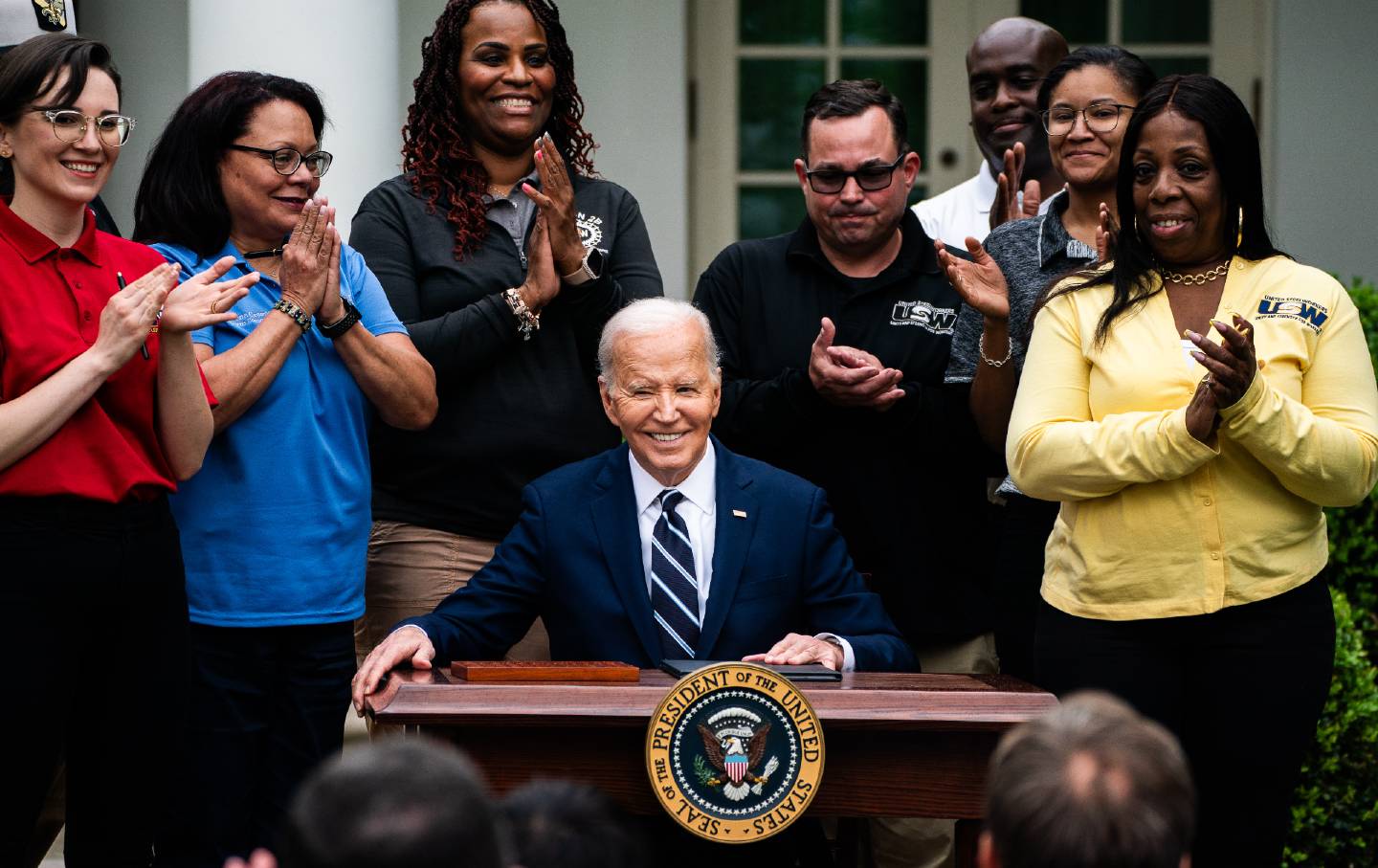
If David Lynch directed a political thriller—that’s how surreal this election season must feel to Democratic strategists. Last week’s New York Times and Siena College survey showed President Biden somehow losing in five swing states to a man currently enduring one of the most personally embarrassing trials in American history. The number-one source of discontent? The economy, which more than half of voters rated as “poor.” It is true that stubborn inflation continues to hike the price of essentials like gas and food, stoking consumer pessimism. And yet Biden’s economic moves have also brought record job growth, sub-4 percent unemployment, and a boom in wages that’s outpaced inflation.
So, how to explain this gap between perception and reality? To hear party stalwarts tell it, Biden’s polling conundrum is simply a signal that Democrats have yet to—sing along if you know the words—get out their message. Should voters stop watching so much TikTok, and instead consult some 30-second ads and a stump speech or two that tells them the economy is great, actually, they’d come to appreciate this period of unique prosperity.
But what if the average American already understands their own economic circumstances? Let’s imagine for a second that Americans’ dissatisfaction has less to do with a failure to read the jobs report and more to do with loan delinquency spiking, household debt ballooning, and personal bankruptcies multiplying. For all the good news in the traditional economic indicators, we’re also in the midst of the worst debt crisis since the Great Recession.
That’s largely due to the predatory practices of multinational banks, billionaire lenders, and other exploitative corporations. Perhaps voters’ resentment is not misguided but misplaced.
While the Biden campaign might be frustrated that the president’s economic achievements aren’t getting enough recognition, the average American is more concerned about a different sort of credit. Last year, Americans’ credit card debt topped a record high of $1 trillion. The default rate on that debt has more than doubled since 2021. The expiration of pandemic-era debt relief programs explains these trends only in part. Another cause was uncovered in a recent audit from the Consumer Financial Protection Bureau, a crucial advocate for workers saved last week by a surprisingly reasonable Supreme Court decision. The CFPB found that the largest credit card companies charge higher interest rates and higher annual fees than smaller institutions—to the tune of $400 to $500 a year of excessive payments from the average cardholder. That represents a windfall of billions for the corporations who least need it, courtesy of the customers who can least afford it.
The same spike in default rates has hit the auto industry. According to the Thompson Consumer Law Group, this curve is especially steep in the swing states of Georgia, Michigan, and North Carolina—which have three of the top 10 highest auto loan default rates in the country. The path of responsibility here, too, leads to Wall Street. Auto loans are becoming harder to pay partly because costs associated with car ownership have risen. That includes motor vehicle insurance, which has soared at a rate not seen since the days of stagflation almost 50 years ago. These record increases have brought others: This year, shares of Travelers and Allstate have traded at all-time highs. Meanwhile, subprime auto lenders have taken a page out of the Lehman Brothers playbook, making loans to buyers with zero credit and then loading those buyers with millions of dollars in illegal fees. Just the latest sign of the pervasive influence of the Rumpelstiltskin School of Economics.
And when hedge funds aren’t saddling Americans with hopeless debt, they’re inflating rents to leave even less money for ever-bigger interest payments. Private equity firms like Blackstone are increasingly buying up single-family homes, and institutional investors are projected to own 40 percent of the market by decade’s end. They have a funny habit of raising rents while refusing to maintain their properties, and then evicting residents who complain. From the home to hospice care, no area of family life seems too sacred for private equity’s profiteering.
Advocates and lawmakers have already offered Biden a portfolio of solutions to the debt debacle. The Poor People’s Campaign, for example, has put together a five-part Jubilee Platform that calls for forgiving medical, housing, and utility debt, and waiving all interest payments. Less sweeping but still effective is Democratic Senator Jeff Merkley’s bill that would eliminate corporate ownership of single-family homes. It remains mysteriously stuck in committee. Biden might consider putting the full heft of the executive branch’s power behind such proposals, and making debt relief one of his campaign’s signature issues.
More than that, Biden could “pick fights,” to quote CAP President Patrick Gaspard. Specifically, he could follow economic historian Adam Tooze’s injunction to “re-politicize the economy.” The recently announced June 27 debate would be a perfect forum for this strategy’s debut. There, he could announce himself as the people’s champion against Trumpian economics by exploitation. He could muster the same moxie with which he challenges hecklers to push-up contests, and tell the billionaires lately flocking to Trump’s campaign that they should meet him outside in the parking lot. He could, in short, become a pugilist for populism.