Students at Universities Across Jordan Are Protesting for Gaza
For months, thousands have flooded the country’s streets in protest. But students say that the surge of encampments in America helped increase actions at Jordanian universities.
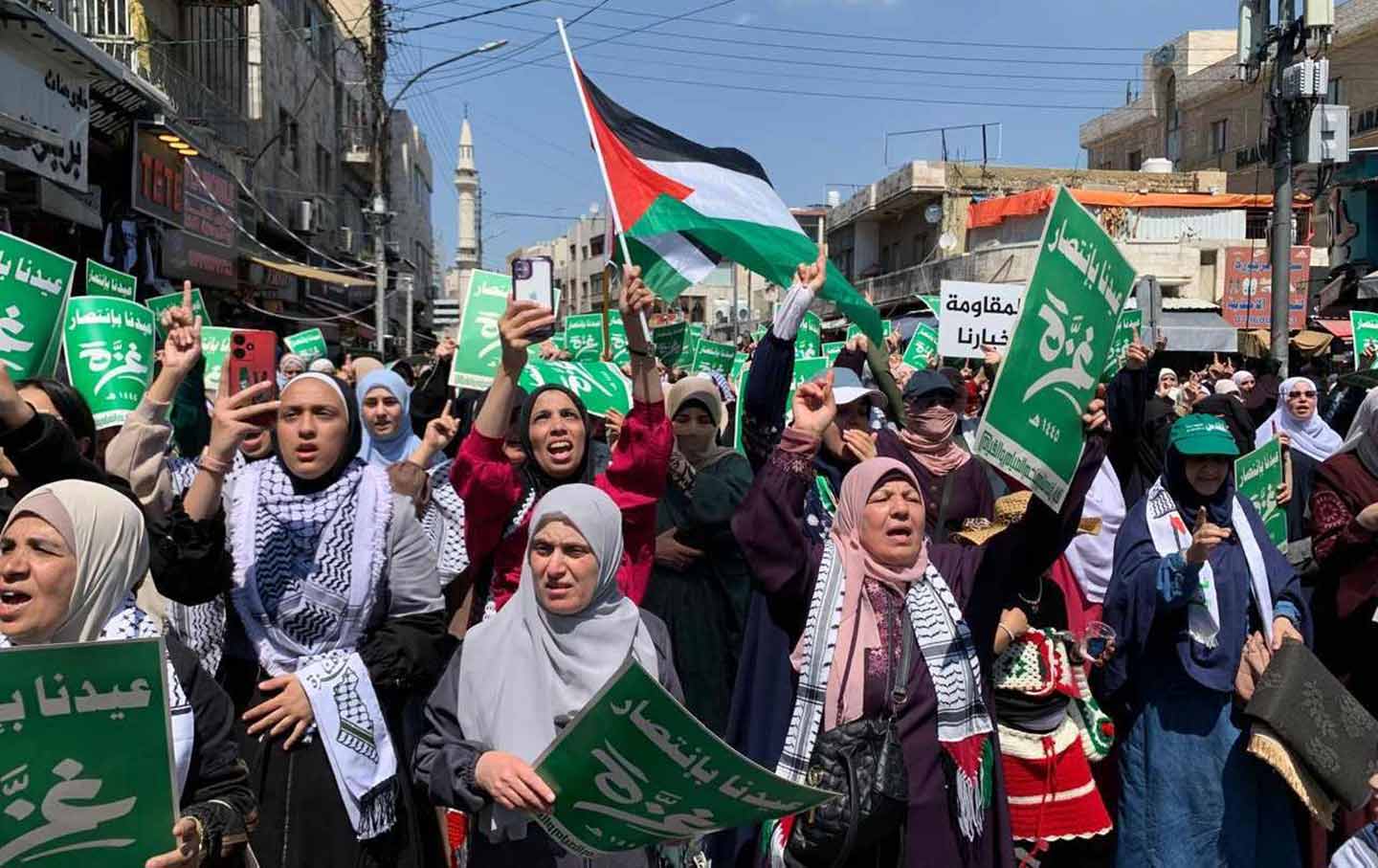
In Amman, Jordan, about an hour away from the West Bank, the Palestinian cause hits close to home. For months, thousands of people have flooded the streets every Friday in protest near the Israeli embassy and the King Hussein Mosque at the center of the capital city.
Recently, however, there has been a marked shift. On April 30, dozens of Jordanian students gathered in protest, waving Palestinian flags and donning keffiyehs, at university campuses across the country—Hussein bin Talal University in Ma’an, Mu’tah University in Mu’tah, Yarmouk University in Irbid, and Al-Zaytoonah University in Amman. And on May 1, students staged protests at the Hashemite University in Zarqa and the University of Applied Sciences in Amman.
“We have relatives who lived through the Nakba or the war in 1967 or other wars,” said Tereza, who goes by a pseudonym due to likely retaliation from her university. Tereza is a third-year engineering student and a leading organizer within the Student Forum for Supporting the Resistance—the nationwide coalition of student groups calling for such protests. “We see the struggle that the Palestinians go through. Being a Jordanian, I think it’s special to us,” she said. “It’s a part of who you are to fight for the liberation of Palestine.”
Jordan hosts more than 2 million Palestinian refugees—the world’s largest Palestinian diasporic group overall—and has a strategic partnership with Israel that has long fomented discontent. More than half of its population are of Palestinian origin, and even Jordan’s Queen Rania has Palestinian roots.
“We left our land and came here,” said Mays Abuajamieh, a Jordanian-Palestinian student who arrived for a planned protest at the University of Jordan before it was postponed after the arrest of a key organizer. Mays’s family migrated to Jordan from the West Bank city of Hebron in 1948 during the Nakba—the displacement and dispossession of millions of Palestinians by the Israeli army. “Why am I here [to protest] today? Because I always feel helpless about doing anything for Palestine. Gaza is dying every day.”
Though Gaza protests have been held on university campuses in the past, Jordanians have staged the majority of their demonstrations in the streets because of the retaliation from universities and authorities against pro-Palestinian student activists. Most of Tereza’s colleagues in Tajdeed, a leftist organization within the Student Forum, have been arrested and given warnings, she said. Some have been expelled.
Jordanian student protestors have been critical of the American government’s support for Israel and, in turn, their own government’s global partnerships. At the Hashemite University protest on May 1, chants described America as being complicit in Israel’s violence. But students say that the recent encampments for Gaza on American college campuses helped energize the Jordanian protests. “The government and the administrations are not allowed to prevent students from free speech inside the campus,” said Tereza. “But the movement in America broke this fear…. It sparked a new hope for us to continue this fight.”
“We have closely observed the successive events and unpredictable movements unfolding in American universities, advocating for the Palestinian cause and expressing solidarity with Gaza and its resistance,” wrote the Student Forum in its public statement calling for nationwide protests in universities. “This commendable initiative, which has resonated in over 30 American universities, has now transcended borders.”
The statement also called on Jordanian universities to condemn “all forms of violence” against students in American and other international universities, and to retract punishments faced by Jordanian students for their support of Gaza.
“I take immense pride in the global protests supporting Gaza, especially those in America,” Sia Sawan, another University of Jordan student who came for the May 1 protest, told The Nation. According to Tereza, the Student Forum’s next steps involve forming educational initiatives on campuses to further raise awareness about the Palestinian cause. “It’s truly heartwarming and gives us the pride to continue our efforts,” said Sawan. “What’s happening in Gaza is absolutely heartbreaking, and as human beings, it’s our duty to do our absolute best to help stop this crisis.”