Campus Police Are Among the Armed Heavies Cracking Down on Students
While some of the worst behavior has come from local and state police, university police have shown themselves to be just as capable of brutality.
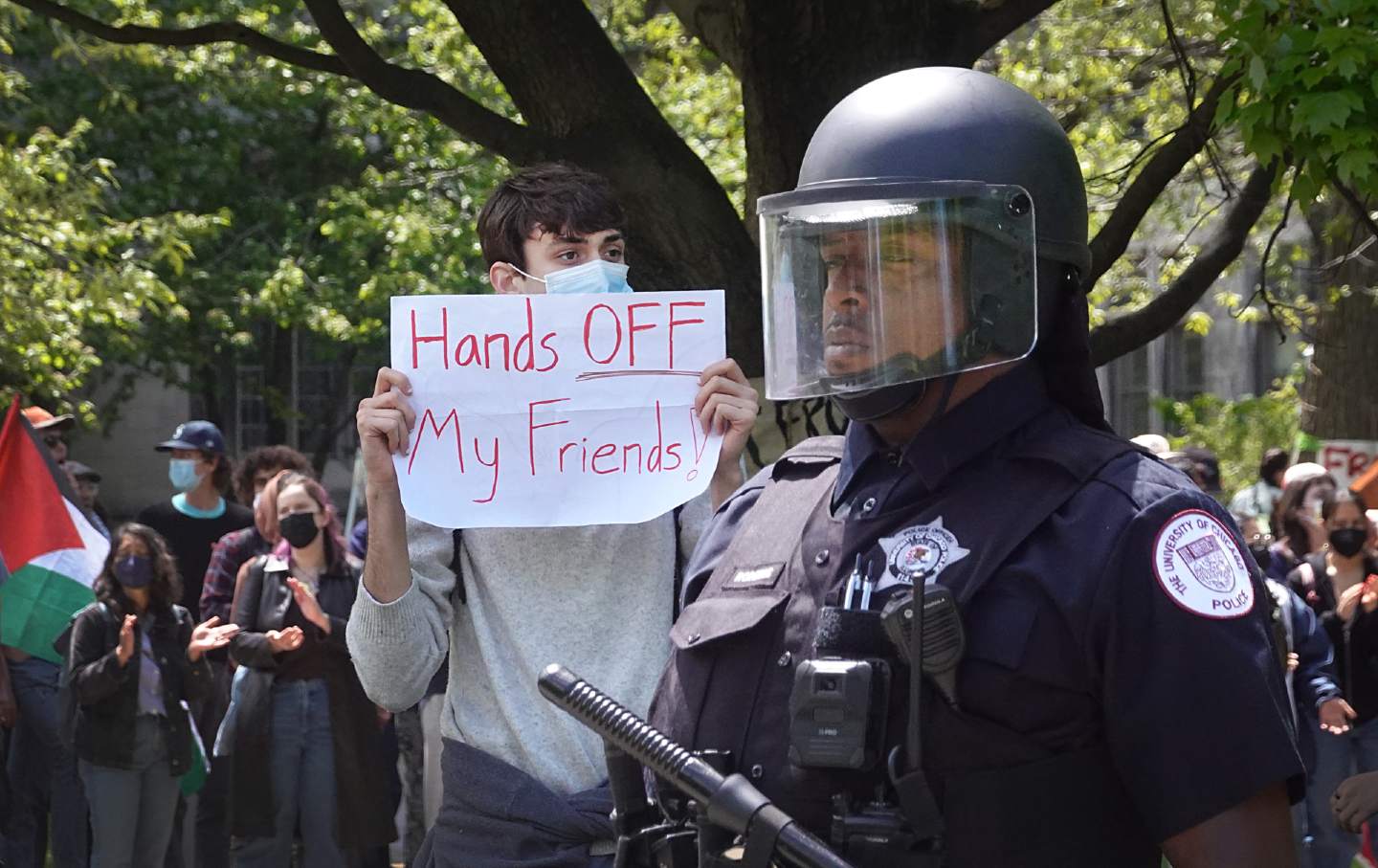
A campus police officer stand stands at the ready as protesters demonstrate at the University of Chicago on May 3, 2024.
(Scott Olson / Getty Images)Over the last two weeks we have seen the widespread criminalization of student dissent—and on a scale that has not been seen since the Occupy protests of 2011. While some of the most egregious behavior has come from local and state police—such as placing snipers on the roof of a building overlooking protests at Ohio State and Indiana University and the violent mass arrests of peaceful student protesters at Columbia, City College, and University of South Florida—university-based police departments have played their part too. And they have shown themselves to be just as capable of brutalizing students and faculty as state and local police.
Among the more egregious incidents, we have seen campus police join with official law enforcement to violently arrest students and faculty at Emory, the University of Illinois, and the University of Texas. At UCLA, university police stood by as an encampment was overrun by violent counter-protesters.
The history of campus police goes back to 1894 and the emergence of a watchman-like system at Yale. These watchmen were granted the legal powers of municipal police and were able to execute arrests and use force as necessary, differentiating them from security guards who generally are unarmed and must rely on local police to make arrests. Modern campus policing as we know it, however, emerged for the most part much later in the 1960s and ’70s, in the wake of the violent police repression of student protests in those decades. During that era, universities invited law enforcement onto campuses, where they famously brought the heavy weight of their force down on students—from the arrests of Free Speech Movement protesters in Berkeley to the NYPD’s violent attack on students at Columbia to the killing of four Kent State students by Ohio National Guard troops
In response, beginning in the 1970s, universities decided to follow a different approach to campus unrest: Rather than deploy local police who worked at the behest of city officials often wanting to “send a message” to protesters, universities developed campus police forces that, at least in theory, would be under the direct control of administrators and thus able to provide a more nuanced, preventive, and less violent approach to campus protests. The hope was that this would minimize disruption to campus life, restore legitimacy to university administrations in the eyes of students, parents, and the general public, and give schools more resources to protect campus infrastructure.
To justify these new and expanded campus police forces, university officials invoked the rhetoric of local control and community service. They argued that that having a police force under the direct authority of college administrators would reduce the level of violence around policing protests because these forces could be more proactive and preventative rather than reactive and retributive. By being a full-time presence on campus, they could channel protest activity into approved methods that didn’t disrupt college operations and didn’t require the involvement of outside police forces.
In practice these new forces tended to be a lot like their municipal peers. Headed up and staffed with officers from surrounding departments, they shared the same training and worldview as police generally. As recent research by Samantha Simon in Before the Badge and Michael Sierra-Arévalo in The Danger Imperative shows, this training and worldview instilled in them a deep culture of fear that bred a high level of defensiveness, suspicion, and unwarranted use of force. They viewed disruption as inherently threatening to the social order and thus worthy of criminalization. As with other police forces racism and sexism also became rampant.
During the last two decades, these campus police have become even more like local police. As a new volume Cops on Campus, edited by Yalile Suriel, Grace Watkins, Jude Paul Matias Dizon, and John J. Sloan, details: campus police have largely followed the rest of policing in becoming more warrior-like since 9/11. Many university police departments have formed tactical squads and received military surplus equipment from the Department of Defense’s 1099 weapons transfer program. A 2016 Associated Press report found that campus police departments across the country have obtained assault rifles either through the 1099 program or through direct purchases. It also disclosed a DOD report that 91 campus police departments had obtained over 800 rifles in the prior decade. While most departments refused to disclose direct purchases, the University of Wisconsin–Madison reported spending $11,000 on AR-15s in 2010 with plans to purchase more in the following years.
Under normal circumstances campus police play two primary roles, one is the protection of university resources and property and the other is the protection of members of the campus community—that is, students, staff, faculty, and administrators. Most of this work involves the surveillance and harassment of those deemed outside the campus community. In 2018, for example, Portland State University police operating off campus shot and killed Jason Washington, an unarmed young African American man involved in breaking up a fight. Police fired 17 rounds, striking him nine times. Students had opposed giving PSU police firearms in 2014 raising concerns about exactly such a scenario.
Campus police have not reserved their force only for those deemed outside the community, however. During the Occupy protests, University of California Police subjected UC Davis students to direct application of pepper spray in a video that became a viral meme at the time. There have also been cases where police have racially profiled non-white students and even arrested, brutalized, and shot them—including during mental health crises. In 2010 University of Florida police shot a graduate student in the face and hand causing permanent injuries. This March, a Washington State University officer shot at a student having a mental health crisis. As is too often the case, the student called for help and was greeted with armed police instead of a mental health response.
University police forces have also been expanding in recent years as their campuses expand into surrounding communities. Both the University of Chicago and Johns Hopkins University Police Departments were given permission to expand policing into surrounding communities where the universities have extensive real estate interests and in the process subject local residents, many of whom are poor and non-white, to an additional layer of intensive policing. In an essay for the Cops on Campus volume, the scholar Davarian Baldwin argues that this is in keeping with the larger vision of the neoliberal university and its efforts to expand research, medical services, and urban redevelopment without regard to their impact on displaced communities.
By unleashing both campus and other police forces on student protesters, administrators are making the same mistakes they made in the past. They are brutalizing their students and faculty—the very communities that define their institutions as “universities” and as a result, are contributing to a legitimacy crisis that runs the risk of escalating into a profound crisis of confidence in universities. Already, we have seen commencement ceremonies canceled at USC and Columbia as well as the cancelation of in-person classes and campus services at Columbia, UCLA, and the City College of New York.
Over the last several years student movements across the country have called for an end to campus-based police forces. They want all cops off campus—university-affiliated and municipal. Students at Portland State successfully de-armed their campus police and students at the University of Chicago and Johns Hopkins partnered with community-based organizations to oppose police expansions.
In 2022, a “Cops off Campus” coalition was formed that links these efforts together across the United States and Canada. The presence of armed police on college campuses, they insist, has done little to enhance a university’s public safety and instead serves as a private army to be used by administrators to advance institutional interests that often clash with the well-being of students and surrounding communities. When push comes to shove, campus police are no better than their off-campus counterparts and should be disbanded. The existence of campus police forces are a profound threat to our social movements and exist primarily to enable the ongoing work of the neoliberal university that places a significant burden on surrounding communities.