The Protesters’ Call for Divestment Is Not a Technical One
It is a question of will, not capacity.
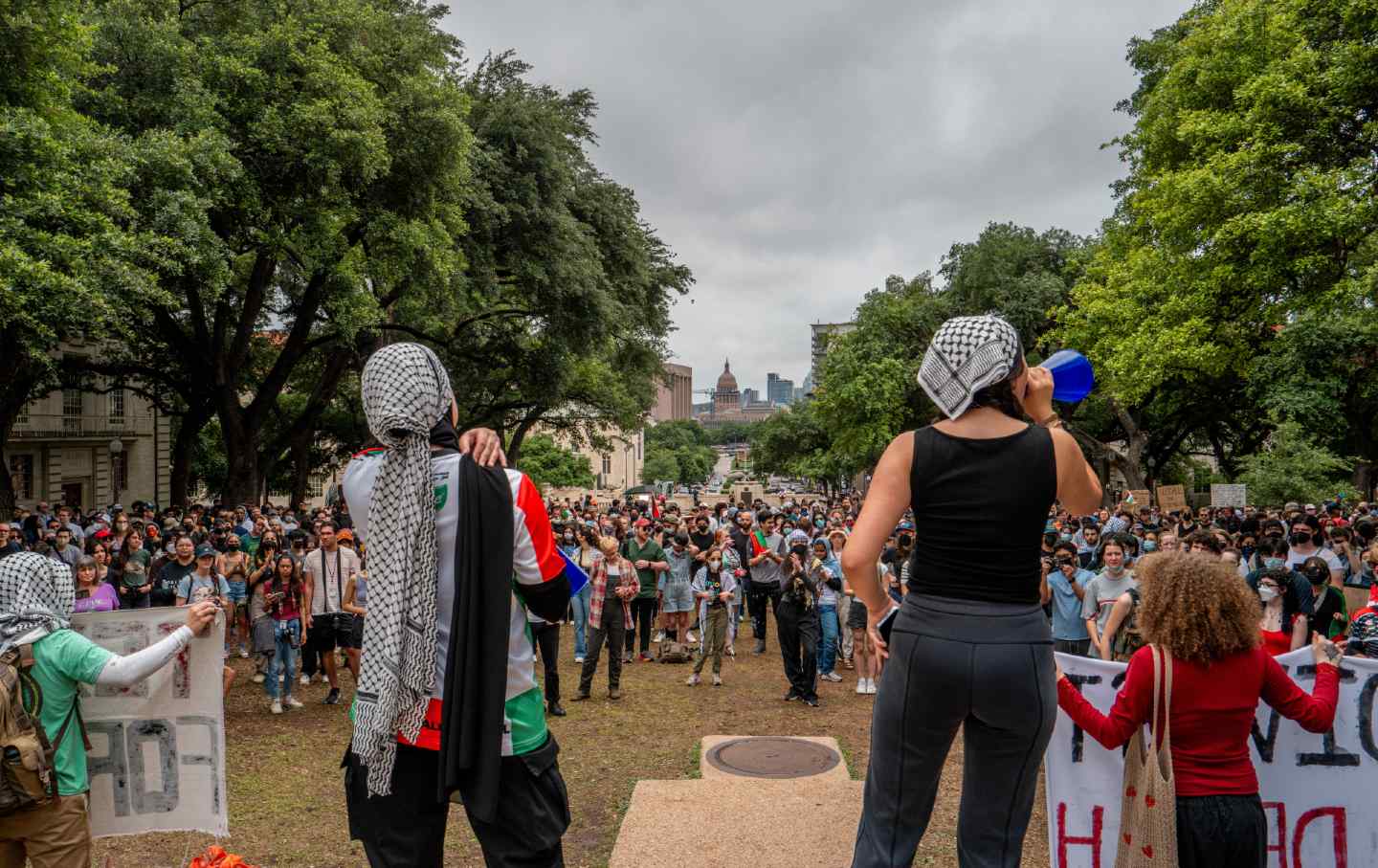
With over 2,000 students arrested, campus demonstrations against the war in Gaza are front-page news. The news channels highlight conflict: militarized police arresting demonstrators, the alleged threats posed by the demonstrators (although the greatest violence came from the attack of counterprotesters on the encampment at UCLA). Republican politicians leap to blame Biden for chaos, while gearing up four committees to grill (harass) university presidents. The mayor of New York City and others blame “external actors.” The usual pundits are trotted out to chide the demonstrators on what they got wrong.
Too often overlooked is the broader meaning and impact of the demonstrations. Perhaps more important than the clashes that get the most attention are the negotiations and agreements reached between students and university officials at Brown, Vassar, the University of California at Riverside, Rutgers, Northwestern, Middlebury, and several other campuses.
The chant of the demonstrators is “Divulge, divest. We will not stop. We will not rest.” Among the first reported agreements was at Brown, where students ended the encampment when the university’s president agreed to allow the school’s leadership to vote in October on a divestment plan for companies tied to Israel.
Cynics—and some of the demonstrators—dismiss the agreements as ploys to gain a peaceful end to the demonstrations in time for commencement ceremonies. In fact, these agreements are likely to be a big deal.
Symbolically, these agreements begin to put Israel in the same category as apartheid South Africa. For years, South Africa was considered an ally and Nelson Mandela scorned as a terrorist. It took a political movement—and the call to divest from South Africa—to turn that perspective upside down, labeling the apartheid government terrorists and Mandela a freedom fighter. Resisted and scorned as impossible at first, the demand for divestment spread across institutions—universities, churches, corporations, governments at all levels. Making South Africa a pariah nation had significant political and economic effects—and played a central role in the government’s agreement to abandon apartheid.
As with South Africa, the call for divestment has been initially dismissed as stupid, if not impossible. Endowment investments are generally secret and complicated. Identifying companies engaged in Israel would be difficult. But this is not a technical question. It is a question of will, not capacity.
And now the campus protests have given the call to divest from Israel new force. Already, religious denominations like the Methodists have decided to divest from Israeli bonds. If the violence continues in Gaza—and Prime Minister Netanyahu vows that it will, cease-fire or not—the pressure on institutions will grow. Investors will begin to change their risk calculations.
Israel, as never before, is at risk of becoming a pariah nation. If Netanyahu and the zealots in his coalition pursue what the International Court of Justice ruled potential genocide, if the violence continues and the incipient famine spreads, they are likely to destroy Israel as well as Gaza.
The student demonstrations also put Biden on notice. His posture of decrying the human costs in Gaza while shipping 1,000-pound bombs to Israel is morally and politically untenable.
Political pros initially dismissed the demonstrators as few in number. This isn’t Vietnam, where US forces were engaged directly, demonstrators numbered in the hundreds of thousands, and an entire generation of young men faced the draft.
But unlike Vietnam, young people today see the brutal destruction of Gaza, the desperate families, and the children at risk every day on their phones. The pictures give lie to the official propaganda, the sophisticated rationales, and render the administration’s certification that Israel is not committing war crimes preposterous.
That reality is already having an effect. As Thomas Edsall reports in the Times, Biden’s support among young voters has eroded dramatically. He quotes Bill McInturff, a Republican pollster, who found that the Gaza war “reflects one of the sharpest policy differences by age we have seen over a 40-year period.” In pre-Gaza surveys, young voters backed Biden over Trump 61 to 32 percent. In post-Gaza, the advantage collapsed to four points.
Popular
“swipe left below to view more authors”Swipe →The demonstrators may be relatively few in number, but they speak for a generation. The March Harvard Youth survey found that 18-to-29-year-olds favor a permanent cease-fire in Gaza by a five to one margin (51 percent support, 10 percent oppose). Democrats are girding for demonstrations at their August convention in Chicago.
The bigger question will be if the Israeli assault is continuing in the fall when students come back to campus in the run-up to the election.
The drama of the demonstrations, the images of militarized police rounding up student protesters, the partisan posturing around the demonstrations captures the headlines. But don’t miss the sea change that is occurring beneath the surface. Netanyahu and his coalition seem intent on grinding Gaza into the dust, but they risk bringing Israel and perhaps Biden down at the same time.
More from The Nation
The Specter of Lepenism Looms Over France’s Social Crisis The Specter of Lepenism Looms Over France’s Social Crisis
Joining forces with the “yellow vests,” youth demonstrators are raising the alarm in a country falling to the far right.

Progressives Are Backing Puerto Rican Independence. It’s About Time. Progressives Are Backing Puerto Rican Independence. It’s About Time.
More and more leftists are concluding that statehood for the island is not enough.
The Saudi Phase of the Iran War Signals More Chaos to Come The Saudi Phase of the Iran War Signals More Chaos to Come
The conflict that Donald Trump has repeatedly proclaimed an unequivocal American victory keeps spiraling out of control.
Andy Burnham’s Speech to the Labour Party Conference Could Be the Start of a Positive Social-Democratic Politics Andy Burnham’s Speech to the Labour Party Conference Could Be the Start of a Positive Social-Democratic Politics
But the autumn budget to be released at the end of October will offer needed details.
Why Navi Pillay’s Receiving the Nobel Peace Prize Is So Important Why Navi Pillay’s Receiving the Nobel Peace Prize Is So Important
She believes that human rights and international law are universal principles that must be enforced regardless of violator’s ideology, ethnicity, or geostrategic alignment.