After the Attacks Between Israel and Iran—What Comes Next?
The details of the tit-for-tat reveal that Israel is not the newly triumphant leader of an anti-Iran alliance, but a lonely pariah in a region that is entering a new era.
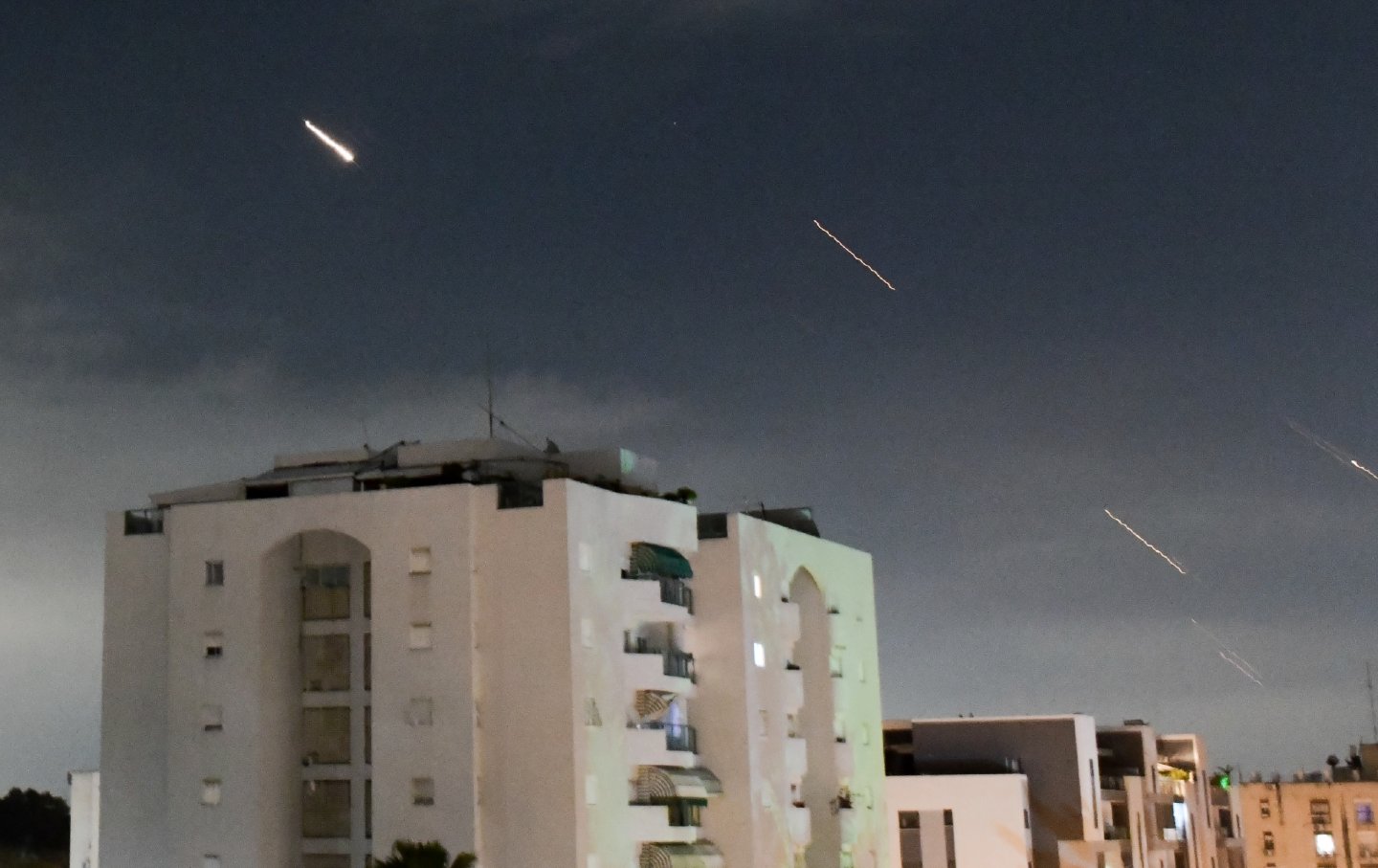
“You got a win. take the win,” President Biden reportedly told Israeli Prime Minister Benjamin Netanyahu after Israel, the United States, the United Kingdom, France, and Jordan intercepted the majority of the Iranian missiles and drones launched at Israeli military installations in mid-April. Not long after, White House national security spokesman John Kirby went on CNN’s State of the Union to claim victory. “This was an incredible success, really proving Israel’s military superiority and, just as critically, their diplomatic superiority—that they have friends in the region, they have friends around the world that are willing to help them,” he said.
Yet on closer inspection, Israel’s tense escalatory exchanges with Iran were hardly a win for Israel. The details of this tit-for-tat reveal that Israel is not the newly triumphant leader of an anti-Iran alliance, but a lonely pariah in a region that is in the process of entering a new era—one that is defined by a less (not more) favorable balance for Israel. The Netanyahu government’s only success may have been in momentarily diverting the world’s attention from its brutal bombing of Gaza.
Let’s recap. On April 1, Israel provoked Iran by launching an airstrike against an Iranian consulate in Damascus, killing seven Quds Force commanders and officers—a flagrant violation of international law. Iran had absorbed several hits by Israel over the course of the years but had chosen not to respond with the same force out of fear that it would get dragged into an open war with Israel that it could not win—at least not then. The Iranian policy of strategic patience was born out of necessity. Tehran calculated that, in the ongoing shadow war between Israel and Iran, time was on Iran’s side.
But on April 13, that patience ran out. Twelve days after the strike on its consulate, Iran launched its first-ever direct missile attack on Israeli territory. Of the 300 or so projectiles that Iran fired, at least nine breached Israel’s air defenses and struck two of its air bases, according to US officials. Given the very limited damage the strikes caused, Iran’s retaliation certainly appeared to have been unsuccessful. In reality, it successfully failed. It was designed not to inflict damage on Israel but to showcase Iran’s capacity to do so by penetrating Israel’s air defenses—and in a way that wouldn’t spark a larger war that Iran could not afford.
Furthermore, Tehran gave Israel a 72-hour heads-up through diplomatic channels, providing the US, Israel, and other partners ample time to make plans to intercept the drones and missiles. As a senior White House official acknowledged, “We used the time wisely to prepare.” After all, it was the US and its partners—not Israel—that shot down a majority of the missiles.
Still, some missiles slipped through Israel’s air defenses, revealing both Israel’s vulnerability and the futility of Trump’s and Biden’s sanctions, which were supposed to inhibit Iran’s military advances. Had Iran not provided a warning, and had Israel not benefited from US assistance, the damage would likely have been far greater.
When Israel countered a few days later, its strikes were muted, thanks in part to Biden’s de-escalation attempts. Israel appears to have easily evaded Iran’s air defenses, inflicting damage on some military installations, though the extent of the damage remains unknown. But Israel’s capacity to strike did not exactly come as a surprise to Iran. After all, Israel has carried out far more sophisticated attacks in the past, including an assassination of Iran’s top nuclear scientist in 2020 using a satellite-operated computer capable of firing 600 bullets a minute..
As the dust has settled, this episode has revealed that Iran’s air defenses remain inadequate but also that Israel’s image of invulnerability, as a European diplomat told us, “has been shattered.” With it, Israel has lost the freedom of action it has enjoyed for decades, one that allowed it to strike neighboring countries with impunity.
Similarly, the notion that this episode revealed a new military alliance between Israel and Arab states does not survive scrutiny. The Saudis and Emiratis shared intelligence with Israel on the incoming projectiles, and the Jordanians intercepted dozens of projectiles entering their airspace. But these interventions appear to have been motivated not by a desire to defend Israel so much as a wish to prevent the strikes from igniting a larger war in the region. In the case of Jordan, Amman acted to keep the aid flowing from Washington and to protect its sovereignty.
Jordanian Deputy Prime Minister Ayman Safadi also made it clear that if Israel went on the offensive, Jordan would similarly shoot down Israeli drones and missiles that used its airspace. “This is a principled position, and these are measures that we have taken in the past, have taken yesterday, and will take in the future, whether the source of the threat is Israel, Iran, or whoever,” said Safadi. (Israel heeded Jordan’s warning during their counter-strike and avoided Jordanian airspace by flying over Syria and Iraq instead.)
More important, some Persian Gulf states with an American military presence informed the US that it could not use bases in those countries for operations against Iran. (Tehran had warned these countries that they would become targets if they permitted the US to attack Iran from their territories.) As veteran US diplomat Chas Freeman observed, “In a sense, Iran has achieved the neutralization of American forces in the Persian Gulf that it long sought.”
Far from being a win for Israel, the strike on the Iranian embassy triggered a series of events that have led to a new, less favorable balance of power between the countries. While it would be a stretch to call this a win for Iran, behind the spin, Israeli defense analysts must be deeply regretting the April 1 strike.
Become a Sustaining Donor This September
Between the reemergence of right-wing red-baiting and Donald Trump’s use of the chilling National Security Presidential Memorandum–7 to criminalize left political organizing, we’re seeing McCarthyism reborn before our eyes.
This assault on democracy cannot be ignored or wished away. Resisting it requires bravery in the face of threats and repression, a steadfast commitment to the truth, and the unwavering belief that we can—and will—overcome this darkness.
We must have an independent media that sets the record straight, unearths corruption and abuses of power, and advances a politics of justice and dignity for all if we’re to win this fight.
That’s why I’m writing to you today. This September, The Nation needs to add 100 monthly donors to sustain our progressive journalism. Your contribution makes the next investigative report, the next truth-speaking column, and the next pathbreaking essay all possible.
I hope you’ll support our work with a recurring donation today. If you donate $10 or more a month, we’ll send you a brand new “Hands Off the Free Press!” sticker to recognise your commitment to our cause. Please, donate today.
Onward,
Katrina vanden Heuvel
Editor and Publisher, The Nation