Voters Don’t Want 19th-Century Abortion Laws
Arizona’s Supreme Court ruling reinstating a draconian abortion ban puts Republicans at odds with the American public.
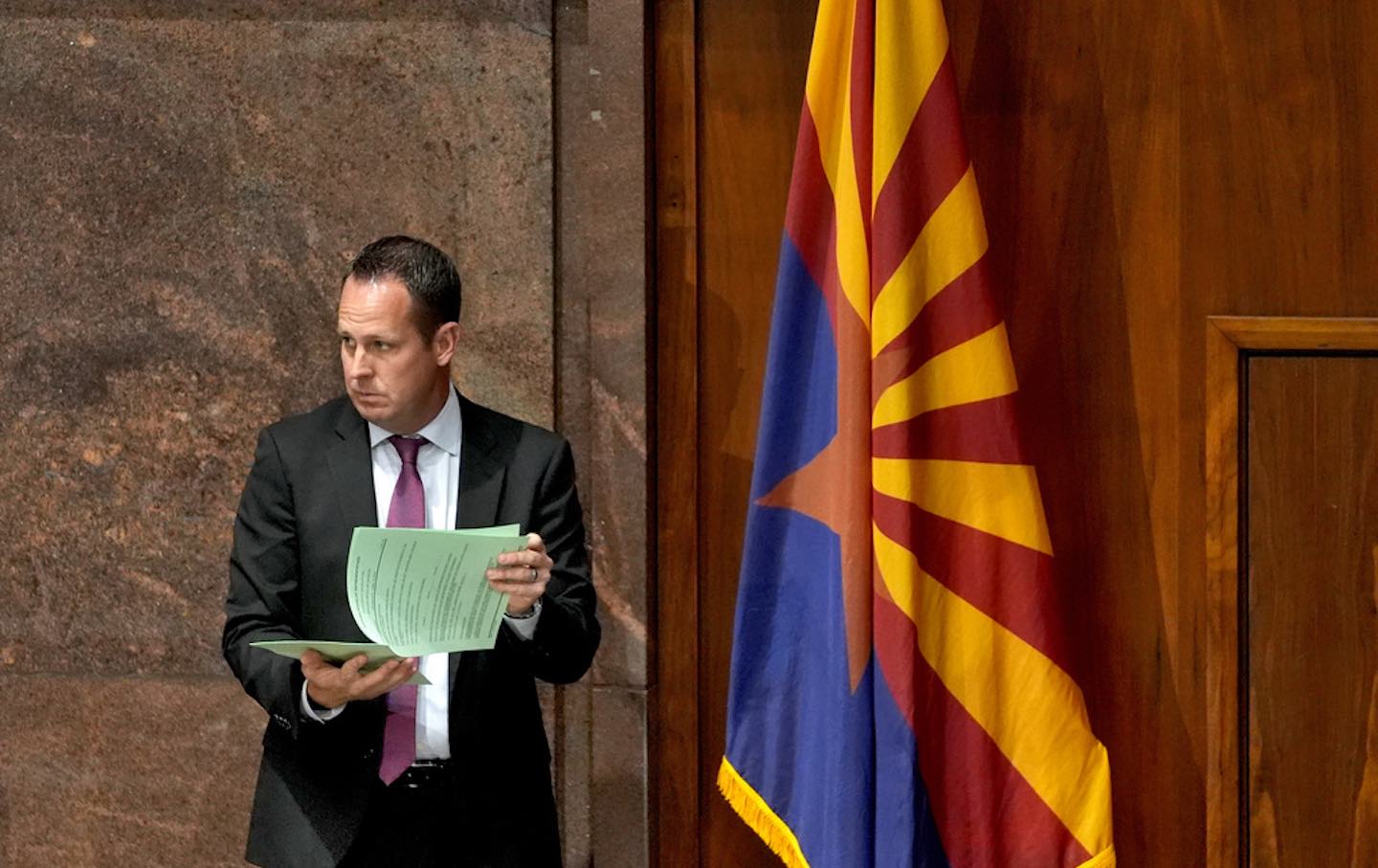
Arizona Republican Representative Travis Grantham looks over documents at the state capitol, Wednesday, April 10, 2024, in Phoenix.
(Matt York / AP Photo)Tuesday’s extraordinary Arizona Supreme Court ruling, reinstating an 1864 territorial-era law banning virtually all abortions, has placed abortion-access centerstage in a key swing state heading into election season. Where Republican state legislators had previously passed a 15-week ban—signed into law by ex-governor Ducey—this law, resurrected by a 4-2 court ruling, bans abortions from the moment of conception.
The law, which was put onto the books decades before Arizona even became a state, bans abortion in almost all circumstances—including rape and incest—and imposes criminal sanctions, notably incarceration for up to five years, on providers who help patients have abortions. While the state Supreme Court, which is dominated by ultraconservatives—all seven judges were appointed by Republican governors—put the abortion ruling on hold pending further appeals, if implemented it will turn Arizona into one of the most harshly anti-abortion states in the country overnight. “That was quite a mauling,” says Serra Sippel, interim executive director of the Brigid Alliance, a national organization promoting abortion access and helping patients travel out of state to secure healthcare services. “Taking us back 160 years to a very dark time in this country. It’s a terrifying time to be a pregnant person.”
Since Arizona imposed its 15-week limit on abortions in March 2022—a law which went into effect after the Dobbs decision overturned Roe v. Wade—the Brigid Alliance has helped fund travel to nearby states such as California, New Mexico, and Colorado for abortions, and also to states as far afield as Maryland. In 2023, it worked with 195 Arizonans who needed to travel out of state for abortions. But, according to Kaiser Family Foundation estimates, more than 10,000 additional abortions, carried out before the 15th week of pregnancy, were conducted within the state. Now, if the near-total abortion ban goes into effect, Sippel anticipates that the number of Arizonans her organization helps travel out of state will soar. And, at the same time, as the stories of these women circulate, she expects political rage about the abortion decision to grow. “This sort of draconian law is just not acceptable to the people,” she says. “The majority of people in this country do support people having access to abortion care, and they don’t want government restricting their rights to bodily autonomy.”
It is, says pollster Paul Bentz of the public affairs company Highground, an unmitigated disaster for the Republicans: A swath of polls in recent years have found that more than 60 percent of voters, across the political parties, support abortion rights, and in 2022, Highground found that only 22 percent of Arizonans favored criminal penalties against abortion providers. Yet any Republicans who back a legislative fix to this Civil War–era law risk alienating their base, which remains wedded to the most hard-core anti-abortion positions. “It really doesn’t give Republicans anywhere to go,” Bentz told me. The presidential race “now becomes an issue about abortion.”
On Wednesday, state Republicans proved Bentz’s point by repeatedly blocking Democrat-led efforts in the Senate and House to introduce measures repealing the 1864 law. Indeed, so desperate were House leaders to avoid the issue that they adjourned their chamber for a week.
Days before the Arizona ruling, Donald Trump had sought to neutralize the issue by saying that he didn’t favor a federal ban—indeed, on Wednesday he said he wouldn’t sign such a ban—and wanted the states to have the last say on the issue. Now, judges in a key swing state have decided that 21st-century women should be controlled by a mid-19th-century territorial law. Arizona Attorney General Kris Mayes called the ruling “unconscionable” and an “affront to freedom.” And state Republicans have embarked on a game of duck-and-weave to avoid addressing the issue. Yet, by Trump’s own formula, crafted just days before the ruling, that’s OK.
Arizona’s electorate isn’t so sanguine. For months now, Arizona for Abortion Access, a coalition of abortion-rights advocates, has been gathering signatures to put an initiative on the November ballot that would write abortion rights into the state Constitution. They had already gathered more than 500,000 signatures (more than the number required to qualify the initiative) prior to the ruling—and had announced that, in order to build a cushion against challenges to their signatures, they would continue their signature gathering campaign until the July 3 filing deadline. Now, they say, they anticipate racing toward their target of 800,000 signatures within weeks rather than months. On Tuesday, says Dawn Penich-Thacker, communications director for the campaign, “the phone was ringing off the hook,” and young people—who often shy away from signature-gathering efforts—were leading the charge to sign the petition to put the abortion-rights measure on the ballot. “Once Arizonan voters get to be the deciders,” Penich-Thacker says, “we will have a fundamental right to abortion in the state Constitution.”
For the Republicans, the ricochet effects could be profound. In the 2020 elections, just shy of 80 percent of Arizona’s registered voters cast votes—making it the second-highest voter participation rate in state history. This year, Bentz and his colleagues had estimated that turnout would be between 70 and 75 percent. Now, with the Supreme Court ruling, his modeling suggests turnout could again approach, and possibly even exceed, 80 percent. “I anticipate with this announcement it could go back to near-record high numbers,” Bentz says—giving Democrats a huge opening, “because younger voters don’t tend to go MAGA.” It will, he believes, make it harder for Trump to win the state, for Kari Lake to thread a path to victory in her Senate race, for the GOP to keep control of two competitive US House seats in the first and sixth congressional districts, and for the GOP to retain its razor-thin majorities in both houses of the state legislature.
This is the single biggest political gift the Democrats have been given so far in this election year. It will, surely, galvanize progressive voters in Arizona, mobilizing them to protect rights and to vote against political extremism. Similarly, it ought to provide a huge get-out-the-vote boost to neighboring Nevada, where voters are similarly pro-choice, and where an effort to codify abortion rights in the state’s Constitution is also underway, as I reported last week. Both of those states are critical swing states—and in both, Democrats can now say the threat to rights is no longer abstract but immediate and on their doorstep.