Trump and Orbán Are Kindred, Authoritarian Spirits
The presumptive GOP presidential nominee will host a friendly dinner with the Hungarian prime minister, an unrepentant enemy of pluralist democracy.
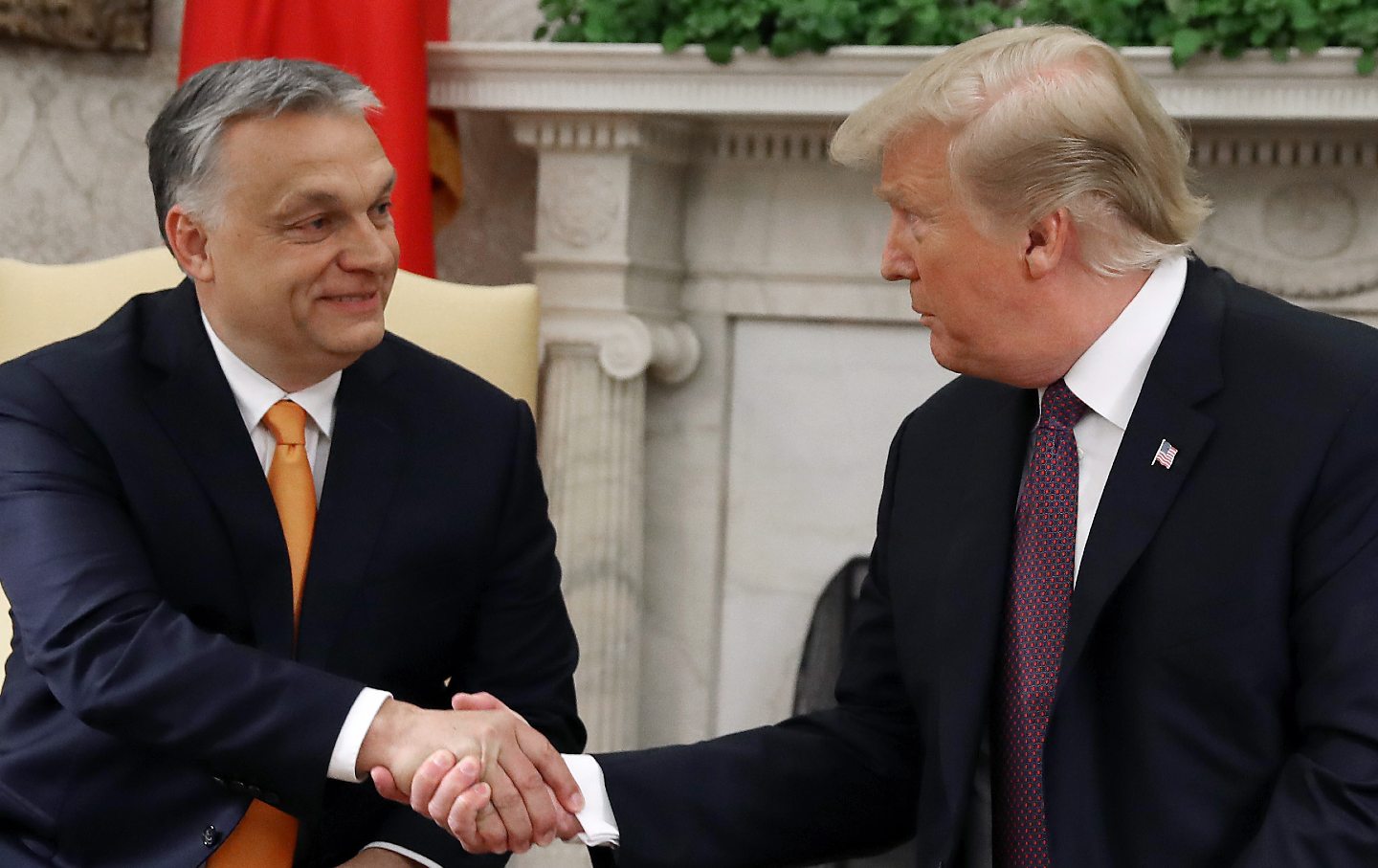
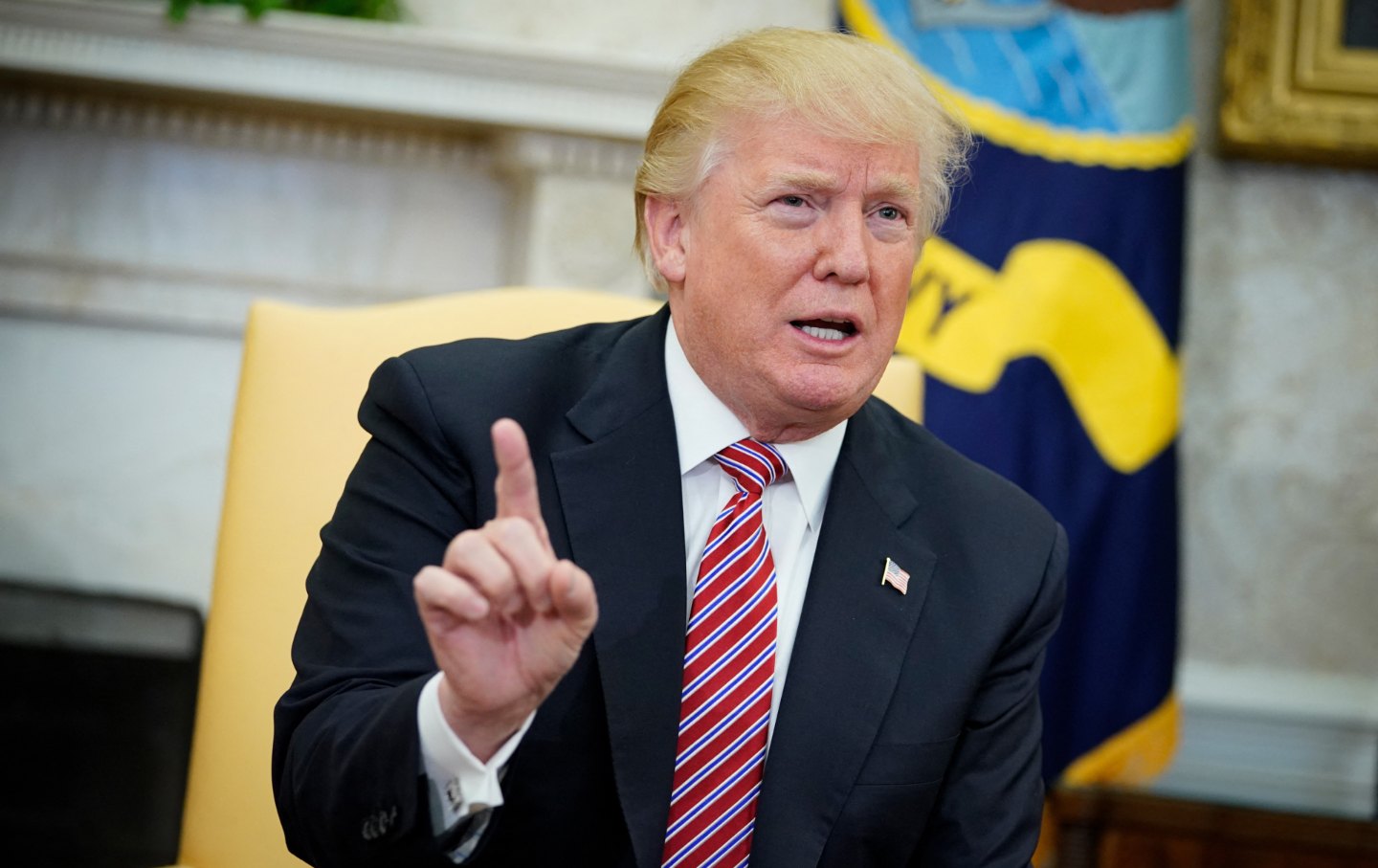
Donald Trump shakes hands with Hungarian Prime Minister Viktor Orbán in the Oval Office on May 13, 2019, in Washington, D.C.
(Mark Wilson / Getty Images)Donald Trump will be relishing some big wins this week: The US Supreme Court ruled to override Colorado’s decision to expunge him from the state’s presidential balloting for violating the 14th Amendment’s insurrection clause, and, after a raft of certain Super Tuesday primary victories, his renomination as the GOP’s presidential standard-bearer will be all but official. As he celebrates, he’ll be unwinding at his Mar-a-Lago home with a kindred spirit who looms ever larger in the Republican Party’s pantheon of authoritarian power: Hungarian Prime Minister Viktor Orbán.
The Trump-Orbán confab, slated for Friday, is a private affair, so the agenda will remain fodder for pundit speculation. But it takes no great imaginative stretch to infer the kind of grievance-laden refrains likely to dominate, given the close affinity between the two strongman leaders. Orbán is a fierce opponent of Western support for Ukraine, and has maintained close ties with Russia since the 2022 invasion. Trump, a longtime Vladimir Putin fanboy, has lately come under fire for saying he’d allow Russia to “do whatever the hell they want” to NATO member states delinquent in paying for their defense. Both leaders are anti-immigrant and use overtly fascist rhetoric to characterize the alleged threat that non-native, and non-white, bloodlines pose to the ethno-nation’s hardy biological stock. Both men tirelessly advertise their heroic aversion to the woke affinities of a cunning, all-powerful global cabal of liberal deep-state administrators.
Indeed, the Conservative Political Action Conference has taken to holding annual meetings in Budapest; Orbán himself keynoted the last one in 2023, and will again do the honors in late April. MAGA movement intellectuals hail Orbán’s regime—which has viciously cracked down on dissent, trampled the independent judiciary, and transformed the country’s universities into founts of ideological agitprop, all while demonizing immigrants and gays—as a prophetic foretaste of what a second Trump administration might achieve. And the militant right-wing initiatives marshaled under the Heritage Foundation’s “Project 2025” plan for a Trump restoration make it abundantly clear that such talk is not simply wish-fulfillment fantasizing on the American right. During last year’s CPAC gathering in Budapest, Heritage chieftain Kevin Roberts declared, “I stand in awe” before the Orbán regime’s repressive track record, while Arizona Representative Paul Gosar, a past attendee at stateside white nationalist events, gushed that “Hungary is a beacon.” Orbán reciprocated these warm sentiments in a flourish of Trumpian self-congratulation, announcing that Hungary on his watch serves as an “incubator where the conservative policies of the future are being tested.”
It should be a blaring distress signal that a major party’s presumptive presidential nominee hosts a friendly dinner with a foe of pluralist democracy. (Then again, President Joe Biden has not lately covered himself with glory on this front, granting a warm White House reception to hard-right Italian Prime Minister Giorgia Meloni, replete with a cringey kiss on the forehead–a decidedly awkward look for an incumbent trying to position himself as the last best hope of American democracy.) Yet the affinities that Trump and Orbán share go well beyond their broad strongman profiles in power. Susan Faludi, who lived in Budapest on and off during the aughts while researching a book about her Hungarian-born father, was among the first commentators to note the overlapping affinities of the Trump and Orbán worldviews when Trump was still a breakout candidate in the 2016 primaries. Far deeper than the bullying personal mien of each leader was a social mythology on the rise in each country steeped in “grievance and a sense of violation,” Faludi wrote:
The United States has never been sliced and diced like Greater Hungary. Nonetheless, after a half century of misbegotten wars in Southeast Asia and the Middle East, economic downturns and deindustrialization, and blue-collar and middle-class decline, the virus of self-pity is running in the country’s veins. It infects the Trump rallies whose crowds bemoan a nation no longer “great,” the Tea Party assemblies where family members of “the fallen” from our most recent failed conflicts are paraded for applause, and all those municipal flagpoles from which POW/MIA banners have been flying since Vietnam. Feeling sorry for ourselves has become a chronic condition, proudly showcased. Our national mope-fest might seem like the end result of a new civic humility. Instead, it is the means to an end—an end that is decidedly unhumble. Victimhood becomes the enabler of brutality.
Like many other baleful political trends, Orbánism can be summed up in an Onion headline: “Conservative Man Proudly Frightened of Everything.” That’s also the essence of MAGA messaging on the border, which has, via the negligence of a feckless political press and the spinelessness of the Democratic establishment, catapulted border security to the top of the list of voters’ concerns, and elevated Trump’s fascist playbook on immigration enforcement into respectable policy discussion. In key respects, if we’re not careful, the electoral profile of Orbánism—an authoritarian regime in which elections are still held, yet their outcomes increasingly don’t matter—looks to be the future in American politics. In other words, the brave new incubator of conservative policy innovation is creating a transatlantic monster.