On the Brink of a Government Shutdown—Again
For the fourth time since January, Congress is facing a deadline to fund essential spending priorities. The House GOP has neither shame nor sense of responsibility.
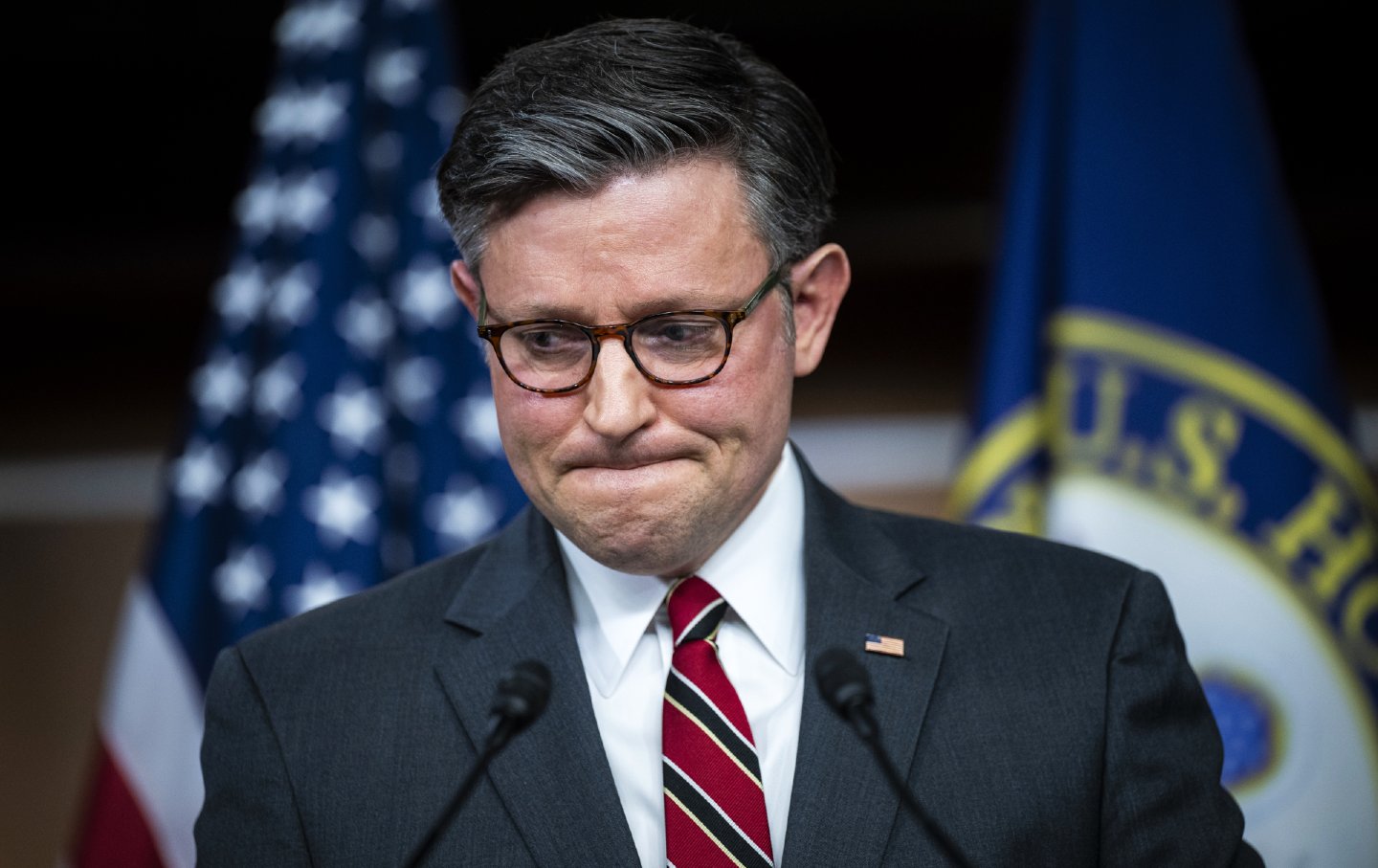
House Speaker Mike Johnson, a Republican from Louisiana, speaks during a news conference at the US Capitol in Washington, D.C., on February 14, 2024.
(Graeme Sloan / Bloomberg via Getty Images)Welcome back, my friends, to the shit show that never ends. For the fourth time in its brief tenure, the 118th Congress is on the brink of a government shutdown, with a fifth deadline to fund essential spending priorities just a week behind this Saturday’s cutoff date. (This tally doesn’t even count the near-death debt-ceiling deal last spring—the accord that set former House Speaker Kevin McCarthy on a path to dismissal at the hands of eight professionally outraged hard-right members.)
When McCarthy’s eventual successor, Mike Johnson, cut his own deal to approve a continuing resolution to avert a shutdown in January, he tried to tamp down a brewing revolt among the members of the anti-government Freedom Caucus with a bit of scheduling legerdemain. In lieu of using a big deadline to produce an ungainly omnibus deal to keep the government funded, Johnson proudly debuted a two-tiered spending deadline. The first tranche of funding bills—enabling the continued operations of the departments of Agriculture, Veterans’ Affairs, Housing, and Transportation—would need to secure passage in the House by March 1. The next batch of spending bills, slated to expire March 8, pay for everything else, namely the departments of Justice, Commerce, Defense, Homeland Security, State, Education, Interior, and Health and Human Services, as well as the Environmental Protection Agency and the legislative branch.
With a straight face, Johnson proclaimed that this staggered approach to the main business of the House—minding the government’s purse strings—would permit his fractious conference, operating with a razor-thin majority, to better advance and secure its legislative priorities. “We’re not surrendering, we’re fighting,” the new speaker said at the time. “But you have to be wise about choosing your fights.”
Now, Johnson’s self-touted wisdom is bearing fruit—with the same desperate rush to avert a shutdown that provoked the January deal. The GOP House conference, already boasting historic levels of legislative inactivity, confronted Saturday’s shutdown deadline with the sage circumspection that it’s displayed since the new majority was seated last January: It took an extended recess and returned with no coherent plan of action. So Johnson once again faces the least palatable option for the survival of his speakership: obtaining a rules suspension to broker a spending deal that relies on Democratic support to get passed.
“What’s stunning to me is that you’ve got the shutdown deadline, and you’ve got Ukraine funding, funding for Israel and the border and Taiwan,” Norman Ornstein, a longtime Congress watcher and emeritus fellow at the American Enterprise Institute, told me. “You have all these critical issues, but Republicans take longer recesses than usual.” This dilatory approach to the GOP’s self-imposed deadline, combined with the power dynamics under a shrinking House majority, leave Johnson in a tighter spot to produce results than he was in during the January spending wars. “If they fuck this up and can’t make it work, and Johnson somehow brings a plan up under suspension, this is one where you’re going to need a substantial number of Republicans on board,” Ornstein said. “If you’re looking at the [supplemental] funding bill for Ukraine and Israel, you’re going to lose some Democrats because of Israel funding, so you’ll need a significant number of Republicans.”
It’s also an election year, which makes it especially difficult for Republican lawmakers to make the case to hold on to and expand their House majority, or christen a new Senate one, when they’ve throttled basic government services—on top of their leadership battles and operatic culture-war inquisitions. That’s why Johnson’s Senate counterpart Mitch McConnell is already lobbying him to avert a shutdown: McConnell knows that, even with a 2024 map that favors a GOP Senate majority, pulling the plug on federal services could lead to electoral disaster. That’s the unmistakable lesson of past GOP-engineered shutdowns, from the 1995–96 Gingrich-authored debacle to Donald Trump’s border-wall fiasco of 2018.
Johnson has conducted a frantic round of meetings with Senate leaders and President Joe Biden trying to forestall a partial shutdown by the end of the week. In his most recent White House confab with Biden, Senate majority leader Chuck Schumer, and House minority leader Hakeem Jeffries, Johnson met the Democrats’ pleas to approve Ukraine funding with a renewed push to move forward on border security—even though the Senate-brokered bill on the issue has been denied a floor vote at the behest of Johnson’s chief political retainer, former president Donald Trump. Johnson, in other words, is not merely content with repeating the Beckett-style negotiations over a shutdown on autoplay; he’s going out of his way to draw attention to the greatest, self-inflicted legislative cock-up of the 118th Congress. This really says everything about today’s class of Republican lawmakers: Even as they reckon with preordained policy doom, they’re unable to come up with any fresh material. “It’s such an embarrassment to any concept of responsibility, of following the oath they all took, of running a critical institution,” Ornstein said. “And that they have no shame about it, that just compounds everything.”