Border Wars: The Phantom Menace
Congress has once again extended the deadline for a budget agreement, all but guaranteeing a sequel to threats of a government shutdown.
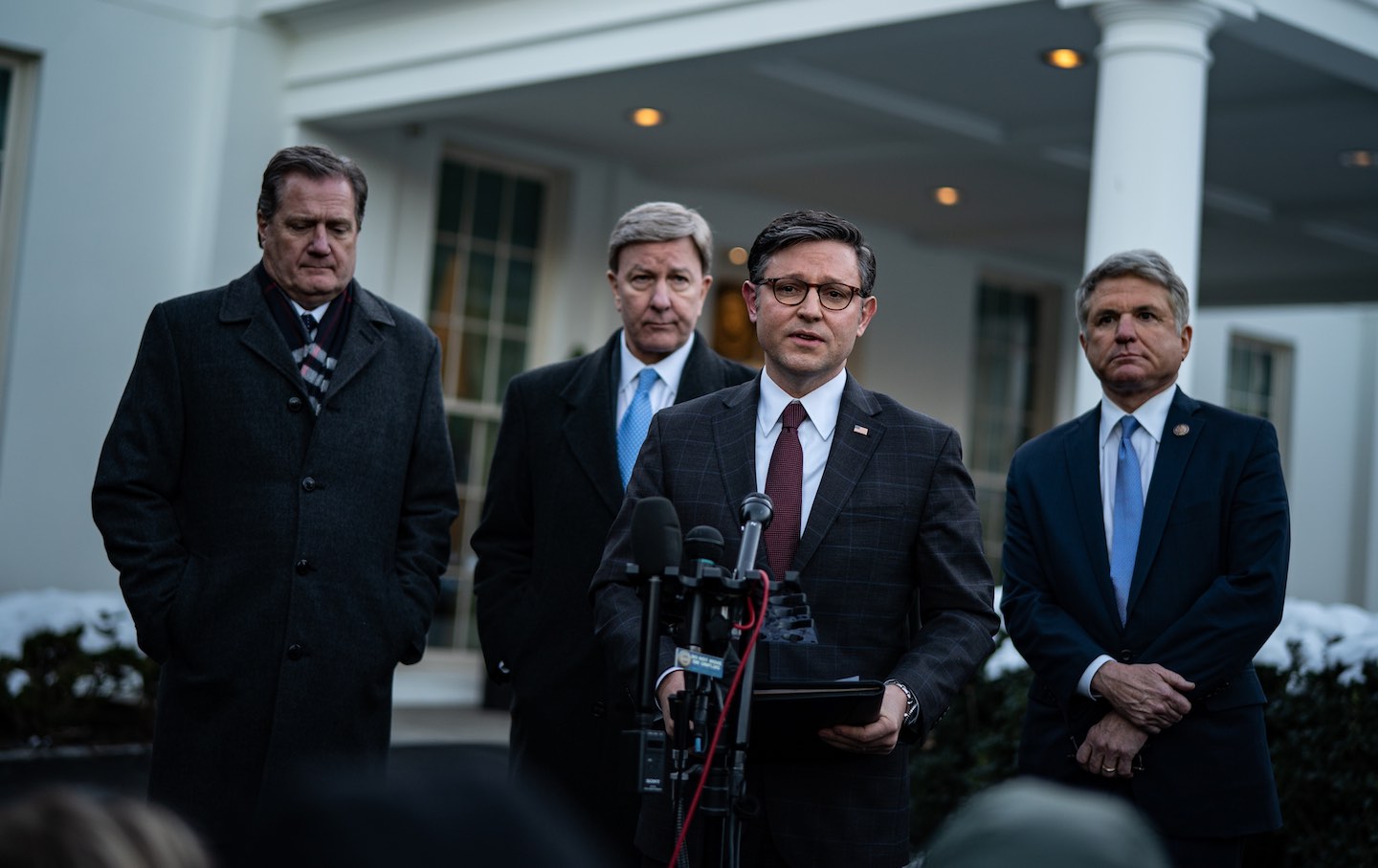
Speaker of the House Mike Johnson (R-La.) speaks to the press alongside from left, Representatives Mike Turner, (R-Ala.), Mike Rogers, (R-Ohio), and Mike McCaul, (R-Tex.), following a meeting with President Joe Biden and congressional leaders outside the West Wing of the White House in Washingtion, D.C., Wednesday, January 17, 2024.
(Salwan Georges / The Washington Post via Getty Images)It was curiously fitting that the approach of the latest existential budget deadline in Washington arrived with minimal fanfare: So many prior urgent deadlines and leadership questions have convulsed the do-nothing 118th Congress that inertia has simply become business as usual.
It’s true that this present deadline has been strategically miniaturized. Before Congress reconvened this week, leaders in both chambers reached yet another accord to extend the bedeviled budget negotiations into March via a continuing resolution vote that passed on Thursday. That meant that the January 19 deadline formerly penciled in during the last budget extension has been pushed ahead yet once more on the calendar, with a new pair of shutdown deadlines on the books now for March 1 and March 8. (The staggered deadline for prospective shutdowns, which House Speaker Mike Johnson of Louisiana originally touted as a great procedural breakthrough, appears largely and against all odds to make the whole budget ordeal more opaque and cumbersome than it had been before.)
The underlying political dynamics of getting to yes in a fractious and obstructionist House majority remain unchanged for Johnson—to get Thursday’s vote through, he again had to rely on the Democratic caucus, as the House GOP’s anti-government provocateurs once more derided the compromise and threatened mutiny against their overseers. With the House Republican spending rebellion stuck on autoplay, the speaker spent the past week focusing on another spending battle altogether: the $100 billion package that ties Biden administration outlays to Ukraine, Israel, and Taiwan to new crackdowns on border security. Negotiations over the border measures have been moving through the Senate, which gives Johnson the maneuvering room for vacuous culture-war posturing he so desperately lacks in the main budget battle. So after a Wednesday meeting with Biden and senior White House officials, Johnson pronounced himself dissatisfied over the state of play, mostly because of stalled momentum on proposed curbs on presidential parole authority in asylum cases—a key plank in the House’s own complete nonstarter of a border bill, HR 2. Johnson did say he backs Ukraine aid now, in spite of his past voting record against it, but pledged to stand firm until he got concessions on the border. “We need the questions answered about the strategy, about the endgame and about the accountability for the precious treasure of the American people,” he told reporters after the Wednesday meeting.
The rhetoric in Johnson’s remarks was as lofty as the substance was incoherent. Just for starters, a reduction in presidential parole authority would actually increase the overall volume of people seeking entry, documented or otherwise, at the border, which is the alleged crisis right-wingers profess to want to remedy. Viewed in the admittedly narrow and xenophobic ambit of Republican discourse, the furor over hamstringing parole authority is a bit like trying to combat a drought by declaring water contraband.
What’s more, the Democrats who have led Senate negotiations in the border bill have, true to traditional centrist form in intraparty policy disputes, recklessly caved in to a host of draconian GOP demands on key matters of asylum and detention—so much so that Senate Republicans are already trumpeting the border provisions of the deal as an historic win. “The Democrats will not give us anything close to this if we have to get 60 votes in the United States Senate in a Republican majority,” Senate minority whip John Thune of South Dakota said. “We have a unique opportunity here. And the timing is right to do this.” Senator Lindsey Graham of South Carolina, a longtime marionette of the MAGA movement, concurred: “To those who think that if President Trump wins, which I hope he does, that we can get a better deal—you won’t,” Graham announced. “You got to get 60 votes in the United States Senate. To my Republican friends: To get this kind of border security without granting a pathway to citizenship is really unheard of. So if you think you’re going to get a better deal next time, in ’25, if President Trump’s president, Democrats will be expecting a pathway to citizenship for that.”
The takeaway here couldn’t be clearer: Republican lawmakers in the Senate are loudly exulting that they rolled their Democratic counterparts—though it again bears noting that blocking a pathway to citizenship, for all the excitement it sends coursing through the pheromones of MAGA world, again does absolutely nothing to reduce the flow of incoming immigrants. Yet Johnson—who is keenly aware that, in putting forward his $1.66 trillion spending deal, he’s embarked down the same path of budgetary pragmatism that claimed the speakership of his predecessor Kevin McCarthy—cannot afford to be seen brokering even an absurdly right-leaning compromise on immigration, lest Georgia GOP Representative Marjorie Taylor Greene and other hard-right members of the House make good on their threat to schedule a motion-to-vacate vote on Johnson’s speakership.
It’s difficult to convey just how completely upside down and surreal all the relevant political calculations are here. In order to demonstrate his MAGA bona fides, Johnson is inserting an objectively unworkable set of demands into a border negotiation that represents a major political win for the GOP—so much so that its backers in the party are stressing that they wouldn’t get a better set of concessions in a second Trump administration bound and determined to complete the full nazification of the southern border. Then again, the demagogic border politics of the right have assumed outsize importance as traditional GOP-branded culture war crusades, such as coerced motherhood and book bans and other agitprop retoolings of public school curricula, have badly harmed the party’s electoral prospects. The net result here is that Johnson, who fears being penalized by his conference for promoting non-obstructionist budget accords, is counting on the box-office appeal of staking out a more-MAGA-than-thou position on what will likely be the GOP’s sole legislative breakthrough in the 118th Congress’s second successive long, pointless, and militantly counterproductive session. If nothing else, you’ve got to marvel at all the many intricate and acrobatic feats of projection that spur the Mike Johnsons of the world to proclaim with a straight face that it’s the immigrants who represent such a toxic drain on the nation’s precious resources.
Become a Sustaining Donor This September
Between the reemergence of right-wing red-baiting and Donald Trump’s use of the chilling National Security Presidential Memorandum–7 to criminalize left political organizing, we’re seeing McCarthyism reborn before our eyes.
This assault on democracy cannot be ignored or wished away. Resisting it requires bravery in the face of threats and repression, a steadfast commitment to the truth, and the unwavering belief that we can—and will—overcome this darkness.
We must have an independent media that sets the record straight, unearths corruption and abuses of power, and advances a politics of justice and dignity for all if we’re to win this fight.
That’s why I’m writing to you today. This September, The Nation needs to add 100 monthly donors to sustain our progressive journalism. Your contribution makes the next investigative report, the next truth-speaking column, and the next pathbreaking essay all possible.
I hope you’ll support our work with a recurring donation today. If you donate $10 or more a month, we’ll send you a brand new “Hands Off the Free Press!” sticker to recognise your commitment to our cause. Please, donate today.
Onward,
Katrina vanden Heuvel
Editor and Publisher, The Nation