
Will Human Rights Survive?
Seventy-five years ago, the UN adopted the Universal Declaration of Human Rights. Can we ensure its implementation today?
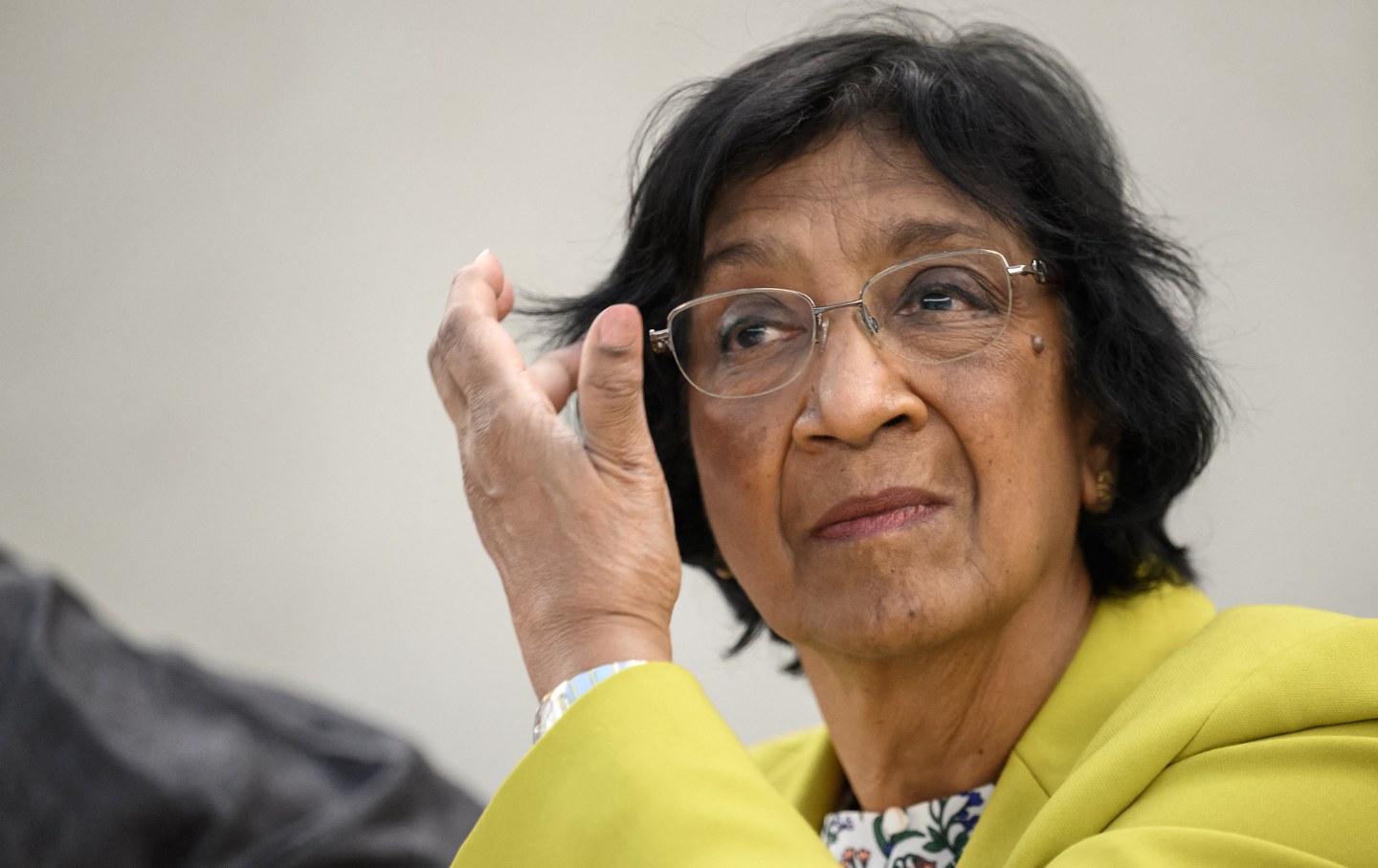
To mark Human Rights Day, on December 6, Roosevelt House presented an extraordinary program honoring Eleanor Roosevelt’s role in drafting and passing the Universal Declaration of Human Rights. The event featured a dialogue between the incomparable Meryl Streep (as Eleanor) and the much-respected former UN high commissioner for human rights Navi Pillay.
Jessica Neuwirth, director of the Human Rights Program at Roosevelt House, introduced Pillay: “It is now my great pleasure to introduce Navi Pillay, who is here at Roosevelt House as a Human Rights Fellow in residence. Over the past weeks she has met with and inspired our students and faculty, and has helped us in our efforts to move the agenda forward on various cutting edge human rights initiatives at the United Nations including consideration of the situation in Afghanistan as gender apartheid and the nascent idea for an international anti-corruption court.
“I was lucky enough to meet Navi Pillay when I was a student, and she was a young lawyer in South Africa getting a doctorate from Harvard Law School while at the same time fighting apartheid and defending political prisoners, some of whom ended up on Robben Island Prison. One of her many innovative cases gave prisoners in Robben Island, including Nelson Mandela, some protection from abusive prison guards. At the end of apartheid, Navi’s legal expertise went into the formulation of a new constitution for South Africa, considered one of the most progressive in the world. And prisoner-turned-president Nelson Mandela appointed Navi Pillay to serve as a judge, the first woman of color to serve on the bench in South Africa. Soon thereafter she was nominated by Mandela to serve as one of the first judges in the newly created International Criminal Tribunal for Rwanda, where in its first case she found rape to be a form of genocide and defined rape in international law.
“She later became president of the Rwanda Tribunal and presided over the so-called ‘media case,’ which held radio executives and a newspaper editor accountable for the hate speech that fanned the flames of genocide. Following her election and service as one of the first judges on the International Criminal Court, Navi Pillay was appointed UN high commissioner for human rights. As high commissioner, she traveled the world and spoke out forcefully against human rights violations wherever they occurred, with the judicial impartiality she is known for. She also brought to this post her extensive experience as a civil society advocate—a cofounder of the South African Advice Desk for Abused Women, and a cofounder with me of Equality Now. Following her so-called “retirement,” Navi Pillay has continued to work tirelessly for human rights.
“She serves on the board of the Frontline Women’s Fund and as president of the International Commission Against the Death Penalty. She is president of the Advisory Council of the International Nuremberg Principles Academy and she is chair of the UN Commission of Inquiry on Israel and Palestine. As if that was not enough, she is also serving as an ad hoc judge on the International Court of Justice, in the case against Myanmar that has been brought under the International Convention Against Genocide. It is an honor to have her here with us tonight. Please welcome Navi Pillay.”
NAVI PILLAY
It is a real privilege to be with you tonight for this celebration of the 75h anniversary of the Universal Declaration of Human Rights [UDHR]. I have been thinking back on the 40th anniversary that Jessica mentioned. Back then in 1988, I was a human rights advocate in apartheid South Africa, and I was lucky to be invited to join Amnesty International’s groundbreaking world concert tour that aimed to popularize the Declaration. The media in my country reported, “Harvard doctor, Navi Pillay, has gone rockin’ and rollin’ with Bruce Springsteen.” The concerts were great fun, the music uplifting and a powerful medium for expressing both the agonies of suffering and the celebration of struggles for rights.
Growing up under apartheid, I only knew of poverty, disadvantages, and my second-class status as a person of color. I never dreamt that in my lifetime apartheid would end. Change happened because of the collective action of the international community, supporting us in our efforts to end systemic racism in South Africa.
In 1993, I attended the Vienna World Conference on Human Rights where the Office of the High Commissioner for Human Rights was first promoted by civil society to better ensure implementation of the Declaration of Human Rights. This was the first UN conference I ever attended—I was representing Equality Now, a women’s rights organization that was less than a year old at the time. South Africa had been recently readmitted into the United Nations after becoming a democracy, and I remember President Nelson Mandela encouraging NGOS to participate in the discussions on human rights. For me, it was awe-inspiring—like coming out of darkness and seeing the light for the first time.
I never dreamt that I would one day occupy the position of UN high commissioner for human rights, for which we were advocating at that conference in 1993, with a mandate for the protection and promotion of all human rights of all people, all over the world. I have worked for an expansive vision of human rights, one that includes LGBTI people, Indigenous people, migrants, people of all castes, race, and religion, and of course women and children. I have worked for justice and accountability—through national and international courts, through treaty bodies and other UN mechanisms. And I have worked for protection of civilians, and for economic and social rights, which are priority rights for developing countries.
Article 25 of the Declaration provides that everyone has the right to a standard of living adequate for their health and well-being, including food, clothing, housing and medical care and necessary social services. Climate change is a threat to all these rights.
The importance of economic and social rights as well as civil and political rights are upheld equally in the UDHR. Yet political support for economic rights is fractured and divisive between states in the north and south. The withholding of the Covid vaccine by rich countries leaving poor countries without this life-saving measure is a chilling reminder of how far we are from the noble goals of the Universal Declaration of Human Rights.
Popular
“swipe left below to view more authors”Swipe →I am often asked what keeps you positive about human rights. I have many heartening stories to tell. Let me leave you with one: I was seated under the trees, in the flooded muddy plains of the Blue Nile area in the north of South Sudan. My staff had arranged for me to speak with the 12 to 15 women gathered there, They had various deep scars on their faces. Some had four gashes, indicating the tribes they belonged to. Others had their front teeth extracted. They were branded like cattle. They spoke different languages and we needed four interpreters to understand one another. This was the deep rural area where cattle was the means of wealth—and time had stood still for a century. Two of the women said that their 12-year-old daughters had been killed by their husbands and sons for refusing to enter the marriages arranged for them, to very old men, in exchange for cattle. “We know where their bodies are buried and told the police. But nothing has been done. We gave birth to the girls—do we not have any rights?” they asked. I explained the rights in the Declaration to which we are all entitled but left the place feeling very despondent at the huge gap between the rhetoric of rights and their reality. I feared that it would take another century for them to catch up. But a month after I had returned, the ambassador of South Sudan based in Geneva came to see me. He said, “Something has happened in my country that has never happened before; those women you spoke to organized themselves into a group and went to see the governor of the province and demanded their rights.” Each of us can make a difference—telling people about their rights is the first step, and it is clear that Eleanor Roosevelt understood that.
I have been in and around the United Nations for a long time now, but I know that the key to change are the ordinary people in all parts of the world who bring the rights in the Universal Declaration of Human Rights to life. That is all of us, and I am here to tell you that the world can change for the better quickly in ways that we never dreamed.
Thank you.
More from The Nation
Israel’s Extremist Election Israel’s Extremist Election
The run-up to the vote on Tuesday is exposing the façade of Israeli democracy—and the fealty of the country's so-called opposition when it comes to matters of Jewish supremacy.
“NAZA” and Israel’s History of Automated Warfare “NAZA” and Israel’s History of Automated Warfare
As violent technologies like spyware, predictive targeting algorithms, and 2,000-pound warheads become ordinary instruments of military rule, once-abhorred practices become routin...
Brazil’s Workers’ Party Is Not Stopping Brazil’s Workers’ Party Is Not Stopping
With just a few days remaining before the runoff election, supporters of Lula’s party are doing everything possible to rally support behind the president.
Brazil’s Decision Brazil’s Decision
The moral compass and basic humanity of political leaders really does matter.
Albanian Student Strikes Spur a Political Crisis Albanian Student Strikes Spur a Political Crisis
A new round of protests against the ruling party’s corruption has Prime Minister Edi Rama giving cops bonuses to crack down on dissent.

