
Why Young People in Argentina Backed Far-Right President-Elect Javier Milei
Young voters helped deliver a shocking first-place finish for Milei in the August open primaries, and almost 70 percent backed him in the November election.
Before Javier Milei won the presidency of South America’s second-largest economy in a runoff against Sergio Massa, the center-left candidate from the ruling Peronist party, Argentina was consumed by the presence of another electrifying figure: Taylor Swift.
Swift’s Eras Tour landed in Buenos Aires the week before the presidential election, and indeed her final show in the city on November 12 conflicted with the last debate between Milei and Massa. In the days prior to her arrival in the Nuñez neighborhood of Buenos Aires, where she was set to perform, pink posters began to appear.
Inspired by Swift’s opposition to Marsha Blackburn in the 2018 Tennessee US Senate election and support for Joe Biden in the 2020 US presidential election, some fans of Swift had printed and plastered “Swiftie No Vota Milei” (Swifties Don’t Vote for Milei) on the sides of bus stops and construction sites. On the bottom of the posters, the parallel was made even more explicit with a hashtag “#MileiEsTrump” (Milei Is Trump). Some even more creative fans toyed with the assignment, producing photoshopped versions of Swift’s Era’s tour posters to preemptively celebrate Massa’s soon-to-be Presidential Era Tour.
Local and international outlets, including the German and French national broadcasters, ran with the story; the mix of popular culture, international fandom, and global politics proved to be irresistible. In similar fashion, earlier this month, a New York Times headline proclaimed, “The New Enemies of Argentina’s Far Right: Swifties and the BTS Army.”
The only problem? In Argentina, young people flocked to Javier Milei and his far-right party. Voters under the age of 29 delivered a shocking first-place finish for Milei in the August open primaries, and then later a whopping 11-point victory in the runoff. Almost 70 percent of young voters backed Milei in the November election (with surveyed men demonstrating a slightly greater preference for him than their female peers).
So important and central was the youth vote to Milei’s campaign that in his unprecedented endorsement of the far-right firebrand, the neoliberal former president Mauricio Macri, whose center-right party failed to make the runoff, called on his fellow party members “to have the humility to follow the youth… They have made their decision and they deserve our support.”
Of course, in a country with nearly 140 percent annual inflation, 60 percent of youth falling below the poverty line, and the average income having dropped consistently in the last decade to around $450 a month, it’s unsurprising that so many young voters were sick of the incumbent Peronist party. This financial crisis also helps to explain why the attempts to leverage Swift’s popularity for Massa’s presidential campaign fell flat.
The most obvious forces of American imperialism in Argentina, such as the ones that demand the devaluation of the peso, or back anti-Peronist dictatorships, also have a softer cultural face that looks something like sold-out Taylor Swift concerts. Agustina, a 25 year-old legal assistant from the Buenos Aires working-class suburbs, explained to me that in her experience, while “the American middle class loves America, the Argentine middle class hates their own country. They want to be Americans.” The combination of hard and soft imperial technologies can encourage many young Argentines to want to be anything but. Indeed, 70 percent of young Argentines say they want to emigrate.
Milei embraced this dejection and offered an anti-patriotic nationalism. He argued that the country had fallen into despair, decay, and impoverishment for decades—if not more than a century—and that Argentina ought to return to its 19th-century liberal, free-trading principles. It was once one of the wealthiest countries in the world, he said, and should still be a First World power, but instead its currency is worth less than “excrement.” During the first presidential debate, Milei proclaimed that “in 50 years we will be the world’s biggest shanty town” if Argentina continues on its current path. “But if you give me 20 [years, we will be like] Germany. If you give me 35: the United States.”
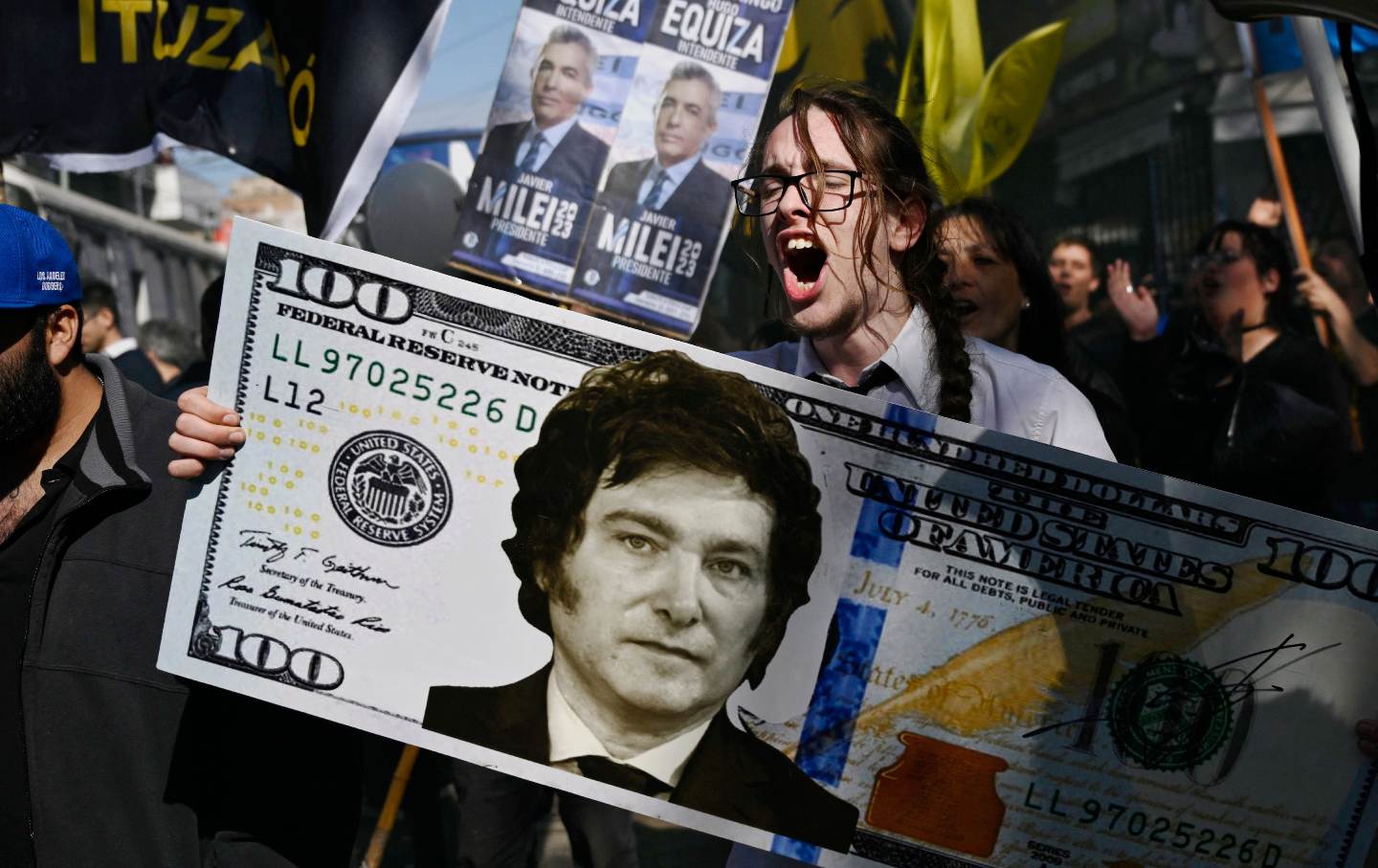
The self-proclaimed anarcho-capitalist’s signature policy, famously, is his promise to do away with the Argentine peso, shut down the nation’s Central Bank, forgo monetary sovereignty, and adopt the US dollar as Argentina’s legal tender. His campaign aides and allies often donned MAGA hats and “Don’t Tread on Me” flags, and oversize cardboard US $100 bills plastered with Milei’s face were a typical sight at rallies.
Beyond dollarization, other parts of Milei’s platform make plain his wannabe-American political visions. He has called for the right to bear arms (Argentina does not have anything like the Second Amendment, and most other candidates, even those on the right, have opposed this proposal) and replacing the public education system with charter schools and vouchers (another policy not backed by the the traditional center-right party); has claimed that climate change is a communist hoax; regularly invokes the notion that the state participates in pedophilia; hopes to orient the country toward the United States and Israel and away from China and Brazil, its biggest trading partners; wants to turn the clock back on abortion rights; has questioned if Biden won the US presidential election in 2020 and asserted baselessly that fraud has occurred throughout his country’s own electoral process.
It is unsurprising that his out-of-the-ordinary hairdo and career as a television personality have elicited comparisons to Donald Trump, a likeness he has proudly embraced. Tip O’Neil’s famous quip has been turned on its head. No longer is all politics local; today, all politics are global. In August, shortly after winning the primaries, Milei sat down for a one-on-one interview with Tucker Carlson. And soon after Milei won, Trump took to social media to proclaim that it was time to “Make Argentina Great Again!”
Popular
“swipe left below to view more authors”Swipe →If the left-wing Pink Tide first came, and returned, to Latin American politics championing a vision of a proud Third World nationalism, solidarity, and integration, it is unsurprising that the present right-wing riptide in the region offers a different vision, one of self-loathing, and a shift in orientation away from countries with shared histories and languages and toward global hegemons and international music stars.
On Sunday night, before he took the stage to proclaim victory, a member of Milei’s team switched out the podium’s placard. In lieu of the hotel’s logo, or that of his party, a different image appeared: a newly designed seal of the office of the Argentine president-elect, with a sketch of the Casa Rosada (Argentina’s White House equivalent) in the middle.
Argentine media immediately picked up on the parallels. A news anchor explained the seal to an unfamiliar audience. “It is an idea based…or copied from an American tradition. In Argentina we always used our patriotic seal. What did Milei do? Nothing with the Patriotic Seal. ‘Let’s make our own new seal!’ Oriented towards where? The United States.”
Become a Sustaining Donor This September
Between the reemergence of right-wing red-baiting and Donald Trump’s use of the chilling National Security Presidential Memorandum–7 to criminalize left political organizing, we’re seeing McCarthyism reborn before our eyes.
This assault on democracy cannot be ignored or wished away. Resisting it requires bravery in the face of threats and repression, a steadfast commitment to the truth, and the unwavering belief that we can—and will—overcome this darkness.
We must have an independent media that sets the record straight, unearths corruption and abuses of power, and advances a politics of justice and dignity for all if we’re to win this fight.
That’s why I’m writing to you today. This September, The Nation needs to add 100 monthly donors to sustain our progressive journalism. Your contribution makes the next investigative report, the next truth-speaking column, and the next pathbreaking essay all possible.
I hope you’ll support our work with a recurring donation today. If you donate $10 or more a month, we’ll send you a brand new “Hands Off the Free Press!” sticker to recognise your commitment to our cause. Please, donate today.
Onward,
Katrina vanden Heuvel
Editor and Publisher, The Nation
More from The Nation
We Need to Protect College Sports from Ted Cruz We Need to Protect College Sports from Ted Cruz
In this week’s Elie v. U.S., our justice correspondent looks at the Supreme Court’s rejection of Trump’s latest move to restrict mail-in voting. Plus, why Ted Cruz’s college-...
Why Aren’t We Talking About the Warmongering Lies of Mike Rogers? Why Aren’t We Talking About the Warmongering Lies of Mike Rogers?
The media’s relentless focus on Hasan Piker allows the dishonest GOP hawk (and actual Michigan Senate candidate) to evade scrutiny.
Netanyahu Is Accused of Ignoring Warnings About October 7 Netanyahu Is Accused of Ignoring Warnings About October 7
Will justice be served?
AI Is a Kitchen-Table Issue AI Is a Kitchen-Table Issue
And with the Trump administration encouraging unregulated growth in the industry, Democrats need to start acting like it.

