
The 14th Amendment Isn’t Going to Save Us From Donald Trump
Yes, Donald Trump’s attempt to foment an insurrection should bar him from running for president, but no judge will have the raw courage to kick him off the ballot.
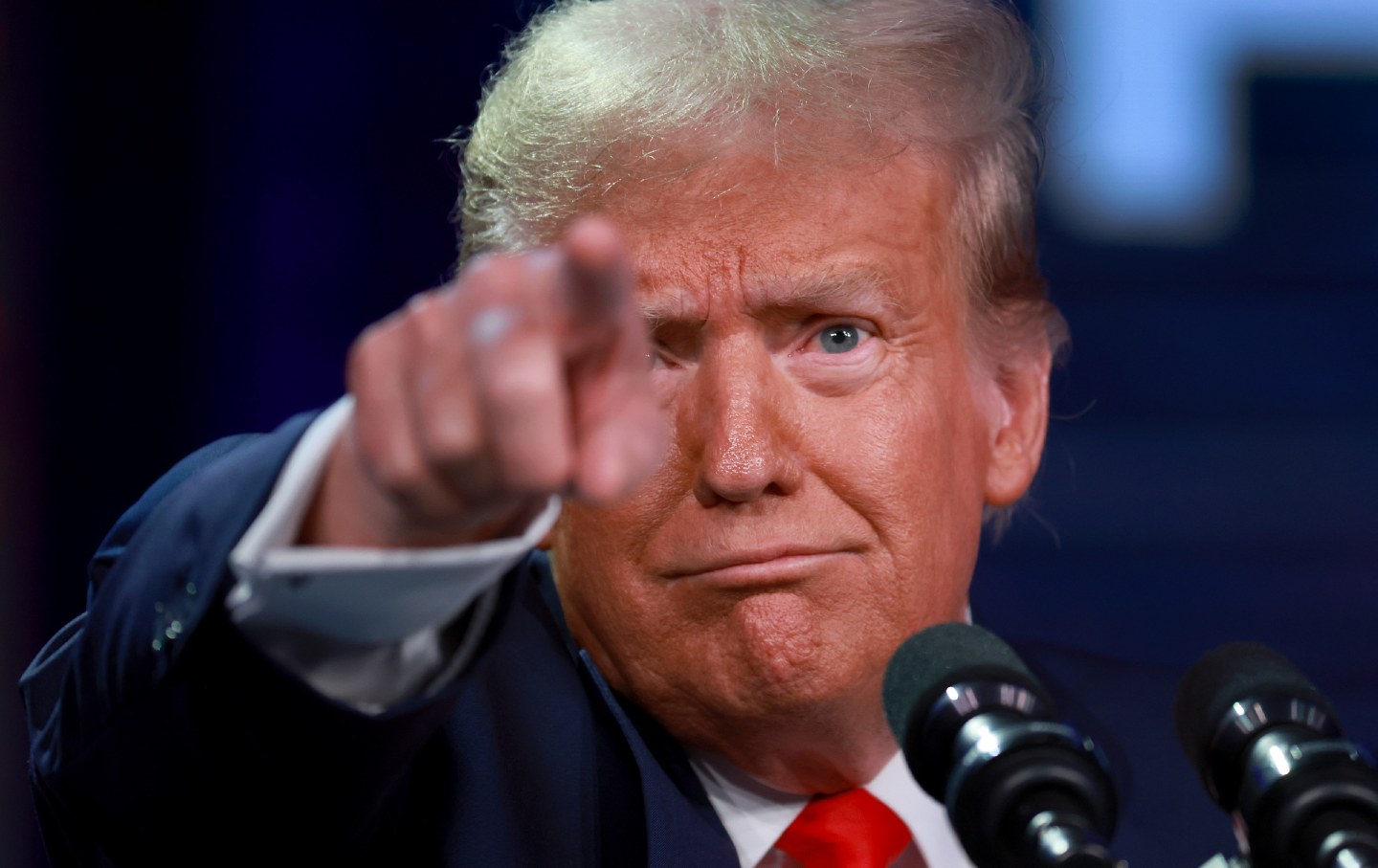
Donald Trump gestures during the Florida Freedom Summit at the Gaylord Palms Resort on November 4, 2023, in Kissimmee, Fla.
(Joe Raedle / Getty Images)I hate to be the bearer of bad news as we approach the holiday season, but Section Three of the Fourteenth Amendment will not be riding in on a sleigh powered by eight days of pumpkin-spiced rocket fuel to stop Donald J. Trump from running for president.
I know what the law says. For the uninitiated: Section Three of the Fourteenth Amendment says that no person having previously taken an oath to uphold the Constitution who engages in “insurrection or rebellion against the same” is eligible to seek office again. I know that many have hoped that this provision would stop Trump (and a bunch of other January 6 insurrectionists in Congress) from running for office ever again. But it’s not going to work and, at some point, liberals have to stop engaging in magical thinking.
Before we even get to the law of it all, we should talk as adults about the realpolitik of what these Section Three lawsuits, brought in state after state in order to get him kicked off as many ballots as possible, are asking the courts to do. The lawsuits ask some random state court judge (or federal judge or panel of judges) to rule that the most popular Republican in the country is ineligible to run for president according to state election laws and the Constitution. They ask judges to tell people who want to vote for Trump that they are not allowed to vote for him, and they ask these judges to do this on their own authority and without the implicit backing of the Army of the Potomac or the 101st Airborne Division. They want the judges to do this even as those judges know that any decision kicking Trump off the ballot will eventually be appealed to the Supreme Court of the United States, a body packed with six judges picked by Republican presidents, three of whom were handpicked by the very man they’re supposed to kick off the ballot.
Who does that? Which judge wants to functionally impale their career as an impartial adjudicator for a cause that will surely be struck down by the Supreme Court at the earliest opportunity? Again, real talk: Which judge wants to do that, get overturned, and still need to hire extra security for the rest of their life because they ruled that a man with a proven ability to inspire his followers to violence can’t run for office? People want judges to take all these risks based on a constitutional provision that has been functionally ignored for 150 years—and back when it was used to bar Southern office holders who voted for secession from running for office again, it had to be enforced by a literal occupying army. Come on. Judges are human beings, not ChatGPT algorithms. The practical political reality of kicking Trump off the ballot was always going to make judges find any legal, quasi-legal, or legal-sounding way to avoid doing it.
Once you understand that, you can understand why the lawsuits—largely brought by the nonprofit watchdog group Citizens for Responsibility and Ethics in Washington or other private citizens—have totally failed thus far. It’s not that these lawsuits get the Constitution wrong: For what it’s worth, I remain convinced that Section Three should apply to Trump as obviously as it applied to Jefferson Davis. The problem is that no judge wants that smoke, and even if they did, the Republican-controlled Supreme Court will never strike the Republican candidate from the ballot. Judges don’t have the raw courage to do this, and, frankly, I don’t blame them.
Instead, judges—including a federal one appointed by President Barack Obama—have been using all of their skills and legal tricks to try to keep Trump on the ballot. You can almost see their desperation in the variety of reasons they’ve come up with to reject Section Three. Here’s a brief recap of some of them:
- In Florida, an Obama-appointed judge ruled that the people who brought the lawsuit had no standing to challenge Trump’s inclusion on the ballot. In so doing, they avoided the question of whether Trump was able to be on the ballot, or who would have the right to sue to stop him.
- In Michigan a state judge ruled that there is no law in the state preventing Trump from participating in the primary, and only Congress can decide if he is eligible to participate in the general election; this is convenient, since Congress just so happens to be controlled by lots of people who supported the insurrection in the first place. If Trump can’t run, there are a whole bunch of congresspeople who also can’t run.
- In Minnesota a panel of state judges also ruled that Trump is eligible for the primary, but gave leave for litigants to challenge him again should he make it to the general election. It’s worth pointing out that these judges are focusing on the primary ballot rules, when the primary ballots aren’t really the issue. If Trump is ineligible to hold office, then whether he is eligible to run in the primary is entirely beside the point.
I don’t agree with any of these rulings, but you see what judges are trying to do: avoid the issue and force somebody else to make the call. Still, the ruling in Colorado last week was the most pathetic version of this trend. In that case, the state court judge said that Trump “engaged in insurrection” but wasn’t sure if Section Three applies to the president. I’m not making that up. The judge questioned whether serving as an “officer of the United States” (as is required to make Section Three apply) includes serving as the president of the United States.
It’s the kind of thing you write when you know the right answer but are afraid of the consequences of that answer.
There are still outstanding lawsuits against Trump in 17 states but, with four losses already, I doubt that there’s a judge in Arizona or Virginia who wants to be a hero. At this point, barring Trump from the ballot feels more like a way for a judge to get impeached by a Republican state legislature than a way to stop Trump from running as a Republican.
Even if there is some judge out there with the courage to apply the Constitution to a white man from Queens, if you think state court judges are good at finding legal technicalities to avoid uncomfortable decisions, wait till you see how the pros on the Supreme Court do it. There is simply no way on this round Earth that Chief Justice John Roberts is going to put himself and his court in between Trump and a presidential election. I’m still worried that the Roberts court will find some way to intervene and stop the criminal trials of Trump and his insurrection associates until after the next election. The idea that this court will allow Trump to be kicked off the ballot altogether is not even worth contemplating.
Put simply: Section Three asks too much of judges. It asks them to save democracy (as in preventing traitors to democracy from ever rising to power again) by destroying democracy (as in preventing voters from reelecting traitors if that is their wish). It’s just not a thing judges or courts can do, even if they’re acting in good faith, and not a thing they’re willing to do when they’re acting in bad faith.
Popular
“swipe left below to view more authors”Swipe →Trump is going to be on the ballot next November. He might be on the ballot from a jail cell, but he’s still going to be on the ballot. Millions and millions of people will vote for him, even though he attempted a coup and is planning to take on dictatorial powers should he be elected again. And nobody, certainly not a random judge, will be coming to save us and prevent the Republican Party from trying to force him on us again.
The only way to stop him is to beat him at the polls, beat him in the Electoral College, and then beat him and his forces when they try to overturn the election results, again. So I hope everybody rolls up their sleeves and puts in the work this Thanksgiving of trying to convince their family members not to vote for Trump, because that’s the only way to stop him. Happy Holidays.
More from The Nation
Will the GOP’s Big Money Save Jon Husted in Ohio? Will the GOP’s Big Money Save Jon Husted in Ohio?
Former senator Sherrod Brown is leading in most polls, but a tidal wave of spending may prop up the struggling incumbent.
James Talarico Is Preaching a Gospel of Pluralism James Talarico Is Preaching a Gospel of Pluralism
He’s not the only progressive doing it.
Even Republicans Are Waking Up to Trump’s Corruption Even Republicans Are Waking Up to Trump’s Corruption
And, somewhat shockingly, so are Democratic elites.
Mamdani Can No Longer Avoid the Issue of the NYPD Mamdani Can No Longer Avoid the Issue of the NYPD
The mayor has been able to put difficult questions about policing on the back burner—until now.

Why Democratic Leaders Keep Waging War on the Young Why Democratic Leaders Keep Waging War on the Young
The party's silver-haired establishment is caught up in an existential culture war.

