Jewish Women Have a Long History of Organizing for Labor Rights
Fran Drescher is just the latest example of the pivotal role Jewish women have played in the union struggle.
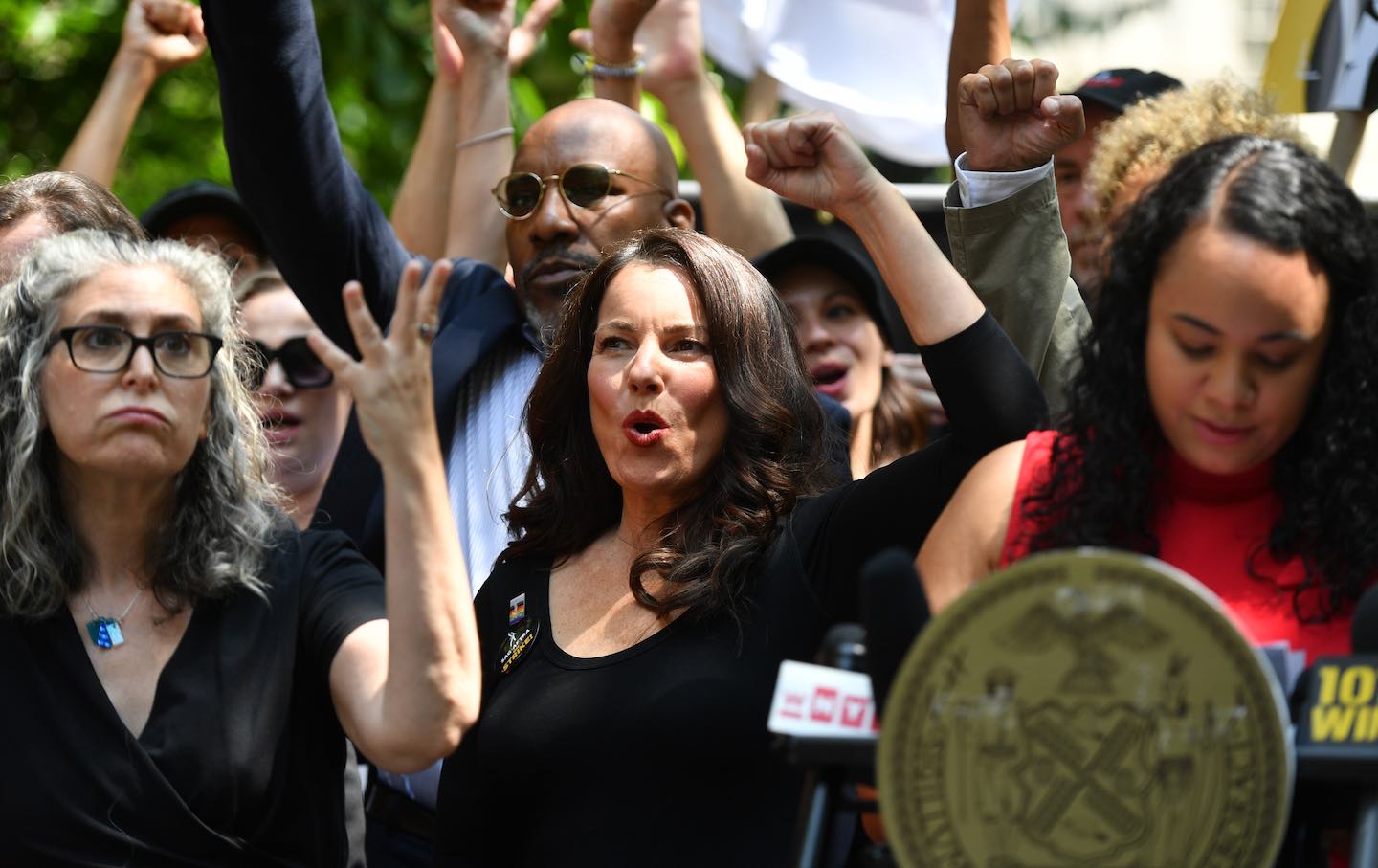
Fran Drescher, the president of SAG-AFTRA, stole the show—and Hollywood’s lunch—when she announced the largest strike by the union of entertainment and media workers since 1960. That unmistakable voice pierced through the corporate pablum with the kind of no-bullshit moral clarity we’ve come to identify with the most famous democratic socialist in America, Bernie Sanders, or the once-highest-paid woman on TV, Judge Judy. It wasn’t just the strength of her words but the Yiddish-inflected cadence that has reverberated through more than a century of the American labor movement. Jewish women are inextricable from the history of labor rights; there’s nothing “unlikely” about the fact that Drescher has taken her place in it. The only shock is how little that history is acknowledged in mainstream discourse or on the contemporary left, where supporters seem eager to identify the virtues of socialist ideas and achievements but slow to claim the role of Jews in their formation.
Take International Women’s Day (IWD). Every year on March 8 there’s a flurry of Twitter activity from accounts marked with red rose emojis correctly pointing out the socialist origins of the holiday. Although some of the historical details are murky, such as which exact strike the day commemorates, what’s crystal clear is the role that Jewish garment workers like Theresa Malkiel played in codifying it. Malkiel proposed establishing a National Women’s Day in 1909, the year of the Uprising of the 20,000, the largest strike of women garment workers ever. The 11-week strike supercharged the labor movement in the period before the Triangle Shirtwaist Factory fire, which helped revolutionize workers’ rights in America. Its organizers, ardent unionists like Clara Lemlich, Rose Schneiderman, and Pauline Newman, rallied their troops—predominantly young Jewish immigrant women and girls like themselves—in the language they knew best: Yiddish. Significant numbers of Italian women and girls joined in too, but as the historian David Von Drehle notes, having fled poverty rather than pogroms, Italian workers held out some hope of returning home—an option unavailable to their Jewish counterparts. Jewish immigration from the Pale of Settlement to the United States nearly quadrupled between 1910 and 1924 to 4 million, and the newcomers had the chutzpah to fight back against unfettered capitalism. Sick of these ungrateful, reactive racial inferiors, the American ruling class—no, it did not consider Jews white—shifted US policy to exclude them by passing the 1924 Immigration Act. In addition to completely barring most immigrants from Asia, the law restricted entry from eastern and southern Europe to 2 percent of those countries’ representation in the US as of the 1890 census—well before the mass migration of Jews to America. It was actually easier to get into the United States from Mexico than from Poland. Nevertheless, Jews continued to organize and agitate for better working conditions, and Jewish women in particular fought a decades-long battle for formal recognition within the labor movement.
And yet you’d be hard-pressed to find Jewish women celebrated in online mentions of IWD or in any of the attendant media coverage about the history of labor rights. Even a recent story in The New York Times about a memorial to the victims of the Triangle Shirtwaist fire referred only to “immigrant women,” as if the fact that most of them were Jewish were irrelevant to their circumstances.
The same is true of the media commentary on the film Oppenheimer that fails to point out that the physicist enlisted to end the war against the Nazis was the child of German Jewish immigrants. It’s not entirely surprising though, since the film itself barely scratches the surface of his Jewishness, either as a source of the discrimination he was subjected to or as a source of his motivations, let alone the fact that 90 percent of the physicists who worked on the atomic bomb were Jewish and maybe that’s kind of important to understanding their experience? But it’s truly striking to see how those who focus on representation also completely overlooked that fact, even while making arguments about other areas where the film fell short. A story that ran on NBC News’ website, for example, called attention to the erasure of the Japanese experience while itself erasing Oppenheimer’s identity. If representation matters, why doesn’t it matter for Jews?
This lack of visibility of Jews in the mainstream mirrors their hyper-visibility and vilification on the right. In some ways, it may be a kind of weird, even well-intentioned, overcorrection to it. Regardless, the effect is nullification, creating a schizoid situation in which we’re constantly fighting over the facts of our existence. And facts matter. The fact that Oppenheimer and Drescher are Jewish isn’t incidental but foundational to understanding them within the moral and historical context of their work.
Drescher invoked the connection directly in a July live-stream event with Sanders. In a comment that perhaps reveals more about her worldview than any of those viral video clips, she recounts a realization she had as she sat opposite a Jewish man at the negotiation table: “I looked at a guy who obviously was religious and took off for Shabbat and whatever, and I’m thinking maybe he’s a great family man, maybe he makes donations, maybe he supports his community. But his job is to screw me and my members, and…that’s kind of compartmentalizing. You got to be consistent in your life with how you act, how you treat other people.” What exactly is the conflict here? For Drescher, it’s that being anti-labor is fundamentally not Jewish. That’s what makes watching people sanitize Drescher’s loud and proud legacy so distressing, even when she’s being praised by a colleague: “Her speech pattern, her tone, her unfiltered zest—when she spoke, the entire room shook. They were not ready for that strong, female, powerful, East Coast sound.”
Bubbela, they don’t talk like that in Connecticut. It’s called a working-class New York Jewish accent.
Become a Sustaining Donor This September
Between the reemergence of right-wing red-baiting and Donald Trump’s use of the chilling National Security Presidential Memorandum–7 to criminalize left political organizing, we’re seeing McCarthyism reborn before our eyes.
This assault on democracy cannot be ignored or wished away. Resisting it requires bravery in the face of threats and repression, a steadfast commitment to the truth, and the unwavering belief that we can—and will—overcome this darkness.
We must have an independent media that sets the record straight, unearths corruption and abuses of power, and advances a politics of justice and dignity for all if we’re to win this fight.
That’s why I’m writing to you today. This September, The Nation needs to add 100 monthly donors to sustain our progressive journalism. Your contribution makes the next investigative report, the next truth-speaking column, and the next pathbreaking essay all possible.
I hope you’ll support our work with a recurring donation today. If you donate $10 or more a month, we’ll send you a brand new “Hands Off the Free Press!” sticker to recognise your commitment to our cause. Please, donate today.
Onward,
Katrina vanden Heuvel
Editor and Publisher, The Nation