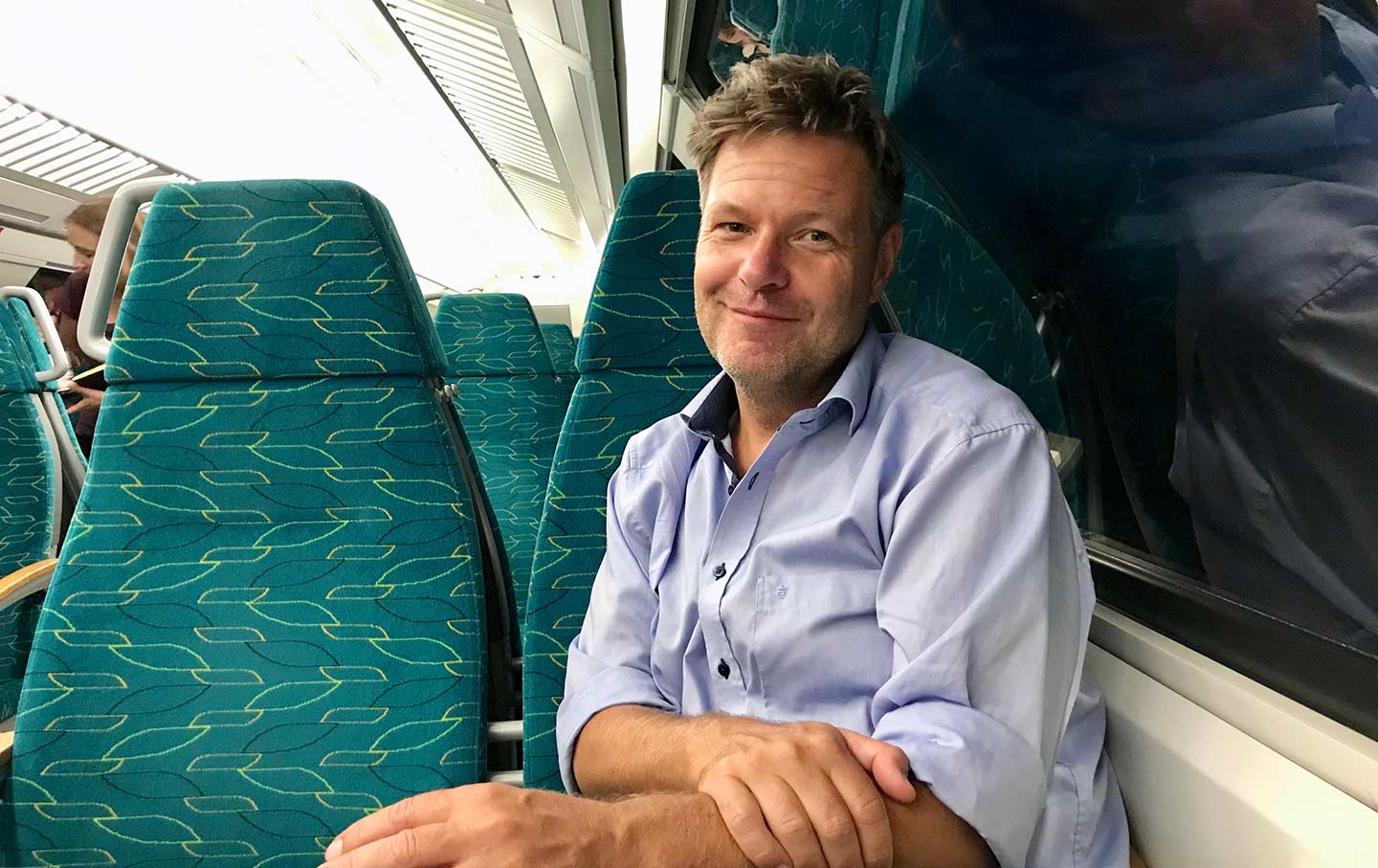
On a Monday night in August, Robert Habeck sat on a train to Berlin from the eastern German city of Cottbus, attempting to eat a falafel sandwich. The yellow sauce was dripping, first on the floor, then on his gray trousers. The pita bread was falling apart, bits of red cabbage were sticking to his nose. A handful of journalists were watching this mess closely, but Habeck—blue shirt, rolled-up sleeves, healthy tan—didn’t seem to care.
Habeck, who has been coleading the German Green Party with Annalena Baerbock for almost two years now, certainly doesn’t want to be a normal politician. He presents himself as something different: a normal person. When he gets a fact wrong in an interview, he apologizes publicly the next day. He takes off his shoes during train rides, exposing holes in his socks, to the delight of detail-seeking reporters. And sometimes, he devours a falafel sandwich in front of an audience. Messily, yes—but with confidence.
Before Habeck, 50, became a professional politician, he was a novelist and playwright. He wants to change the atmosphere around politics first, in order to change politics itself. This strategy—approachability, diplomacy, friendliness—is not only crucial to his personal success; Habeck is, according to surveys, one of the most popular politicians in Germany and many people believe he could become the next chancellor. It’s also key to understanding the astonishing recent rise of his party.
The Greens, who started as an anti-party party in the 1980s, have become what the Social Democrats used to be: a Volkspartei, or mass party. More and more Germans trust them, and only them, to tackle the climate challenges in a severe—and yet moderate—way. The party promises green technologies, green culture, green growth. In short, the right dose of change, which millions can agree on.
While the party won only 8.9 percent of the vote in the last election in 2017, recent polls have given them between 22 and 27 percent—right behind or on par with Angela Merkel’s Christian Democrats. The next general election in 2021 could bring about what many progressives have desired for a long time: a coalition of Greens, Social Democrats, and the Left Party. In such a scenario, Germany could become the first-ever major Western country with a green leader.
Twenty nineteen has been the year of the Greens. In several other European countries such as Norway, Austria, Finland or Portugal, ecologist parties got record votes. In the European Elections in May, the Greens–European Free Alliance increased its number of seats in the EU Parliament by nearly 50 percent. For the first time in years, it felt like there might be some some kind of European counterforce to the right-wing nationalist wave embodied by authoritarians like Viktor Orbán, Marine Le Pen, and Nigel Farage.
Popular
"swipe left below to view more authors"Swipe →
It’s a fitting time for this political shift: The earth is—undeniably—burning, melting, and dying, and unlike centrists, environment-focused parties seem invested in doing something beyond repeating empty, green-seeming phrases. At the UN Climate Action Summit in September, Angela Merkel announced that her country wants to become “climate-neutral” by 2050.
“We all have only one Earth,“ the chancellor said. Her policies, however, could make you think that there are some Earths yet to spare. Year after year, Germany has missed its self-set climate targets. The “climate package” that Merkel’s government passed in September was called “catastrophic,” “a bad joke,” and “disastrous” by German scientists and environmental organizations. Even the German Economic Institute criticized it as insufficient. When it comes to climate politics, Merkel is little more than a politer and quieter version of Trump.
The backlash to ineffectual climate politicking, has, at least, grown stronger. In response to their failing governments, climate movements, such as Extinction Rebellion and the Sunrise Movement, are calling for radical measures. At the end of September, millions of mainly young people, inspired in part by 16-year-old Swedish student Greta Thunberg, took to the streets in more than 150 countries for the largest climate strike in history. It’s thanks to activists like Thunberg, persistent scientists, a number of intellectuals, and green political parties that global warming has entered mainstream debates—40 years late.
No other country has seen such a large-scale green uprising as Germany’s, though. Since last December, thousands of students have gone on strike across the country every single week, making Fridays for Future (FFF) the biggest German protest movement since the “peaceful revolution” of 1989. The Green Party has gained 15,000 new members this year, bringing its membership up to more than 90,000 in total. New words have even entered the German discourse; Flugscham, for example: flight shame.
Climate movements have been growing across the world. But why are the Greens so unprecedentedly strong in Germany, both on the streets and in the parliaments?
If you ask party members and voters, you hear three main things: First, climate change is more noticeable, even in Germany, where farmers suffer from droughts, insect populations die, and meteorologists warn of record floods. “Many people who live in rural areas or smaller cities have told me that they can feel the global heating directly,” Sven Giegold, Green member of the European Parliament, told me on the phone. While climate awareness has grown, Giegold explained, the government’s apathy has become more striking. The Green’s persistence on environmental issues over the last 40 years gives them crediibility.
“It’s not a hipster thing. It’s for normal people,” Giegold said.
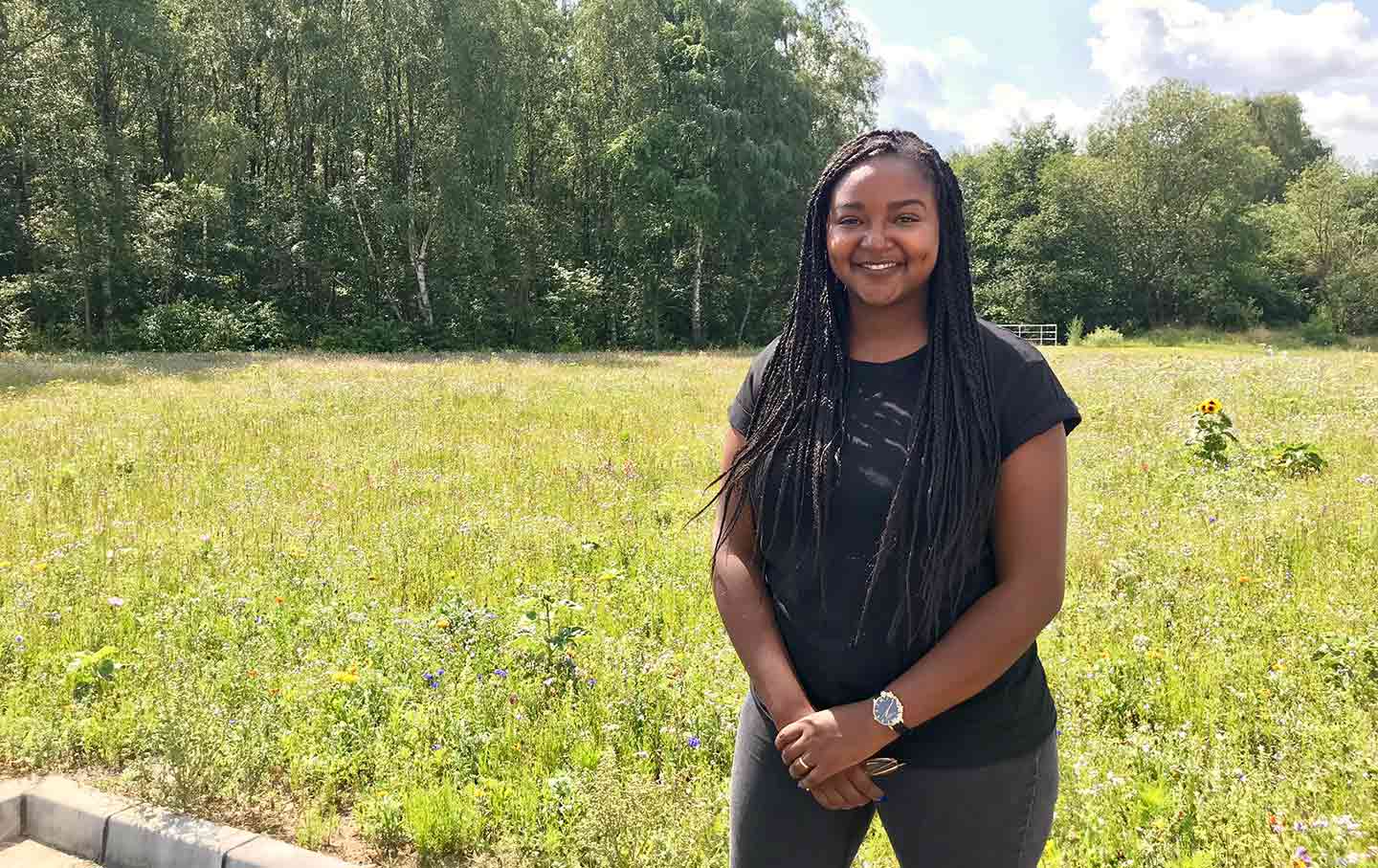
Second, the party has expanded its electorate. In the EU election, the Greens won hundreds of thousands of votes from every other party across the political spectrum. Leftists have criticized the party’s increasing centrism. But as long as the party is successful, nobody within it will dare to rebel. “The Greens are, in contrast to other parties, open enough that I can tell them that they are still too white,” said Aminata Touré, one of the very few Afro-German politicians in the country, and, according to party leader Habeck, “one of the greatest talents.” The 26-year-old, who recently was elected as the vice president of the state parliament in Schleswig-Holstein, stands for a new generation of Green politicians. “If you are part of the government,” Touré said, “you have to make compromises. That’s how politics work.”
And third, every person I talked to for this piece praised the new leadership for their ability to unite the party. The Greens, for a long time divided into a radical wing (the “Fundis”) and a more pragmatic wing (the “Realos”), seem to have reached a consensus: They want to come into power.
It is this very tactic though—trying to please (almost) everybody in order to govern—that is also the party’s greatest risk.
Prior to his falafel-filled train ride to Berlin that August evening, Robert Habeck had attended a town hall meeting hosted by his party in the city of Cottbus. Cottbus, 65 miles southeast of Berlin and not far from the Polish border, is also at the center of one of the biggest brown-coal mining areas in the country. It has lost a quarter of its population since the wall came down 30 years ago. Numerous extreme-right organizations, such as Zukunft Heimat, Identitäre Bewegung, or the hooligan group Inferno, are based in or near Cottbus. In the last major regional elections, the far-right party Alternative for Germany (AfD) won the majority of votes.
Attacks against refugees and people of color have increased in Cottbus over the years. Many residents, however, see the Green Party—with its EU- and refugee-friendly policies, its calls for renewable energies and organic food production—as a threat. In the days before Habeck arrived in Cottbus, political opponents hung up posters with his face and the message “Hostile intentions.” Habeck, as he later admitted, was anxious ahead of the event.
Around 300 people, many of them over 60, sat in a half circle in the old Town Hall, as the Green leader entered the stage.
“I can feel the tensions,” Habeck said. “Our stance against brown coal is met with resistance.” Even before anyone in the audience could say a single word, Habeck pleaded guilty. For far too long, he said, western German Greens like him had ignored their eastern counterpart, Alliance 90 (which fused with the Greens in 1993). For far too long, he continued, his party had ignored the specific problems in the east. “How could we be so blind?” Habeck asked.
For two intense hours, Habeck took on questions relating to these very problems: the postindustrial unemployment rate, the downsizing of public transport, the lack of hospitals; things that helped the far right to rise. Habeck promised a redistribution of money from wealthier to poorer households, but it seemed more important that he listened intently to every single question from the audience, even those that received boos from the crowd.
An engineer from Jänschwalde, a small village near Cottbus, where hundreds of people lost their jobs after a large section of a big brown-coal power plant shut down, attacked Habeck for prioritizing the environment over the economy.
“That’s socialism!,” the man said. The audience mumbled; Habeck stood still. His party, he explained, gives incentives to private companies that invest in solar energy. “That’s the opposite of socialism,” he said calmly. At the meeting’s end, the audience applauded enthusiastically. People asked the father of four sons for selfies. Even in Cottbus, hostile territory, the Green base is growing.
In the past, the Greens were known to be successful in certain areas and milieus—and nearly invisible in others. Kreuzberg for example, a heavily gentrified district in Berlin, has been a Green stronghold for decades. Voting Green there became part of an identity, aligned with a lifestyle that includes recycling, riding a bike, and buying expensive organic food. Or, as some leftists call it: “Green class chauvinism.”
The typical Green voter has been a young, well-educated and higher-earning person, living in an urban area. That is still the case. In the EU elections, however, the Greens not only won nine of the 10 biggest German cities; they also became the strongest force in rural regions such as the Wendland, in smaller East German cities such as Jena, and in blue-collar-towns such as Dortmund.
Even traditionally conservative regions of Germany have been conquered by the Greens. In the election in Bavaria in October 2018, they became number two and won the capital, Munich. Baden-Wuerttemberg, the wealthy home state of Daimler and Porsche, is lead by a Green premier already since 2011.
The Greens, not only in Germany, benefit from the ongoing erosion of the traditional centrist parties—especially the Social Democrats, who have lost millions over millions of voters across Europe in the last two decades. This process—some call it Pasokification, named after the fall of the Greek social democratic party Pasok from a comfortable majority of 44 percent in 2009 to less than 5 percent in 2015—has dramatically altered the political scene in countries like Italy and France. But not only social democracy has been in decline. In the United Kingdom, for example, the governing Conservatives recorded their worst result ever in the European election. The UK Green party, by contrast, secured its best results in 30 years.
“The next legislative period is going to be fun,” Green EU MP Giegold said. “The other parties will need us.”
There was a time when the Greens were the party of anger. They protested and opposed the establishment; some of them even longed for the revolution.
Now, “the AfD is the party that attacks the establishment,” Habeck told me after the Cottbus town hall. “The difference, however, is that the Greens always wanted to democratize society, while the far right wants to attack democracy itself,” Habeck continued. “Today, our party is rooted in the center of society. Our role is it to defend the values of the republic: the constitution, freedom of the press, cultural freedom.”
In 2010, he published a book with the title Patriotismus: Ein linkes Plädoyer, “Patriotism—A Left-Wing Appeal.”
Habeck’s political opponents love to hate on him and his Greens. Far too soft, many leftists moan. Far too radical, many conservatives and liberals rant. Besides,: what will become of Germany, the car-and-sausage nation and export world champion if it is led by a Green? Jörg Meuthen, leader of the AfD, even threatened to leave the country in the event of Habeck’s becoming chancellor.
The story of the Greens began in the ’70s, when environmentalists, anti-war activists, feminists, and other leftists began intense organizing in action groups and grassroots initiatives across the country. German students had been protesting against capitalism, ecological destruction, authoritarianism, patriarchy, and their very own Nazi parents already since the ’60s. One outgrowth of these movements was the far-left militant Red Army Faction, a network responsible for the murders of politicians, industry executives, police officers, and soldiers who, in their eyes, personified the Schweinesystem, the “pig system.” It was an especially tense time in Berlin, divided by a wall, at the hot center of the Cold War. As now, some Germans were wondering if it’s even ethical to bring a child into this world.
In January 1980, the various groups and local parties officially joined forces. The first Green parliamentarians stood out with both their focus on environmental issues and their appearance. Some nursed their babies, others knitted during debates. Joschka Fischer, who later became Germany’s foreign minister, wore sneakers when he was sworn in and caused trouble when he called the parliamentary president an “asshole.”
The mere fact of a high share of women—thanks to intraparty gender parity rules—was a provocation for many members of the Bundestag. When Green lawmaker Waltraud Schoppe spoke about “everyday sexism” and “marital rape” in her very first and now-legendary parliamentary speech in 1983, the male-dominated ranks of the traditional parties were in an uproar (“Witch! Witch!”).
The first Green Party program from 1980 reads, unlike the current party platform, almost like a socialist manifesto. And it serves as a reminder that the Green rise of 2019 can’t be understood without recognizing the decades-long history of Green organizing and politics in Germany.
“The ecological global crisis is intensifying day by day,” the first party program asserted. “Commodities are becoming scarcer, one poisoning scandal after the other, animal species are being exterminated, plant species are ceasing, rivers and oceans are turning into cesspools, humankind is about to become mentally and emotionally stunned in the midst of a late industrial and consumer society, we are burdening the following generations with a sinister legacy.”
There are only a few people from the early days who are still involved in politics. Hans-Christian Ströbele is one of them. The renowned lawyer helped found the party and remained one of its most successful, radical, and party-critical representatives for almost 40 years. Ströbele left the German parliament in 2017, but still writes articles, tweets, and occasionally accepts visits from journalists.
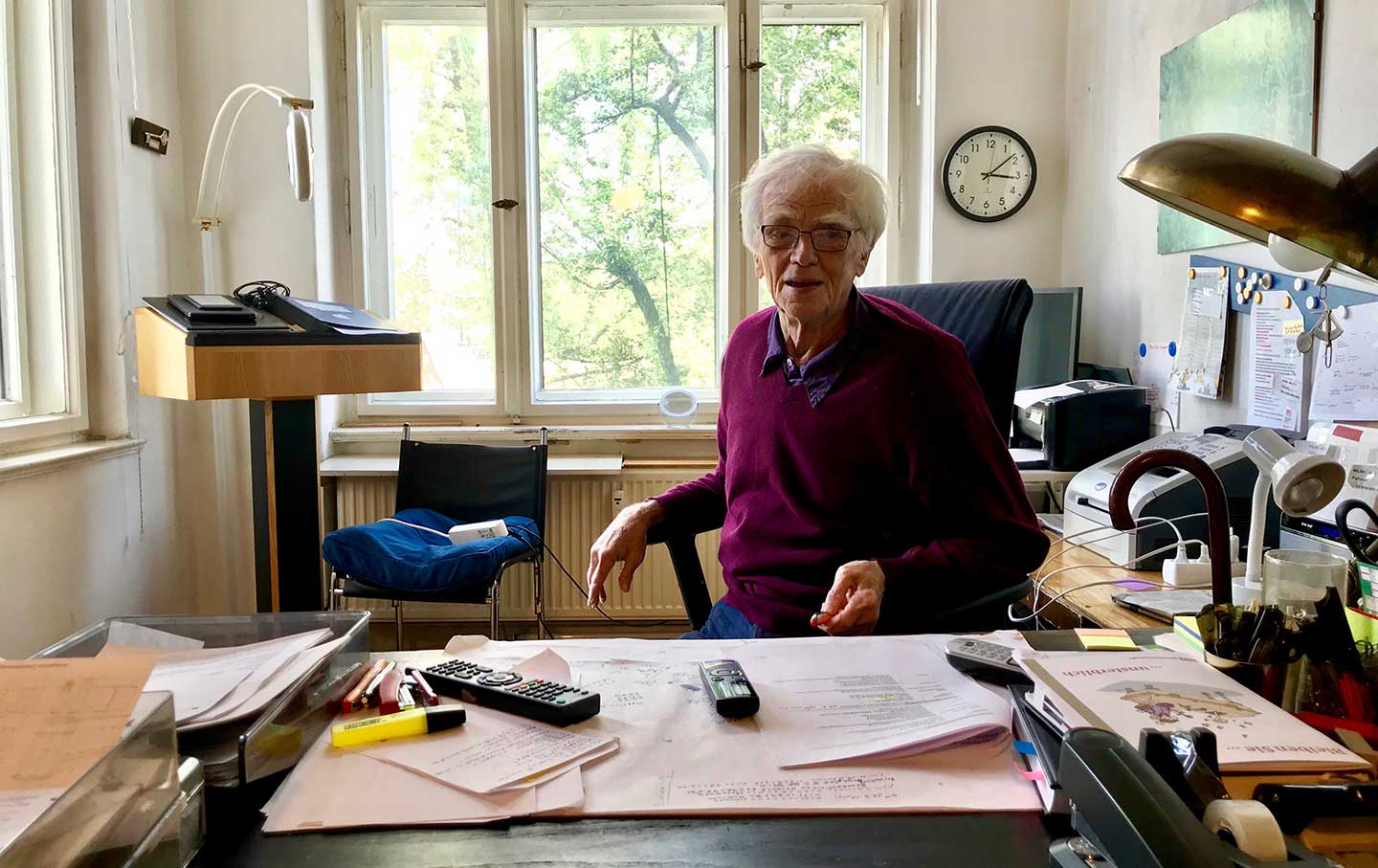
On a sunny afternoon in July, Ströbele’s wife, Juliana, opened the door to their apartment in an elegant, white Gründerzeit building by the Spree river in Berlin-Mitte. “Christian,” she said, “sits in the office.”
Ströbele, who celebrated his 80th anniversary some weeks prior, slowly pulled himself up from his chair. Afflicted with a nerve disease, he looked thin. The black bike Ströbele was known to ride through Berlin until a few years ago still stood in the house’s entrance, gathering dust. His other trademark, wild, bushy, white eyebrows, remained in peak shape.
In the early ’70s, Ströbele took up the cases of the RAF founders Ulrike Meinhof and Andreas Baader—until the moment he was accused of being part of the group’s terror infrastructure himself. A court sentenced him to 10 months on probation. Ströbele still denies the accusations, but “wouldn’t do anything differently today.”
A few years after his work for the RAF ended, the Green project started.
“We entered the parliament with the goal not to become like the other parties and career politicians. It was us against the world!” Ströbele recalled. “But this stance has been lost for a long time.” It was a gradual process: Several founding members, such as the “radical ecologist” Jutta Ditfurth, left the party in the early ’90s. The moderate wing, which coalesced around Fischer, gained more influence. The “long march through the institutions” was finalized when the party became a junior partner in a coalition with the Social Democrats in 1998. For the first time ever, the Greens were part of the federal government.
It was a red-green coalition in name only, with decidedly neoliberal politics that included less taxes for rich people and a welfare reform (Hartz IV) with significant cuts to unemployment benefits and increased pressure on the jobless to find work. Foreign Minister Fischer’s decision to send German troops first to Yugoslavia and some years later to Afghanistan was heavily criticized. Ströbele became the in-house opposition, as former Green comrades turned into political opponents. “I’ve seen people changing through power,“ Ströbele says.
Ströbele’s politics, meanwhile, have not wavered. In the last decades he has supported guerilla fighters in El Salvador, he visited Edward Snowden in Moscow, and just last month he took to Twitter to defend a politician from Left party who cause controversy for wearing an “Antifa” pin in the German parliament. “They [Antifa] know much more about the machinations of the Far-Right and FASCISTS than the intelligent service,“ Ströbele tweeted.
Asked about the current green movement, the Green founder gave an ambivalent answer. “Our issues have reached the majority of the population, which is great,” he said.
“But if you look at the Fridays for Future protesters, for example, who I obviously support, it’s dangerous how much they are accepted while having very little impact on the policies.”
The discrepancy between the felt power of the green movement and its effect so far on actual politics in Germany is indeed striking. Germany has been governed by Angela Merkel for 14 very long years, and neither her Christian Democrat party, nor her coalition partner, the Social Democrats, seem to have understood what structural changes it would take to tackle this global crisis.
Yet many people in the German political and media sphere pretend that the country is already far too green-minded. Michael Theurer, for example, the parliamentary group leader of the liberal party FDP, recently blustered that Germany was becoming an “eco-dictatorship” on account of the Greens’ attempts to curb the number of domestic flights and reduce the consumption of meat. AfD leader Alexander Gauland named the Greens its main rival after the EU election in May. “They are going to destroy Germany,” he said.
While it’s true that the Greens’ success has pushed the government toward certain enrivonmental policies, their political opponents’ warnings about a “Green hegemony” and a “radicalized” Green party are based more in desperation than reality.
The Greens’ program is, in fact, rather moderate. While the German Environment Agency, for example, proposes a carbon price of €180 ($197) per ton, the Greens are asking for only €40 ($43). Some of the party’s policies might have sounded progressive some years ago—its call for decreasing the value-added tax on train tickets from 18 to 7 percent, to name one. In 2019 though, even Transportation Minister Andreas Scheuer, a conservative from Bavaria, has proposed the exact same number. When it comes to anti-capitalist measures such as the nationalization of energy companies, the Left Party is far ahead of the Greens.
At the last party convention in March, Fridays for Future activist Luisa Neubauer gave a speech in which she criticized the Greens for their lack of concrete policies and a clear vision. “We won’t grow out of this crisis,” the 23-year-old student said in front of hundreds of party members in Berlin. “If even the Greens can’t manage to find clarity about it,” she continued, “then I’m not sure why we’re marching on the streets.”
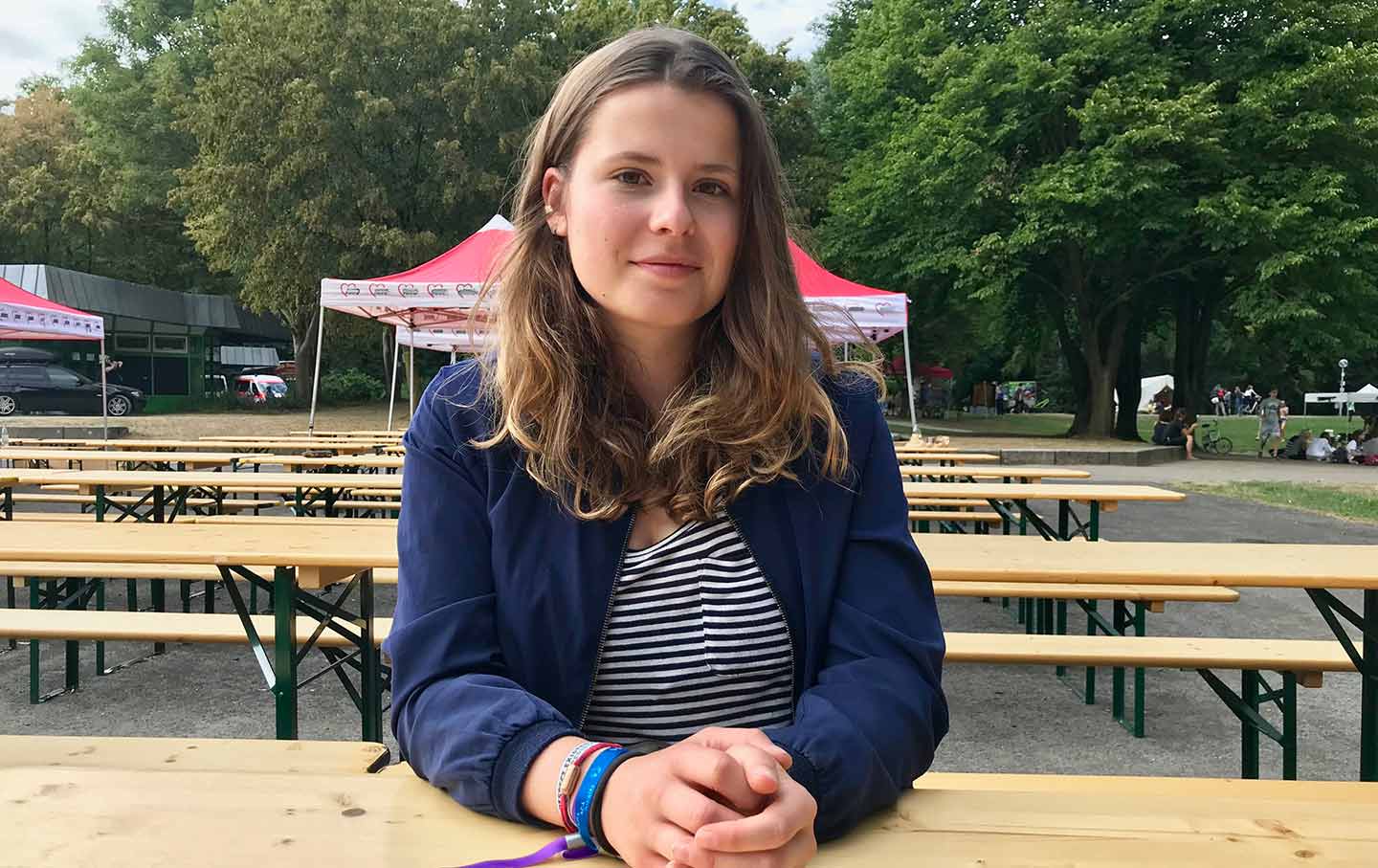
Neubauer’s words were received with massive applause. Party leader Habeck thanked her, “for kicking our ass.” Once again, the Green leadership’s strategy was obvious: synthesizing the different factions into one friendly force.
I met Neubauer, who has become Germany’s most famous climate activist, last July in the western German city of Dortmund, where Fridays for Futures held its first summer congress. For five days, more than 1,400 teenagers and children (some came with their families) were discussing politics, cooking vegan fare, partying and sleeping in tents. Neubauer—long, brown hair, blue jacket, colored wristbands—looks, even by her own admission, younger than her age. In her speeches and interviews, however, she sounds so clear and balanced that it’s hard to believe that she only recently finished college.
Neubauer became friends with Greta Thunberg at the climate summit in Katowice, Poland, last December, and soon after organized the first school strikes in Germany. Since then, she has been invited by CEOs, government officials, TED Conferences, virtually every German prime-time talk show, and even French President Emmanuel Macron to talk about the protest movement’s demands.
One-and-four-tenths-million Germans joined the climate strikes in September, more than in any other country. Neubauer rejects the notion that this enthusiasm will be a passing fad.
“The advantage of this movement,” she said, “is that we’re backed by the sciences.” As the young activist sees it, the years after the 2016 Paris Agreement were crucial for movement building. More people started realizing how dramatic the situation is and how little the German government is willing to change. “Angela Merkel failed us,” Neubauer said. “I mean, this woman is a physicist. If she doesn’t understand what’s happening to our planet, who does?”
On their website, Fridays for Future lists its demands, addressed to the German government: a coal phase-out by 2030, 100 percent renewable energies and net carbon neutrality by 2035. “Our only demand is basically that Germany keeps up with its own targets,” Neubauer said.
Her statement encapsulates the current state of the broader green movement: They politely ask the established parties to please stop killing the earth.
Even Extinction Rebellion, a protest movement many have deemed as “too radical,” tries to avoid proper confrontation in Germany. When activists blocked several traffic hubs in Berlin in October, most of them teamed up with the police to clear the streets peacefully. A few days later, XR activists visited the Green Party headquarters, urging the party to tell the “truth about the ecological catastrophe.” Habeck himself let the protesters inside the building. The party boss was smiling, the activists were singing. Everybody seemed pleased that nobody was made actually uncomfortable.
On our train ride from Cottbus to Berlin, Habeck told me that he and his coleader Annalena Baerbok “try not to speak of ‘we, the Green Party,’ but rather just ‘we,’ to address everyone within society.”
“Language does not represent something that would exist without it, but actively produces reality,” Habeck wrote in his 2018 book Wer wir sein könnten, “Who we could be.”
So far, Habeck’s plan to open his party to a broader votership through reconciliatory language and a green capitalist platform works. The matured Greens have never been stronger in their results and more optimistic in their appearance. They are, as Habeck said in a radio interview in August, “a quasi–ruling party in waiting.”
Was Habeck’s statement, two years before the next election, an accidental moment of arrogance, or was it simply a dry description of the Greens’ growing power? At the very least, it was a window into the party’s new mindset. The fact is that the Greens don’t act like the opposition party anymore. They want to be a party for everybody: leftists as well as conservatives, Friday for Future activists and CEOs, patriots and tech-liberals.
“Radical realism” has become a Green catchphrase—but this moderate approach seems less and less likely to save the environment the party holds so dear.

