
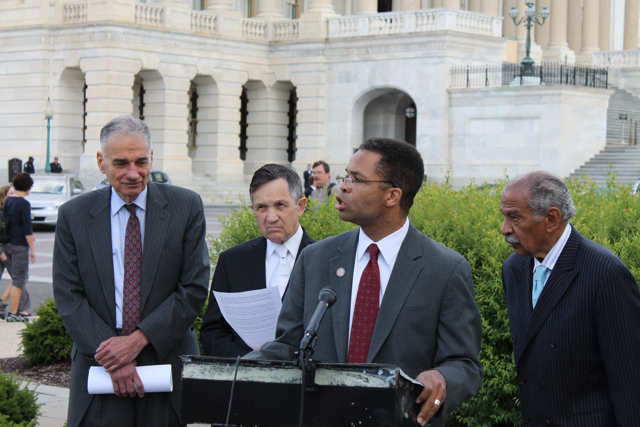
Representative Jesse Jackson Jr. (D-IL) is joined by, left to right, Ralph Nader, Representative Dennis Kucinich (D-OH) and Representative John Conyers (D-MI) at a press conference outside the US Capitol on June 6, 2012, to call for an increase in the minimum wage. Photo by George Zornick.
If today’s minimum wage workers earned the same as their counterparts in 1968, they would receive $10.58 per hour. That, unfortunately, is $3.33 more than the current federal minimum wage.
This would be a serious problem at any time, but it’s particularly relevant now, as the awful economy has forced millions of workers into minimum-wage jobs. (And they’re the lucky ones).
To that end, Representative Jesse Jackson Jr. has introduced the “Catching Up To 1968 Act of 2012.” Within sixty days of being enacted, it would raise the federal minimum wage to $10 per hour, and beginning one year after that, would index it to the Consumer Price Index. For workers that rely on tips, the bill would mandate the cash wage to be 70 percent of the minimum wage and never less than $5.50 per hour.
“We’ve bailed out banks, we’ve bailed out corporations, we’ve bailed out Wall Street, we’ve tried to create sound fundamentals in the economy—now it’s time to bail out working people who work hard every day and they still only make $7.25,” Jackson said this morning at a news conference outside the US Capitol. “The only way to do that is to raise the minimum wage.”
Ralph Nader and Representatives Dennis Kucinich and John Conyers also attended the news conference—a roster of liberal stars if there ever was one. But it’s important to note that raising the minimum wage has often found bipartisan support. Rick Santorum, for example, wrote legislation to increase it, and until recently even Mitt Romney supported tying it to the CPI.
And with 30 million workers receiving minimum wage, it should certainly be a viable political issue. “These are not just liberal workers or progressive workers or conservative workers or libertarian workers,” said Nader. “This is a unifying issue in our country at a time when there are few declared unifying political issues.
Popular
"swipe left below to view more authors"Swipe →
“What is missing is a unified drive by elected members of Congress to provide the requisite courage to challenge the merciless oligarchy, which includes the big-box stores like Walmart and McDonalds, and compel them to adjust their pay.”
Kucinich added that it was a tough sell inside the Beltway, but an easy sell outside of it. “We live in a bubble here in Washington, DC. This place is dripping with wealth. Wealth is just cascading into the capital to buy elections,” he said. “But when you get outside Washington, DC, and you get to the cities and the townships and the villages of America, there are people struggling to survive. There are people who can’t make it on $7.25 an hour if they even have a job.”
The federal minimum wage increased in 2007, from $5.15 an hour. There hasn’t been any evidence that it caused businesses to hire less workers, and in fact research has shown that an increase in the minimum wage doesn’t create an increase in unemployment.
The seminal academic work on that topic was done by Alan Krueger, who is now chairman of the White House Council of Economic Advisers. But alas, despite a campaign pledge to raise the minimum wage to $9.50 by the end of 2011, President Obama has been silent and inactive on the issue.
But it’s a great way for the administration to essentially issue a stimulus package without calling it that. People earning $7.25 per hour—that is, $15,080 per year—are already living on the brink of poverty and are extremely unlikely to save the extra $2.75 per hour, but will instead spend it. Raising the minimum wage will pump badly needed spending power into a struggling economy, which would more than offset any corresponding decline in hiring.
Economist Dean Baker recently told the Huffington Post that it was a no-brainer, politically and economically. “I’m hard-pressed to see why we shouldn’t have the same [minimum] wage we did in the late ‘60s” when adjusted for inflation, he said. “This isn’t welfare. By definition, we’re talking about people who are working. It gets a lot of sympathy from the public, and guess what? It’s good for the economy right now.”

