Pope Leo Is Speaking Truth to Donald Trump’s Power
The pontiff’s Easter address, like so many of his recent statements, countered Trump’s Iran bombast with a cry for peace—and sanity.
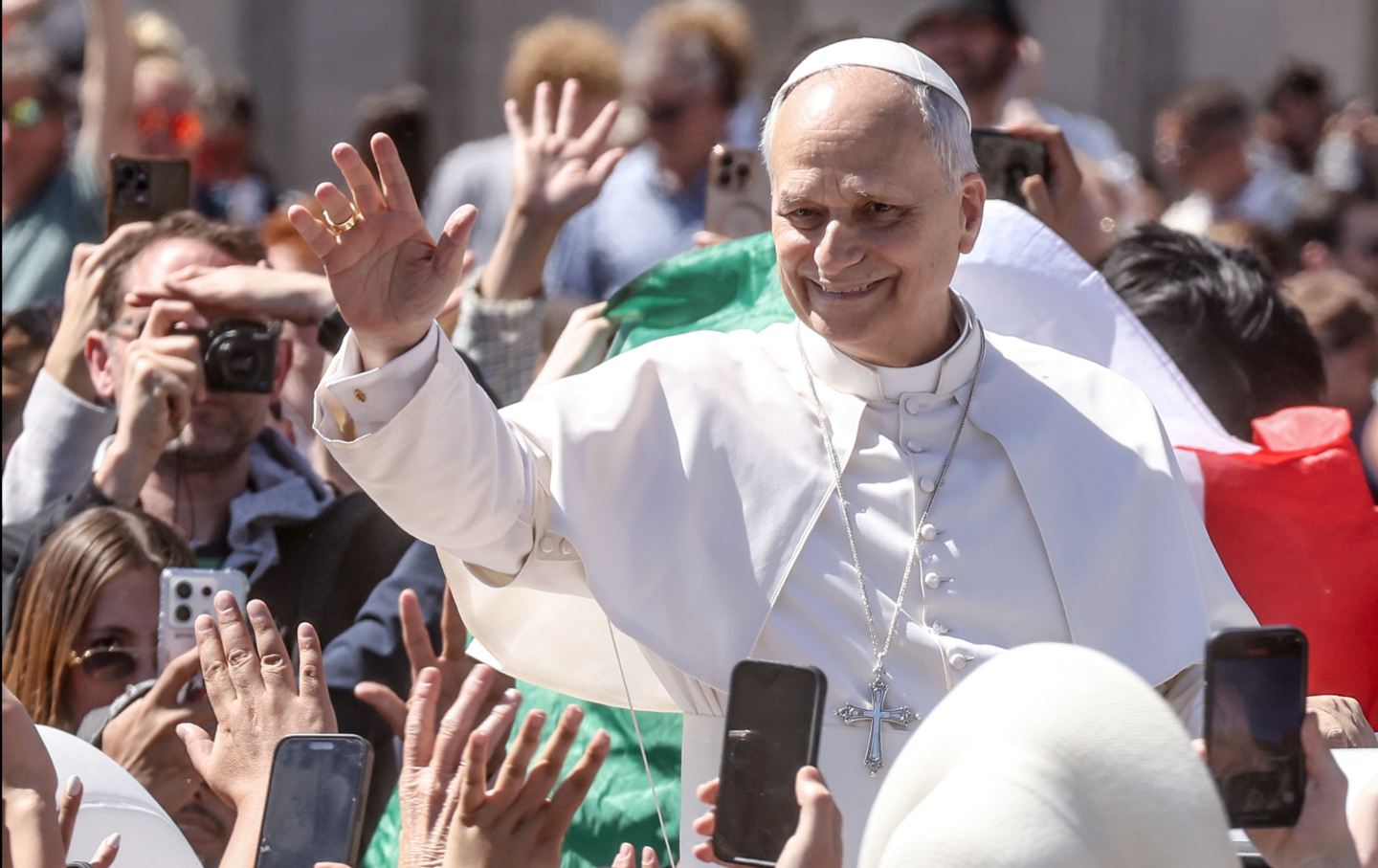
Pope Leo XIV greets the faithful at the end of the Easter mass, on April 5, 2026, in Vatican City.
(Alessandra Benedetti / Corbis via Getty Images)With the war in Iran growing ever more chaotic, and with violence spreading throughout the Middle East, there was no mistaking the urgency of the message that Pope Leo XIV delivered to the world’s Catholics on Easter Sunday.
“Let those who have weapons lay them down! Let those who have the power to unleash wars choose peace!” announced the pontiff, who has emerged as the world’s most prominent advocate for an end to the crisis that Donald Trump sparked with his late February decision to attack Iran. “Not a peace imposed by force, but through dialogue! Not with the desire to dominate others, but to encounter them!”
The pope’s Easter statement, coming in a time of mounting global uncertainty and trepidation, was an appeal to reason in the face of military madness. “From without, death is always lurking,” he warned. “We see it present in injustices, in partisan selfishness, in the oppression of the poor, in the lack of attention given to the most vulnerable. We see it in violence, in the wounds of the world, in the cry of pain that rises from every corner because of the abuses that crush the weakest among us, because of the idolatry of profit that plunders the earth’s resources, because of the violence of war that kills and destroys.”
This was the latest in a series of powerful statements from the American-born pope, who in recent months has provided the steadiest counterpoint to Trump’s ranting and raving. For his part, the president chose to mark Easter by profanely threatening the Iranian people with oblivion. “Tuesday will be Power Plant Day, and Bridge Day, all wrapped up in one, in Iran,” he wrote. There will be nothing like it!!! Open the F*ckin’ Strait, you crazy bastards, or you’ll be living in Hell – JUST WATCH! Praise be to Allah. President DONALD J. TRUMP.”
The pope and the president—arguably the most high-profile Americans on the global stage at this critical juncture in the debate over war and peace—stand on opposite sides of a disputation that has rapidly intensified since the beginning of Trump’s war with Iran. Their differences are now so out in the open that Vermont Senator Bernie Sanders found himself discussing each man’s statements regarding the Iran war. Of the president’s wild-eyed Easter statement, the senator said, “These are the ravings of a dangerous and mentally unbalanced individual.” Of the papal homily, Sanders said, “I agree with what Pope Leo XIV stated [Sunday] in his first Easter speech.”
There is much to agree with in the pope’s increasingly blunt pronouncements about the Trump administration’s illegal and unconstitutional war. When crowds gathered at the Vatican in mid-March, Leo observed, “For two weeks, the peoples of the Middle East have been suffering the atrocious violence of war,” and appealed to all sides, “Cease fire so that avenues for dialogue may be reopened.” He has expressed frustration with US and Israeli bombing raids that “have hit schools, hospitals, and residential centers”—killing thousands of Iranians in a conflict that has also claimed more than a dozen US lives—and argued, “Violence can never lead to the justice, the stability, and the peace that people are awaiting.”
The pope is right about the desire for peace. Trump’s war of whim with Iran has never been popular with the American people, and a new IPSOS poll finds that 66 percent of them want the conflict to end quickly—even if Trump’s ill-defined and frequently incoherent goals are not achieved. “Two in three Americans want the war in Iran to end. We are tired of our tax dollars being wasted on an unnecessary war and ready for change!” says US Representative Mark Pocan, the Wisconsin Democrat who co-chairs the Defense Spending Reduction Caucus. “Trump’s war in Iran costs American taxpayers billions of dollars every day. Instead of pouring money into an illegal and unnecessary war, those resources could be used to actually help Americans at home, like lowering healthcare costs, building affordable housing, or making everyday goods more affordable.”
Faced with widespread opposition, Trump’s administration has tried to present the war as a moral and religious crusade. In a March 26 prayer session at the Pentagon, self-described “secretary of war” Pete Hegseth read a prayer that spoke of directing “overwhelming violence of action against those who deserve no mercy” and said, “Let every round find its mark against the enemies of righteousness and our great nation.”
In what was widely heard as a rebuke of Hegseth and others who pray for divine intervention on behalf of their war making, Pope Leo greeted crowds gathered at the St. Peter’s Square in the Vatican on Palm Sunday with a stark rejection of those who mix faith and militarism: “We turn our gaze to Jesus, who reveals himself as King of Peace, even as war looms abounds him.”“Brothers and sisters, this is our God: Jesus, King of Peace, who rejects war, whom no one can use to justify war,” declared the pope. “He does not listen to the prayers of those who wage war, but rejects them, saying: ‘Even though you make many prayers, I will not listen: your hands are full of blood.’”