
How Students Are Pushing for Justice in US Prisons
The Remedy Project trains students to help incarcerated people file grievances, expose abuse, and, in some cases, secure release.
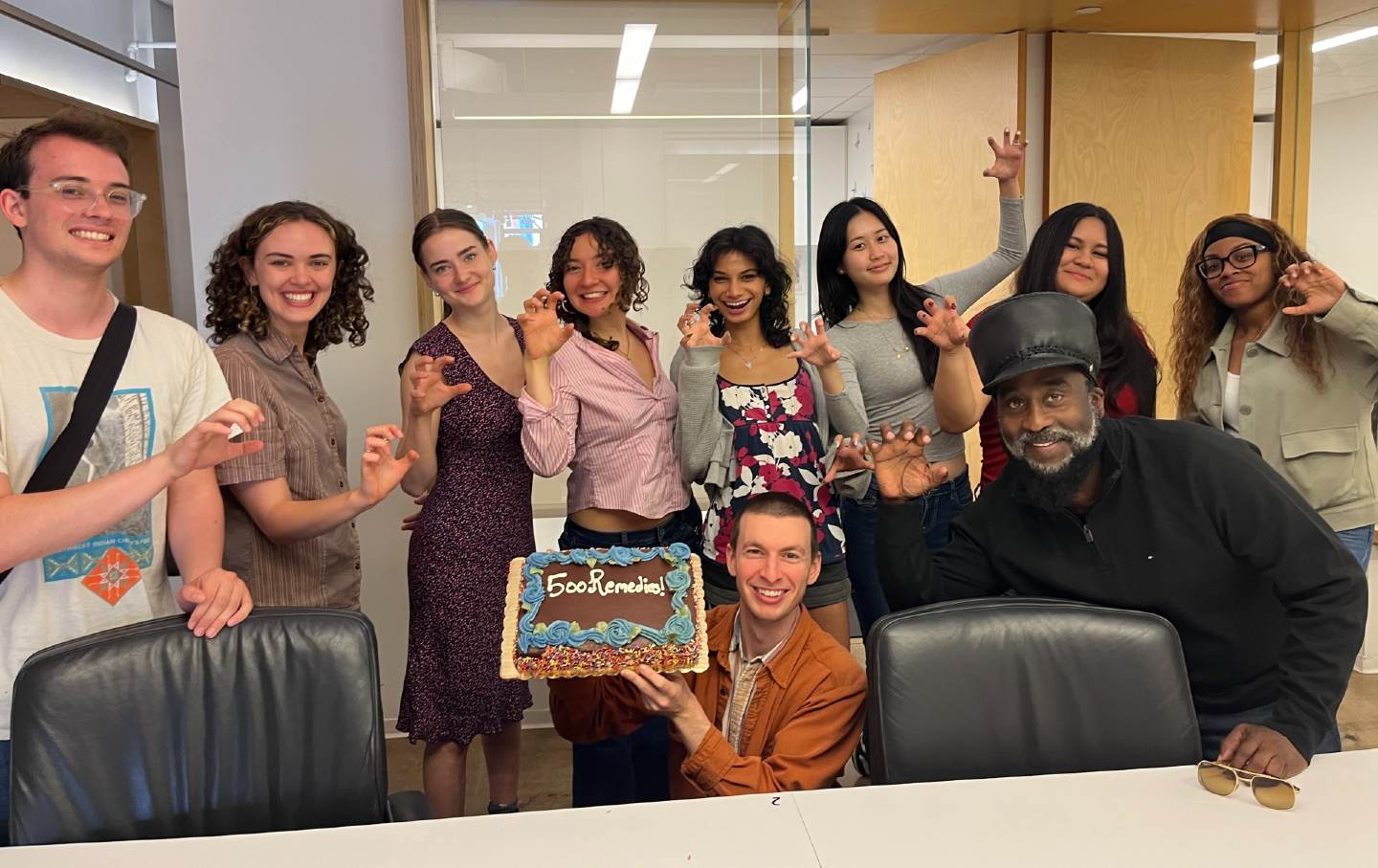
Columbia University’s Remedy Project chapter celebrates filing 500 administrative remedies.
(Anna Sugrue)In March of 2024, Christopher Trenchfield, a Jamaican national on a valid US visa, faced a violent assault from prison staff. A deputy officer at the Santa Rosa County Jail, where Trenchfield was incarcerated on domestic abuse charges, grabbed him by the neck and choked him as a group of around 15 officers physically assaulted him and forced Trenchfield to sleep on concrete outside for multiple nights.
The particular brand of brutality that Trenchfield faced is not unusual, according to The Remedy Project (TRP), a national collective led by students and system-impacted people to challenge injustice in US prisons. “I run across letters constantly from people saying, ‘I know that this prison is the worst one in the system.’” Colin Adams, the remedy advocacy director at TRP, said. “And they’re all talking about different prisons.”
Beyond the malfeasance demonstrated by his assault, evidence showed that Trenchfield was not even meant to be in prison at all: His house had been investigated without a warrant, Florida state charges were dropped against him, and private and state psychologists repudiated the idea he was mentally incompetent. The Federal Bureau of Prisons nonetheless inexplicably continued to pursue detainment.
To call attention to his unjust circumstances, Trenchfield reached out to TRP on January 27, 2025. Six weeks later, he was freed from prison. His release was facilitated by the efforts of students who spent their spring semester fighting for Trenchfield. On top of exams and essays, the students wrote letters to apply pressure to his sentencing judge, senators, and the Jamaican consulate, Anna Sugrue, cofounder of TRP, said. They also used the keystone of TRP’s work: administrative remedies.
Administrative remedies are documents that allow incarcerated people to issue formal grievances about their conditions. The complaints—which can range from a petition for adequate medical treatment to a report about guard misconduct—must be submitted as an administrative remedy for prison staff, courts, or government agencies to consider the grievance.
Aside from being the only organization that works with incarcerated people free of charge to create these submittable documents, TRP stands out for its staffers: students and those directly impacted by the prison system. Following the guiding principle “don’t preach, but do abolition,” the network mobilizes college and high school students seeking to make a direct impact.
According to Olivia Law, a volunteer and Amherst College student, TRP offered her “something very tangible to do to create change,” in a time when “everything feels like it is falling apart.”
The students are taught the remedy-writing procedure by one of the project’s founding members, self-proclaimed “remedy guru,” David Z. Simpson. Simpson learned how to navigate the byzantine administrative process during his incarceration at Federal Correction Institute Beaumont Low in Texas, where he was serving 10 years for conspiracy to import illegal substances into the US.
In Trenchfield’s case, TRP submitted a BP-9 request for administrative remedy. The 20 page document detailed alleged violations of the Fifth, Eighth, and Fourteenth Amendments, violations of the Universal Declaration of Human Rights, and other Supreme Court precedents such as Jackson v. Indiana. “Mr. Trenchfield’s case reveals a deeply unsettling truth: even when the courts act in accordance with justice, those in power can still defy the law,” the remedy stated. “Mr. Trenchfield’s freedom is not merely a matter of legal procedure—it is a moral imperative that demands immediate attention. The FBOP [Federal Bureau of Prisons] refusal to comply with court orders to release Mr. Trenchfield is directly linked to their ongoing attempt to conceal their role in a fabricated case, racial bias, and attempts to…indefinitely commit him.”
Trenchfield is one of hundreds of convicts TRP has helped since its 2020 inception. Filing over 700 remedies in the past five years, the organization has 11 club chapters at schools including Harvard University, Binghamton University, and Cherry Creek High School in Colorado, forming an overall network of more than 500 volunteers.
“We are dedicated as a collective to creating the power to both disrupt the dehumanization of individual incarcerated people and also to tackle the systemic culture of abuse and torture within our prison system to try to transform it into something that is safer and more addressed for everybody,” said Sugrue.
Simpson first thought of the model for TRP while he was incarcerated. Seeking to stop human rights abuses inside prisons, the organization creates an accountable base of students external to a prison. “We don’t just talk over here, we kick ass,” said Simpson. “[TRP] is designed to expose, disrupt, and push back against the prison system and staff who do bad things.”
Their strategy involves a “three-pronged approach”: using public campaigns, building a base of students, and writing administrative remedies.
Despite the success TRP has had with cases like Trenchfield, the remedy process is complicated, and slanted against prisoners, according to the Prison Policy Initiative. July 2024 research from the Data Liberation Project argues that from 2014–24, 98 percent of medical grievances were rejected, for instance.
Dontae Gordon who filed administrative remedies with TRP, said, “I’ve always been kind of knowledgeable about the law and I’m a fighter.” But, he said, “the remedy process is not easy.” While Gordon was incarcerated, he spent time in multiple prisons, and noticed institutional differences in remedy filing. The United States Penitentiary in Allenwood was extremely retaliative (“You could have become a target”) while the Federal Correctional Institution, Milan was more likely to recognize prisoners’ rights.
There are always benefits to the process however, argues Junior Nathan Dinoia, Columbia’s Remedy campaigns chapter lead, even if the remedy is unsuccessful. “So many people just express unbelievable amounts of gratitude to us, even if it didn’t really work,” said Dinoia. “We can’t ever feel like the work we’re doing is insignificant, because it’s not. It is the only sense of accountability prison staff have.”
Popular
“swipe left below to view more authors”Swipe →TRP came into existence after the then–Barnard student Sugrue forged a friendship with Simpson. In 2018, through Columbia University’s Justice in Education program, Simpson took a critical skills class jointly with Sugrue. At the same time, Sugrue was running the Barnard Prison Abolition Collective and working with the Columbia Center for Justice. The two would “chit-chat” on walks back to the 1 train, which Simpson would take on his commute to a halfway house in Brooklyn.
After Simpson missed a couple classes, their professor found out that he had been reincarcerated in Metropolitan Detention Center Brooklyn. The Bureau of Prisons policy violation was for returning 16 and 23 minutes late to his house from class.
A concerned Sugrue reached out. “That’s when it kind of sparked in my head,” Simpson said. After Simpson’s release, he pitched the idea of students working with incarcerated people to Sugrue’s club. TRP, originally called the Student Justice League, was born.
While the organization has contacted over 1,000 people inside facilities, filed 700 administrative remedies, and launched a public education campaign to expose the “human rights crisis” in US prisons, the organization has limited capacity with only three full time staff members. In the future, TRP hopes to increase its workforce significantly.
Recent campaigns have focused on medical neglect, with Columbia’s chapter focusing on the MDC in Brooklyn. A recent campaign raised awareness of Steven Bowen’s case. Bowen suffered from faulty surgery on his jaw without proper treatment. “The way they can continue operating that system without severe backlash is by hiding this understanding of how horrible and bad it really is from society,” Simpson said.“People are destroyed physically, emotionally, and spiritually daily.”
Trenchfield still suffers from the pain of a broken wrist and mental ramifications of the brutality in the prison system. “Even though I’m released, it damaged me. Even if you could forget, you’ve got your body reminding you,” he said on TRP’s podcast. “I still can hear the keys jingling in my ears the same way. I still can see the hurt. I still have flashbacks. I still have dreams.”
But without TRP, Trenchfield claims he would have been “committed indefinitely.” He would visit the TRP New York City office frequently after his release. “Words in the dictionary cannot describe how appreciative I am to TRP and the students. They fight tirelessly,” he said.
Indeed, Simpson believes that it is the passion of young people that continues to fuel TRP. “It’s the thing that keeps me going,” he said. “[People] who have no reason to care other than to love humanity and believe that people shouldn’t be destroyed because they did something wrong.”
Support The Nation’s June Fundraising Campaign
With the midterm elections now firmly upon us, the question is whether Democratic candidates will do more than merely occupy ballot lines as mild alternatives to the red-hot crisis that is Donald Trump.
As Trump spends over $1 billion a day on a globally destabilizing war on Iran and admits that he doesn’t “think about Americans’ financial situation,” millions across the country are struggling with the surging costs of essentials. Democrats must seize this moment and advance bold, small-“d” populist ideas—not settle for cynical caution that once again snatches defeat from the jaws of victory.
The Nation elevates progressive ideas, movements, and elected officials achieving real change across the country into the national conversation. At the same time, our journalists are exposing how crypto and AI-funded super PACs are spending hundreds of millions of dollars to knock out candidates they oppose, reporting on the devastating impact of the Supreme Court’s evisceration of the Voting Rights Act, and sounding the alarm on attempts by red states to quickly redraw electoral maps, disenfranchising Southern Black voters.
We can play this critical role because of support from readers like you. This June, we’re raising $20,000 to power The Nation’s independent journalism in the run-up to November’s immensely consequential elections.
It’s in our power to build a more just society, and your support at this critical moment brings us closer to that bold vision. I hope you’ll donate today.
Onward,
Katrina vanden Huevel
Editor and Publisher, The Nation
More from The Nation
America Is Due for a Deep Clean America Is Due for a Deep Clean
This country cannot deliver on its promises until we collectively act to to ensure equal protection for all.
Sonny Rollins Lived to See Justice for His Wrongly Convicted Father Sonny Rollins Lived to See Justice for His Wrongly Convicted Father
The jazz legend fought for nearly 80 years to clear his father of racially motivated charges.

The Entwined History of Capitalism and Race in the Americas and Beyond The Entwined History of Capitalism and Race in the Americas and Beyond
Better to start the history of the United States in 1492 than in 1776.
The Contradictions of 1776 The Contradictions of 1776
From the outset the United States was founded to protect both freedom and slavery.

Gen Z’s Ability to Detect AI Is Far Lower Than You’d Expect Gen Z’s Ability to Detect AI Is Far Lower Than You’d Expect
A new poll revealed that young people are overly confident in their ability to identify AI content.

Tulsa at a Crossroads Tulsa at a Crossroads
Reparations and restoration on Tulsa Race Massacre Observance Day.

