

Was Europe a Success? Was Europe a Success?
It would be intolerable to belong to a society which denied the freedom of expression.
Mar 23, 2015 / Feature / Albert Einstein
Dream Song Dream Song
January 25, 1965 The surly cop lookt out at me in sleep insect-like. Guess, who was the insect. I’d asked him in my robe & hospital gown in the elevator politely why someone saw so many police around, and without speaking he looked. A meathead, and of course he was armed, to creep across my nervous system some time ago wrecked. I saw the point of Loeb at last, to give oneself over to crime wholly, baffle, torment, roar laughter, or without sound attend while he is cooked until with trembling hands hoist I my true & legal ax, to get at the brains. I never liked brains— it’s the texture & the thought— but I will like them now, spooning at you, my guardian, slowly, until at length the rains lose heart and the sun flames out. This article is part of The Nation’s 150th Anniversary Special Issue. Download a free PDF of the issue, with articles by James Baldwin, Barbara Ehrenreich, Toni Morrison, Howard Zinn and many more, here. John Berryman (1914–1972) wrote five essays and eight poems for The Nation between 1935 and 1970. One month after the last poem was published, he sent a letter to the editor noting the “unremitting hostility” of an unfriendly review by “this bastard,” Hayden Carruth.
Mar 23, 2015 / Books & the Arts / John Berryman

A Message From President Barack Obama A Message From President Barack Obama
The Nation is more than a magazine—it's a crucible of ideas.
Mar 23, 2015 / President Barack Obama

When ‘Commentary’ Parroted ‘The Protocols of the Elders of Zion’ When ‘Commentary’ Parroted ‘The Protocols of the Elders of Zion’
Like it or not, Jews and homosexualists are in the same fragile boat, and one would have to be pretty obtuse not to see the common danger.
Mar 23, 2015 / Feature / Gore Vidal
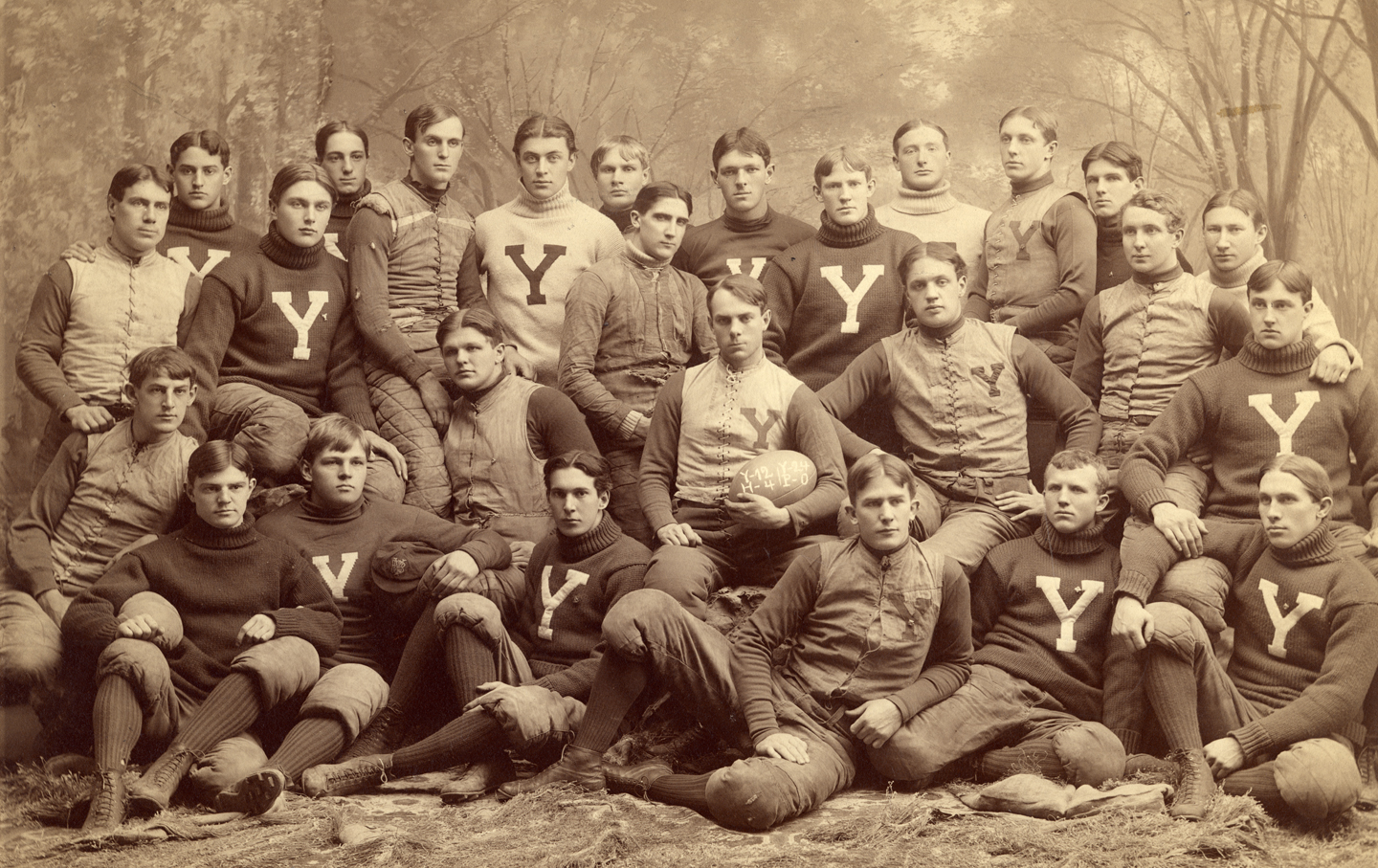
We Have Been Talking About Football’s Brutality for 120 Years We Have Been Talking About Football’s Brutality for 120 Years
American parents should keep their sons out of the game.
Mar 23, 2015 / Books & the Arts / The Editors

Where Reaganism and Astrology Meet Where Reaganism and Astrology Meet
It is scarcely news that the President is in the mainstream of popular American credulity. He has been nurtured in the same rich loam of folk ignorance, historical figment and para...
Mar 23, 2015 / Books & the Arts / Alexander Cockburn
1965–2015 1965–2015
A forum for debate between radicals and liberals in an age of austerity, surveillance and endless war, The Nation has long had one foot inside the establishment and one outside it....
Mar 23, 2015 / Books & the Arts / D.D. Guttenplan

Langston Hughes and Touré on Loving Blackness in a Nation Ruled by White Supremacy Langston Hughes and Touré on Loving Blackness in a Nation Ruled by White Supremacy
The Black artist still must confront the choice between being a messenger about the community and being a pure maker of artistic product.
Mar 23, 2015 / Feature / Langston Hughes and Touré
Varick Street Varick Street
March 15, 1947 At night the factories struggle awake, wretched uneasy buildings veined with pipes attempt their work. Trying to breathe the elongated nostrils haired with spikes give off such stenches, too. And I shall sell you sell you sell you of course, my dear, and you’ll sell me. On certain floors certain wonders. Pale dirty light, some captured iceberg being prevented from melting. See the mechanical moons, sick, being made to wax and wane at somebody’s instigation. And I shall sell you sell you sell you of course, my dear, and you’ll sell me. Lights music of love work on. The presses print calendars I suppose, the moons make medicine or confectionary. Our bed shrinks from the soot and the hapless odors hold us close. And I shall sell you sell you sell you of course, my dear, and you’ll sell me. This article is part of The Nation’s 150th Anniversary Special Issue. Download a free PDF of the issue, with articles by James Baldwin, Barbara Ehrenreich, Toni Morrison, Howard Zinn and many more, here. Elizabeth Bishop (1911–1979), the poet laureate of the United States from 1949 to 1950, published two poems in The Nation between 1945 and 1947, when Randall Jarrell was interim literary editor. She was a longtime friend of the more frequent Nation contributor Marianne Moore, who in a 1946 review in these pages described Bishop as “spectacular in being unspectacular.”
Mar 23, 2015 / Books & the Arts / Elizabeth Bishop
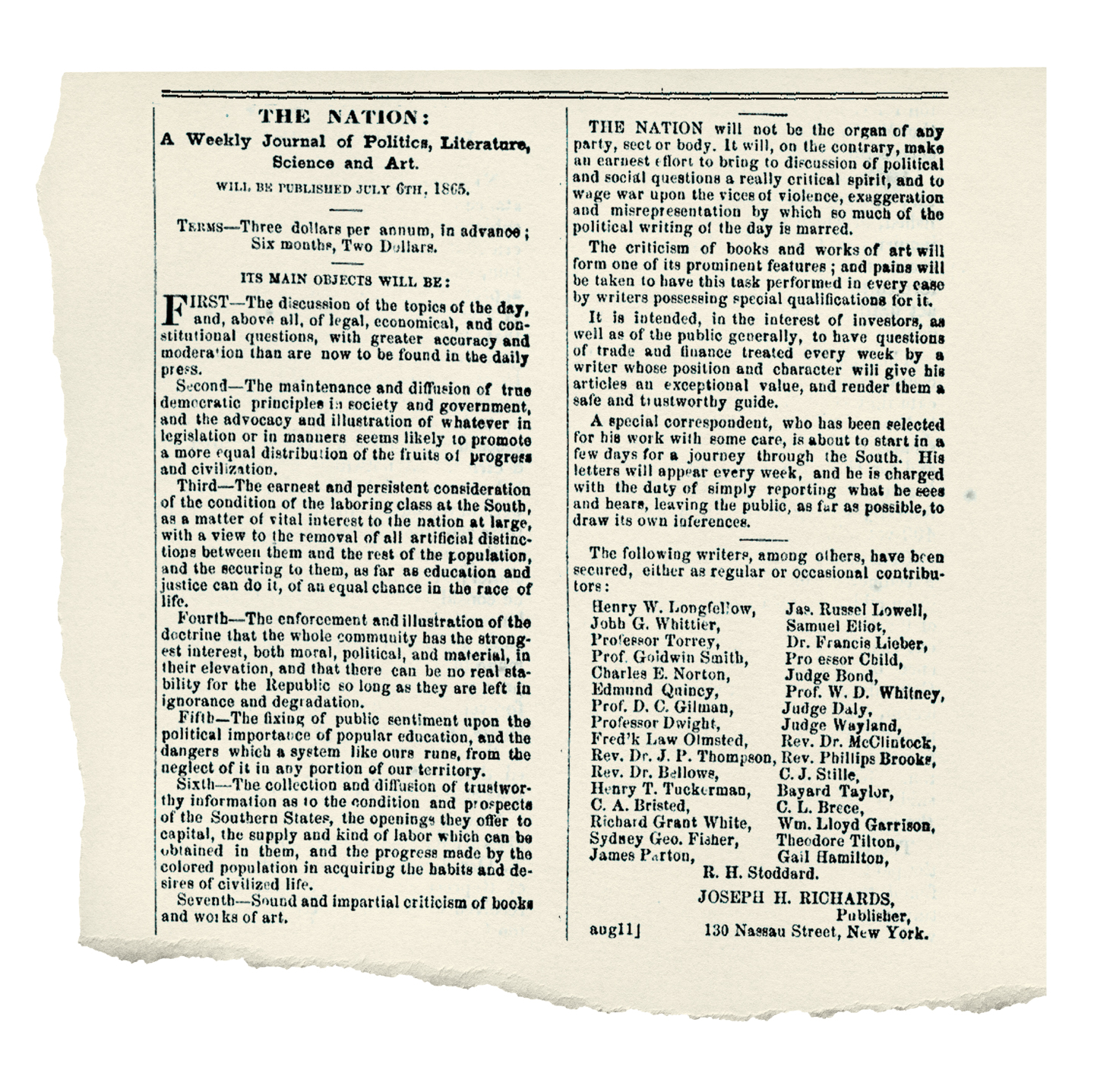
Founding Prospectus Founding Prospectus
The Nation will not be the organ of any party, sect or body.
Mar 23, 2015 / The Nation